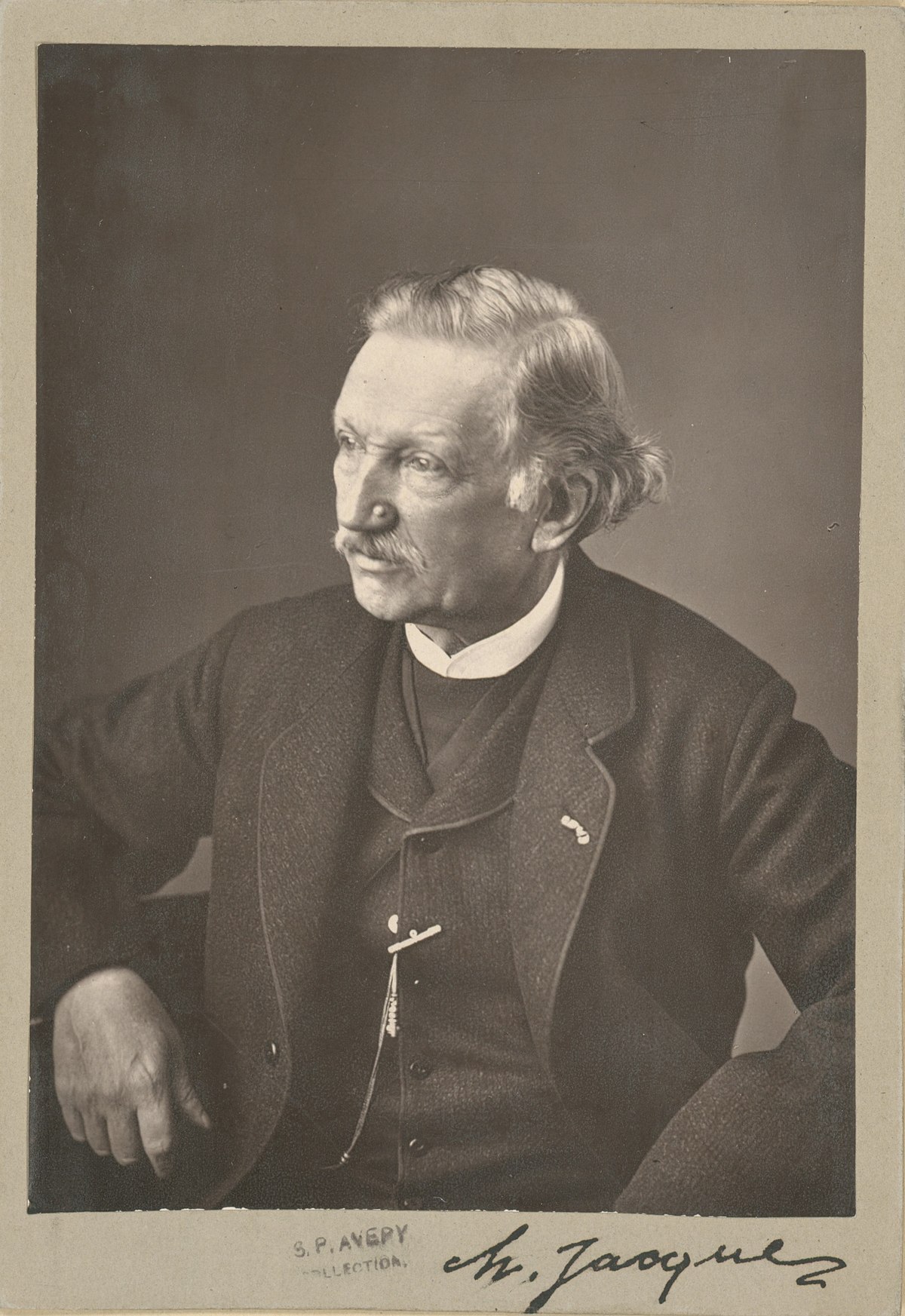
Charles Émile Jacque (1813-1894) was born in Paris. He had minimal formal artistic training, instead relying on his own self-taught methods. At a young age, Jacque worked under a notary, then as a cartographer before pursuing art. He joined the atelier Suisse in 1840, where he trained informally. Jacque also served seven years in the military, during which he sketched army life and sold drawings. After his service, he traveled to England, expanding his knowledge of printmaking. In 1849, he moved to Fontainebleau with friend Jean-François Millet to escape a cholera epidemic, where he became deeply involved in the Barbizon School and focused on rural life, animals, and nature.
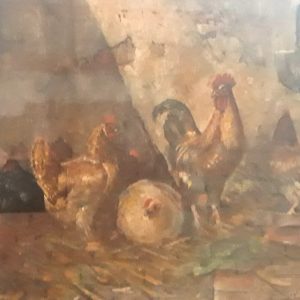
He initially began his career as an illustrator and caricaturist, producing works for Parisian journals like Le Charivari. His transition to etching in the 1840s was groundbreaking, and he became a key figure in the etching revival. Influenced by the Dutch masters, especially Rembrandt, Jacque’s prints focused on rural scenes, landscapes, peasants, and animals. He gained recognition for his detailed depictions of sheep and other farm animals. His dedication to observing his subjects, often going beyond mere observation, set him apart from his contemporaries. Jacque also ventured into farming, even managing a chicken farm to better understand his subjects.
Jacque exhibited his work regularly at Salons and international exhibitions in Bordeaux, London, and Budapest. His first notable recognition came in 1844 at the Salon, where his etching of Théodore Rousseau’s “Le Plateau de Belle Croix” was displayed. By 1846, he received his first commission from the French State, though it was rejected at the Salon of 1847. Despite some early setbacks, Jacque’s work began to gain attention. He was awarded the Chevalier de la Légion d’Honneur in 1867 and was a jury member for the 1867 Exposition Universelle, where his painting Pastorale won a third-class medal. Later in life, his work found success in America, and he received a gold medal at the 1889 Exposition Universelle. Jacque continued exhibiting until his final Salon in 1894.