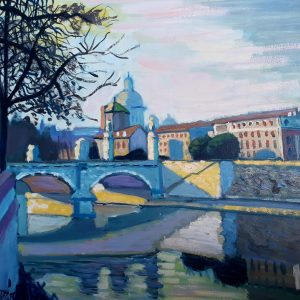
Jordi Curós Ventura (1930–2017) was a distinguished Spanish artist born in Olot, Catalonia, who was deeply influenced by the Abstract Expressionism movement of the 1950s. Educated at the School of Arts and Crafts in Olot, Curós traveled to Paris on a scholarship from the Institut Français de Barcelona, which helped shape his artistic vision. He developed a passion for painting that reflected both contemporary movements and traditional Catalan influences. His works often featured vibrant use of color and innovative approaches to texture and form, showcasing his ability to blend abstraction and figuration.
His artistic career spanned several decades, with significant exhibitions and artistic milestones. His journey began in the early 1950s when he exhibited in various galleries across Barcelona and Madrid, such as the Sala Caralt and Galerías Mendoza. By the 1960s, he was recognized for his participation in major international exhibitions, including the II Bienal Hispanoamericana de La Habana (1953) and the III Bienal Hispanoamericana in Rio de Janeiro (1959). Throughout his career, Curós explored a range of artistic styles, from abstract compositions to landscapes and still lifes, often inspired by the colors and textures of the Costa Brava. His works evolved from figurative painting to Informalism, where he employed large-scale works with bright, tactile enamel surfaces that invited viewers to engage with the emotional intensity of color and form.
Curós’s work has been featured in numerous museums and prestigious collections, including the Museum of Contemporary Art in Barcelona (MACBA), the Historical Archive of the City of Barcelona, and the Zabaleta Museum in Jaén. His paintings have been exhibited in leading galleries and museums across Spain, and he received various accolades, such as the Ynglada-Guillot prize for drawing in 1967. His participation in renowned art events like the III Premio Granollers de Pintura and exhibitions in Lisbon, Rio de Janeiro, and Brussels further cemented his status in the international art scene. Curós’s influence continues to be recognized, with his paintings still admired and collected by art enthusiasts and institutions worldwide.