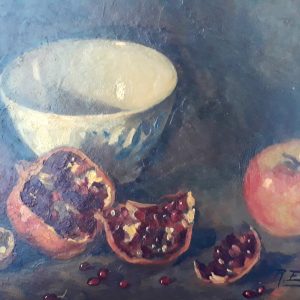
Ramón Estalella Pujolá (1893-1986) was born in Madrid under Cuban citizenship due to his father’s Cuban background. His early life was marked by a deep passion for drawing and painting, which he nurtured under the guidance of notable teachers like Eduardo Chicharro and José María López Mezquita. Throughout his youth, Estalella balanced his artistic pursuits with studies in law at the Universidad Central de Madrid. In addition to his artistic career, Estalella worked in the Cuban diplomatic service, becoming the Chancellor at the Cuban Embassy in Madrid. He was well-connected in intellectual circles and developed lasting friendships with prominent figures such as Salvador Dalí, Joaquín Sorolla, and Federico García Lorca.
His artistic journey began in Spain, where he trained under influential Spanish painters before returning to Cuba in 1925. There, he gained significant recognition with a major exhibition that was widely covered by the Cuban press. His work spans a range of genres, including portraiture and landscape, with a particular attention to fine detail and a deep engagement with light. Estalella was also active in the artistic communities in both Spain and Cuba, frequently contributing drawings to major Spanish and Cuban publications such as ABC, La Esfera, and Blanco y Negro. His participation in collective exhibitions throughout the 1930s solidified his reputation as a skilled and respected artist of his time.
Estalella’s art was regularly featured in both Cuban and Spanish publications, and he participated in numerous collective exhibitions during the 1930s. Though details regarding his exhibitions and awards are less documented, his prominent presence in the art world during that period, alongside his friendships with leading intellectuals and artists, ensured his works were celebrated within the Spanish-speaking artistic community. His major exhibition in Cuba in 1925 was a significant milestone, garnering widespread attention and further solidifying his artistic legacy.