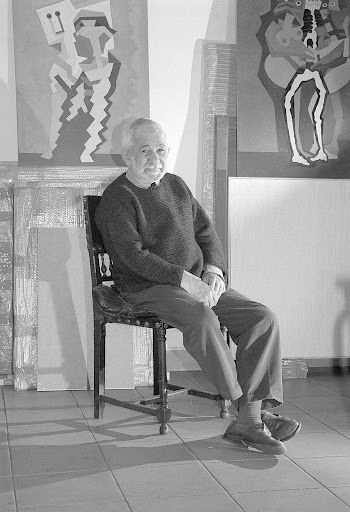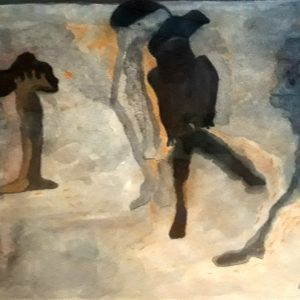
Julio Augusto Zachrisson (1930-2021) was born in Panama City. His early artistic studies began at the Escuela Nacional de Pintura under the guidance of Juan Manuel Cedeño. In the early 1950s, he traveled across several Central American countries, including Honduras, El Salvador, and Guatemala, in search of broader artistic experiences. Eventually, he settled in Mexico, where he studied at the Instituto Nacional de Bellas Artes and was exposed to the aesthetics of Mexican muralism. He also engaged with a new wave of young artists like José Luis Cuevas and Pedro Coronel, who opposed the dominant trends of muralism. His time at the Taller de Gráfica Popular, founded by Guadalupe Posada, was also formative in his artistic development.
His artistic journey took a major step forward in 1960 when he held his first solo exhibition at the University of Panama. That same year, he embarked on a European journey, working in Italy at the workshops of the Academy Pietro Vannucci. Later, he moved to Madrid, where he studied at the Real Academia de Bellas Artes de San Fernando. His time in Spain shaped his artistic production, which explored a powerful world of images and themes rooted in Western culture’s myths and stories, as well as the indigenous legends and the popular culture of his hometown, Panama.
Throughout his distinguished career, Zachrisson received numerous prestigious awards, including the First Painting Prize at the Soberanía Competition (1975) and the Accésit at the VI Bienal de Grabado in San Juan, Puerto Rico (1992). Other notable awards include the National Printmaking Prize from the Academy of Fine Arts in San Fernando, Madrid (1993), the “Aragón Goya” Printmaking Award from the Government of Aragón (1996), and the “Vasco Núñez de Balboa” decoration from the Government of Panama in 2006. His works are housed in important collections around the world, including the Biblioteca Nacional de España, the Museo de Arte Contemporáneo in Madrid, the Museum of Modern Art and the Metropolitan Museum of Art in New York, and the Museo de Arte Contemporáneo de América Latina in Washington, D.C., among others. His art is part of a legacy that stretches across institutions in Panama, Puerto Rico, Poland, the United States, and many other countries.