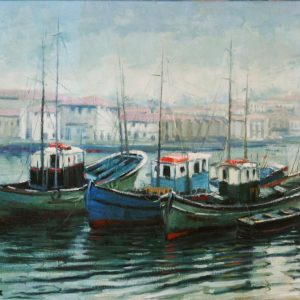
Vicente Giner Valls was born on 15 November 1933 in Castellón de la Plana, Spain, a coastal region whose maritime culture would later become a recurring source of inspiration in his art. He belongs to a generation of postwar Spanish painters who remained committed to figurative traditions while subtly incorporating modern sensibilities, particularly in their treatment of atmosphere, light, and mood.
Giner Valls demonstrated artistic aptitude from an early age. Although his early professional life was shaped by practical considerations, he pursued formal artistic training and steadily developed a personal style grounded in realism enriched by impressionistic influences. Over the course of his career, he participated in numerous exhibitions throughout Spain and parts of Europe, gaining recognition especially for his landscapes, cityscapes, and marine scenes.
The artist is best known for his harbor views, fishing boats, coastal towns, and quiet urban settings. His work often depicts moments of stillness rather than action—boats at rest, waters without wind, towns softened by haze. These scenes are not documentary in nature but poetic, emphasizing emotional resonance over narrative detail.
Giner Valls favored a muted, harmonious palette, frequently built from blues, grays, ochres, and soft earth tones. His brushwork is controlled yet expressive, allowing forms to dissolve gently into light and atmosphere. This approach places his work at the intersection of Mediterranean realism and lyrical impressionism, where structure is preserved but edges are softened in service of mood.
Rather than dramatizing his subjects, Giner Valls sought to elevate the ordinary. Fishing boats, docks, and coastal architecture are treated with dignity and calm, reflecting a contemplative view of daily life along Spain’s shores. His paintings often evoke nostalgia, introspection, and quiet endurance, qualities that resonate strongly with collectors drawn to timeless and meditative imagery.
While Vicente Giner Valls is not associated with avant-garde movements, his work has maintained steady appreciation among collectors of Spanish figurative painting. His maritime scenes, in particular, are valued for their balance of technical skill and emotional subtlety, capturing a disappearing rhythm of coastal life with sensitivity and restraint.