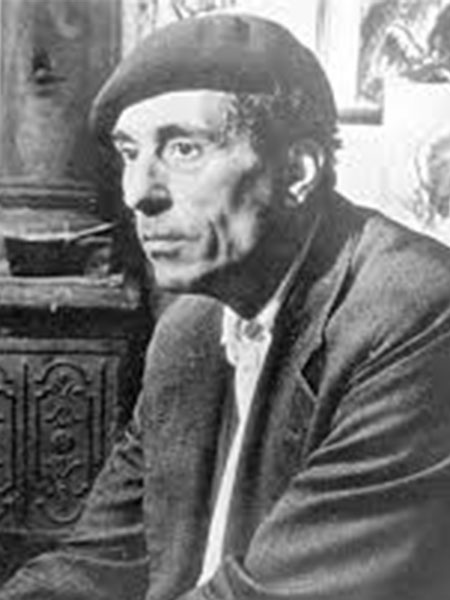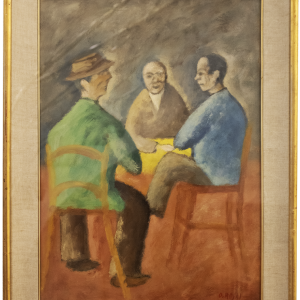
Ottone Rosai (1895–1957) was an influential Italian painter born in Florence, Italy. He showed an early interest in art, studying at the Academy of Fine Arts in Florence. He initially embraced Futurism, influenced by his friendships with artists like Ardengo Soffici, and exhibited with the Futurist group from 1913. His career was shaped by personal challenges, including the suicide of his father, which led him to support his family through various jobs, limiting his artistic output for a time.
Rosai’s work reflects a deep personal vision that evolved. His early Futurist works gave way to a more introspective, figurative style influenced by early Renaissance imagery and Cézanne’s techniques. His depictions of everyday life in Florence, particularly of humble working-class figures, became a central theme, reflecting his connection to the Strapaese movement, which celebrated rural Italian life. In the 1920s and 1930s, Rosai’s style became more austere, with Cubist influences blending into his portrayal of landscapes and portraits. His works are known for their somber tones, strong chiaroscuro, and the juxtaposition of volume and mass, reflecting the emotional and social tension of the times.
The artist exhibited widely across Europe and beyond, including in major institutions such as the Museum of Modern Art. His works were featured in major biennials. Throughout his career, Rosai had numerous solo and group exhibitions, including solo shows such as Art Parma 2024 at GALLERIA STEFANO FORNI.
In 2023, his works were displayed in The Landscape Artists and Italian Art, April in Paris, while his fair booths included GALLERIA STEFANO FORNI at Arte Padova 2023. Rosai’s legacy endures through exhibitions and collections, including his significant presence at the Museo Novecento in Florence, where his works are part of the permanent collection.