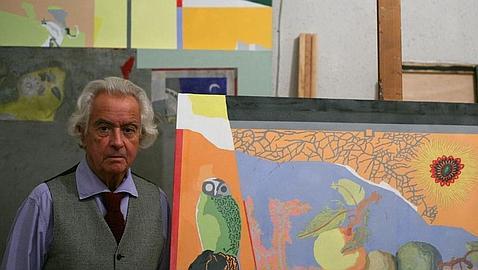
Jorge Castillo (1933) was born in Pontevedra, Galicia, Spain. At the age of one, his family emigrated to Argentina due to political reasons, and he spent his youth in Buenos Aires. Castillo began creating self-taught art from a young age. In 1941, he won an art competition and was admitted to the École des Beaux-Arts in Buenos Aires, though he soon left the school due to dissatisfaction with its methods. He later trained as a technical draughtsman, continuing his education independently. In 1955, Castillo returned to Spain, where he lived in Madrid before moving to Barcelona and later, Geneva.
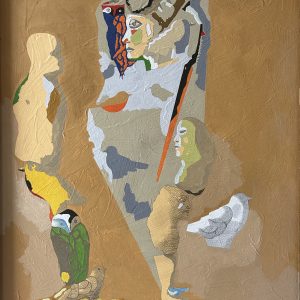
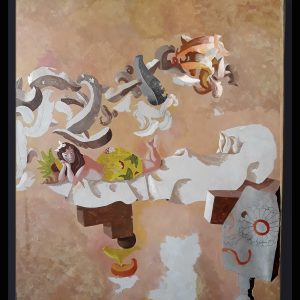
Castillo is known for his contributions to Surrealism and Art Informel. His work spans a variety of media, including painting, graphic arts, and sculpture. His early work focused on surrealistic ink drawings and gouaches. Castillo’s works often incorporated symbolic elements, exploring themes of mythology and human expression. Throughout his career, Castillo was praised for his generosity and influence on younger artists, including Alberto Giacometti, who was particularly encouraging.
He exhibited internationally, contributing to significant art events such as the São Paulo and Venice Biennales in the 1960s. He won the International Drawing Prize in Darmstadt in 1964. His works have been shown in Switzerland, Germany, and Italy, with solo exhibitions at major galleries such as Marlborough Gallery in New York and Galerie Dittmar in Berlin. Additionally, his works were part of group shows such as Homage to Picasso at Gerrish Fine Art in 2024 and exhibitions at Ditesheim & Maffei Fine Art. His notable solo exhibitions include the Galeria Leandro Navarro in Madrid (2010, 2016) and the Cervantes Institute in Stockholm (2015). In 2001, a retrospective of his works was presented at the Centro Gallego de Arte Contemporáneo in Santiago de Compostela, where a permanent museum is dedicated to his legacy.
Castillo’s work is held in prestigious collections worldwide, including the Solomon R. Guggenheim Museum in New York, the San Francisco Museum of Modern Art, the Albertina Museum in Vienna, and the Museo Nacional del Prado in Madrid. His contributions to public sculpture include pieces in La Coruña, Messina, and Barcelona, such as the renowned El Ciclista in Barcelona.