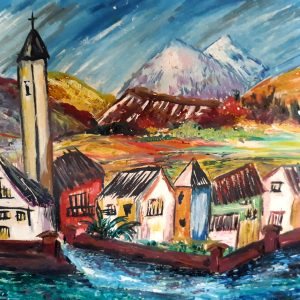
José Cerdá Udina (1924–2020) was a versatile and prolific Spanish artist based in Zaragoza, known for a multidisciplinary career that spanned illustration, muralism, and fairground painting. His style is characterized by a vibrant, expressive use of color and a certain narrative agility, traits honed during his years working as a humorist (creating characters like Mendo y Bruto) and a painter of fairground attractions.
Unlike the sober academicism of his contemporaries, Cerdá Udina’s work often features a bold, almost Fauvist palette and energetic brushwork, prioritizing visual impact and storytelling over strict realism. His artistic lineage continued through his son, the renowned painter Pepe Cerdá.
José Cerdá Udina spent a significant period in the 1960s creating murals along the Costa del Sol; his legacy is most strongly felt in Zaragoza. His career was recently celebrated in the major retrospective “Los mil mundos imaginarios de José Cerdá” (The Thousand Imaginary Worlds of José Cerdá) at the University of Zaragoza (2020), which highlighted his mastery across diverse mediums.
His works are valued today not only for their aesthetic appeal but as documents of a life dedicated to the “trade” of art, bridging the gap between popular culture and fine art.