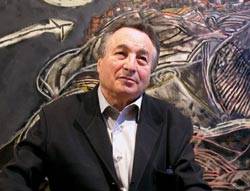
Agustín Úbeda (1925-2007) was born in Ciudad Real, Spain. He studied at the Escuela de Bellas Artes de San Fernando in Madrid and was awarded a scholarship from the French Institute in Madrid, which enabled him to travel to Paris. There, he was deeply influenced by the works of Marc Chagall and Picasso, which marked a shift in his artistic style. He taught at the Escuela de San Fernando, where he eventually became a professor and later chair of the Fine Arts department in 1987.
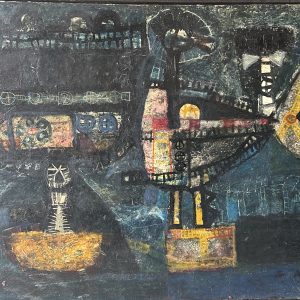
Renowned Spanish painter in the 20th-century, his art features still lifes, portraits, and landscapes, all constructed with a distinctive geometric language. His works often display harmony and balance, with compositions that include elements like striped plains, small distant villages, and ominous skies that add a sense of mystery to his landscapes. These scenes sometimes create an unsettling atmosphere, with the land and structures appearing as though they are on a precarious slope. His figurative style, with its expressiveness and irony, is a standout in contemporary Spanish art.
He won the prestigious Young French Painting Award in 1957 and the Grand Prize for Painting from the Academy of Fine Arts in 1982. His works have been featured in numerous exhibitions, including the 1992 ‘Ten Teachers’ exhibition in Madrid, dedicated to figurative expressionism. His paintings are now part of major collections and can be found in museums such as the Museo de la Ville de Geneva, the Real Academia de Bellas Artes de San Fernando in Madrid, and the Museum of Fine Arts in Santa Fe, New Mexico.