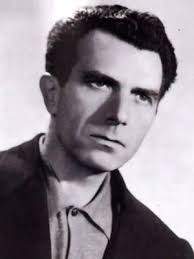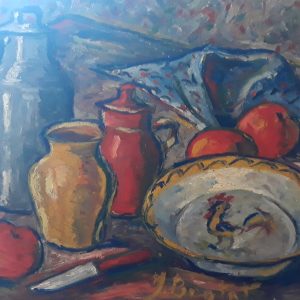
Joan Brotat (1920–1990) was a Spanish painter born in Barcelona, Catalonia. He studied at the School of Arts and Trades of Barcelona, where he laid the foundation for his artistic career. Early in his life, Brotat explored various avant-garde movements, including Informalism and gestural art, while experimenting with collage techniques. However, by the late 1940s, he transitioned into a personal style that drew heavily on primitivism and the aesthetics of Catalan Romanesque art. Brotat’s focus shifted to figurative works, often characterized by melancholic expressions and emotional depth.
Joan Brotat’s unique approach merged historical influences with contemporary sensibilities. By embracing primitivism and reinterpreting Romanesque Catalan painting, he distanced himself from abstract experimentation. His paintings often depicted stylized figures with elongated forms and melancholic faces, conveying solitude and introspection. Through a minimalist palette and symbolic forms, Brotat bridged traditional Catalan heritage with modern expression, contributing a distinctive voice to the mid-20th-century Spanish art scene.
Brotat’s work garnered recognition starting in 1950, with exhibitions in experimental art cycles that showcased his innovative style. Throughout his career, his works were displayed in various Spanish galleries, establishing his reputation as a significant modernist painter. He also participated in a group show at the Museo Reina Sofía, further cementing his place in Spain’s artistic landscape. Although his acclaim remained somewhat niche during his lifetime, his legacy has endured. Brotat’s works were also featured in two major biennials: the Venice Biennale National Pavilion and the Venice Biennale International Exhibition. His personal archives are preserved at the Biblioteca de Catalunya, offering valuable insights into his creative process.