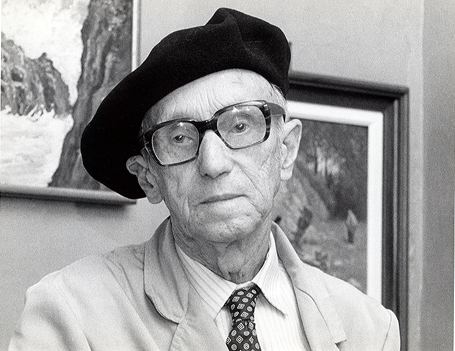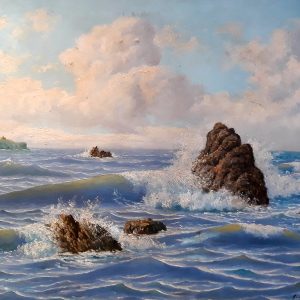
Ángel Planells (1911–1989) was a Catalan artist, recognized as a master of lithography and engraving, and a prominent figure in the Emporda school of Surrealism. Born in Cadaqués, he grew up surrounded by the natural beauty of the Catalonian coast, which greatly influenced his work. Planells developed an early friendship with Salvador Dalí, which left a lasting impact on his artistic vision. He later formed relationships with other notable surrealist artists, including René Magritte, further shaping his distinctive style. Despite his introverted nature, Planells dedicated his life to painting, with a particular passion for surrealism and the use of water and the sea in his works.
Planells’ artistic career spanned several decades, beginning with his studies in Barcelona in 1918, where he trained in painting, lithography, and engraving. He participated in his first collective exhibitions in the late 1920s and had his first solo exhibition in 1930. Throughout the 1930s, Planells became an integral part of the surrealist movement, joining the Logicofobista group and showcasing his works at significant exhibitions, such as the London International Surrealist Exhibition in 1936. However, the Spanish Civil War and the rise of Franco’s regime forced a hiatus in his surrealist works. During this period, Planells shifted toward creating landscapes and still lifes. In the 1960s, he returned to surrealism, reinterpreting earlier themes with a renewed perspective.
Although Planells remained a relatively private and introverted figure, his works have been recognized in several significant exhibitions, including at the State Hermitage Museum in Russia in 2016, as part of a retrospective on Surrealism in Catalonia. His pieces have been showcased in galleries across Spain and internationally, and despite a long overshadowing by Dalí, Planells’ work has gained increasing recognition for its originality and depth. His contributions to surrealism, particularly in the context of Catalonia, remain an essential part of the Spanish art history, with ongoing interest in his paintings evident in various exhibitions and collections.