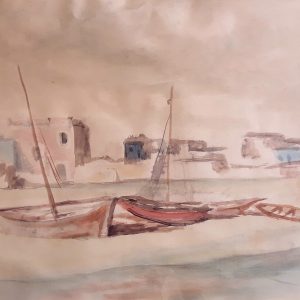
Eduardo Vicente Pérez (1909–1968) was a Spanish painter born in Madrid, the younger brother of the renowned Spanish-American artist Esteban Vicente. He was the son of a Guardia Civil officer and a naïve painter. Eduardo was largely self-taught, and his early years as a painter were spent traveling across Spain, creating landscapes with the help of a British friend. His artistic journey was influenced by his exposure to the artistic community, especially his contact with Manuel Bartolomé Cossío, which led him to participate in the Museo Ambulante project of the Pedagogical Missions initiated by the Spanish Republican government in 1932. This project aimed to bring copies of Spanish masterpieces to rural communities. However, Vicente eventually distanced himself from the project due to disagreements with other artists.
His career took a significant turn during and after the Spanish Civil War. He worked in the propaganda department of the Republican Army, creating posters for the CNT and Solidaridad Obrera. After the war, he struggled financially and worked as a “painter of broad strokes,” decorating cafes, banks, and churches. Despite these challenges, he continued to create personal works of art, primarily landscapes and portraits. In the late 1940s, Vicente’s work began to attract attention. He was invited to New York in 1948 with a scholarship, where he reunited with his brother Esteban. In the 1950s, his work gained recognition through his participation in exhibitions, including the First Hispano-American Biennial of Art and the Venice Biennale. However, by the late 1950s, new art movements like informalism and Pop Art overshadowed his work, leading to a decline in recognition. Vicente tragically died in 1968, shortly before a planned exhibition of his works.
Vicente’s art has been included in several prestigious institutions. His works are held in the Museu Nacional d’Art de Catalunya, where five of his paintings and drawings from the 1937 International Exposition in Paris are displayed. Notably, his large-scale religious works can be found in the Cathedral of Orihuela, including Jesus with the Lepers and The Souls in Purgatory, painted in 1942 and 1943. He also created a significant mural in the entry hall of the 1952 Huelva tax office, symbolizing the region’s wealth in fishing and mining. A retrospective of his work, curated by historian Natacha Seseña, was held in 1999 at the Museo Municipal de Madrid, showcasing 125 pieces, including works painted during the Spanish Civil War, and exhibited alongside Guernica at the 1937 Paris International Exposition.