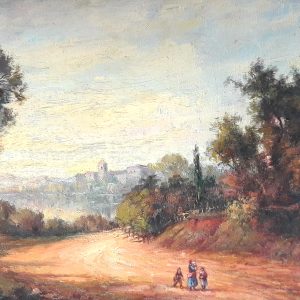
Alexandre-Gabriel Decamps (1803–1860) was a pivotal figure in 19th-century French art, ranked alongside masters like Delacroix and Ingres as a leader of the French School. While historically celebrated as the “founding father of Orientalism” for his revelations of Eastern life at the 1831 Salon, his stylistic approach was distinctively bold. Decamps rejected the smooth finish of the Academy in favor of “rough brushstrokes” and a “vivid dramatic conception,” creating works defined by “startling contrasts of color and of light and shade”.
Decamps left an indelible mark on 19th-century art, hailed by Maxime Du Camp as the “Christopher Columbus of the Orient”. He was recognized with the Grand Council Medal at the Paris Exhibition of 1855. Today, his legacy is preserved in the world’s most prestigious institutions. His paintings and drawings are extensively represented in the Louvre Museum and the Musée d’Orsay in Paris.
Key international collections include the Wallace Collection in London, home to his famous The Turkish Patrol, the Metropolitan Museum of Art in New York, and the Hermitage Museum in Saint Petersburg. His works are also prominent in the National Gallery of Art in Washington D.C. and the Walters Art Museum in Baltimore, solidifying his status as a cornerstone of 19th-century French art.