
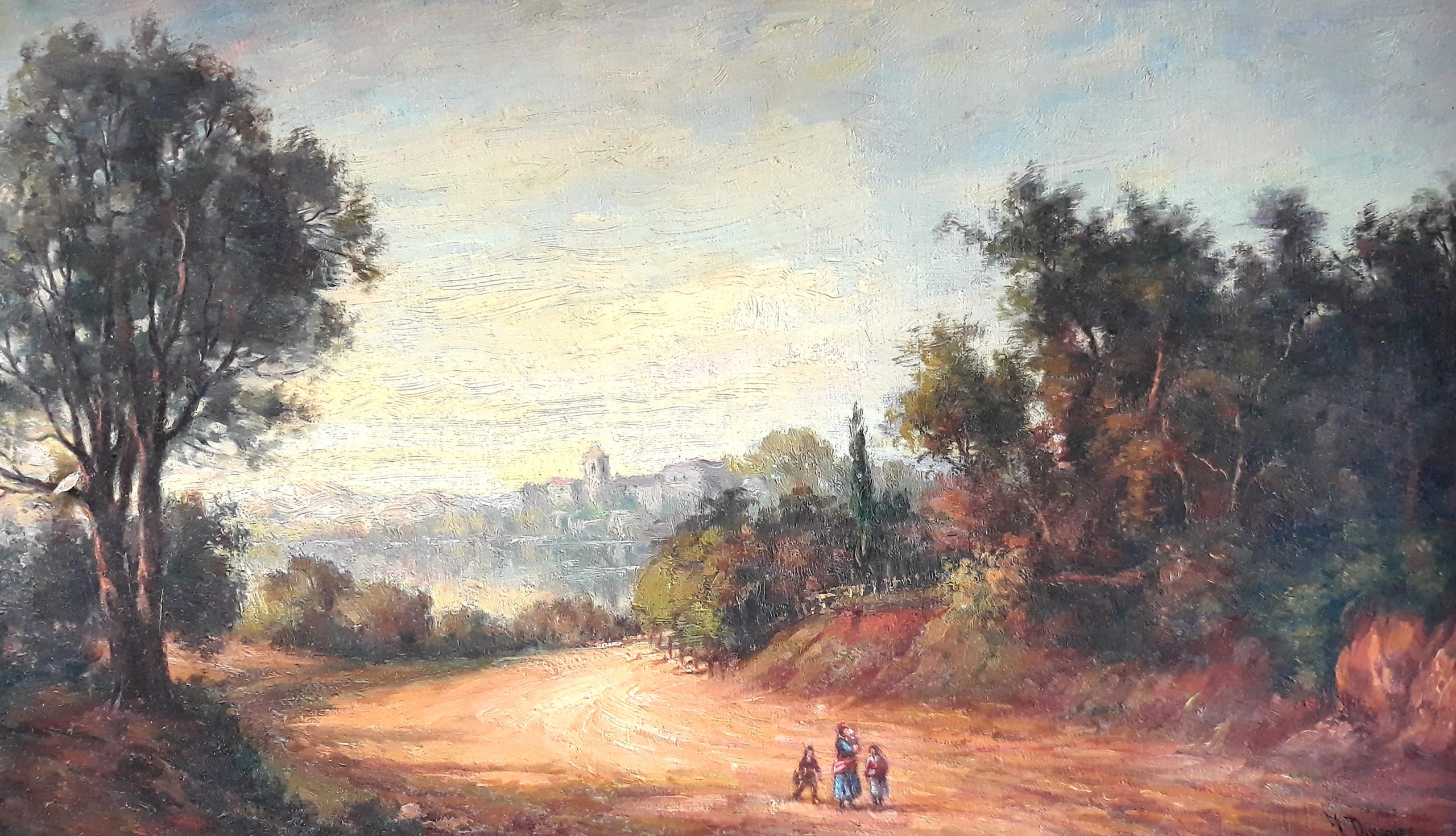
Peasants on the Road
Alexandre-Gabriel Decamps (1803–1860) was a major figure of 19th-century French art, known for his bold rejection of academic polish in favor of rough brushwork, dramatic light, and striking color contrasts. In this luminous rural scene, he applies that fearless approach to a French landscape, where a sunlit road slices through deep shadows cast by towering trees. Small peasant figures animate the composition, while a distant village and church tower dissolve softly into the sky, showcasing Decamps’s mastery of atmosphere, depth, and chiaroscuro.
Alexandre-Gabriel Decamps (1803–1860) was a pivotal figure in 19th-century French art, ranked alongside masters like Delacroix and Ingres as a leader of the French School. While historically celebrated as the “founding father of Orientalism” for his revelations of Eastern life at the 1831 Salon, his stylistic approach was distinctively bold. Decamps rejected the smooth finish of the Academy in favor of “rough brushstrokes” and a “vivid dramatic conception,” creating works defined by “startling contrasts of color and of light and shade”.
In this radiant landscape, Peasants on the Road, Decamps applies his “bold fidelity to nature” to a rustic French setting rather than an Oriental scene. The composition utilizes a strong chiaroscuro effect: a sun-drenched dirt path cuts through the center, glowing in warm ochres, while being framed by the deep, heavy shadows of tall trees on either side. Three small figures wander along the road, adding a narrative element of domestic life.
In the distance, a village silhouette topped by a church tower sits against a soft, atmospheric sky, demonstrating the artist’s mastery of depth and light. Decamps left an indelible mark on 19th-century art, hailed by Maxime Du Camp as the “Christopher Columbus of the Orient”. He was recognized with the Grand Council Medal at the Paris Exhibition of 1855. Today, his legacy is preserved in the world’s most prestigious institutions. His paintings and drawings are extensively represented in the Louvre Museum and the Musée d’Orsay in Paris. Key international collections include the Wallace Collection in London, home to his famous The Turkish Patrol, the Metropolitan Museum of Art in New York, and the Hermitage Museum in Saint Petersburg. His works are also prominent in the National Gallery of Art in Washington D.C. and the Walters Art Museum in Baltimore, solidifying his status as a cornerstone of 19th-century French art.
Reviews