

Imagine standing before Titian’s Danaë (1545, Museo di Capodimonte, Naples). The painting depicts a moment of profound vulnerability: a woman alone in a shadowed chamber, visited by Zeus transformed into golden rain. It’s sensual, intimate, almost scandalous. Yet Renaissance society celebrated it as a masterpiece.
By framing the scene within classical narrative, Titian solved a cultural problem that artists had grappled with for centuries: how to paint desire and intimacy without offending the moral sensibilities of your patrons. Myth provided what we might call “artistic permission”: a culturally legitimate framework that transformed potentially controversial imagery into high art. The classical distance between viewer and subject made the intimate acceptable.

Understanding this strategy is essential for understanding why myth continues to matter in contemporary art, as a living framework for exploring the most fundamental human experiences.
The Architecture of Myth in Renaissance Art
To understand why myth became central to Western artistic tradition, we need to understand the intellectual world of the Renaissance.
During this period, a rigid hierarchy governed artistic subjects. At the top sat “history painting”: works depicting grand narratives from classical antiquity, the Bible, or contemporary history. Below that were portraits, landscapes, and still lifes. This hierarchy reflected the intellectual values of Renaissance society: classical learning was the mark of an educated person, and art that engaged with classical sources was considered more intellectually serious.
For Renaissance artists, classical mythology offered an ideal subject category. These narratives came from Ovid’s Metamorphoses (8 AD), a text that had become widely accessible after the invention of the printing press. Ovid’s stories were intellectually legitimate, culturally authoritative, and endlessly adaptable. They provided a shared vocabulary, a set of stories that everyone educated understood, and that carried cultural weight.
More importantly, these myths allowed artists to explore the human body and human emotion in ways that contemporary subjects could not. A painting of a contemporary woman in a state of undress would be scandalous. A painting of Danaë, a mythological princess visited by a god, was acceptable. The classical distance transformed intimacy into allegory, making the sensual subject culturally legitimate.
The Myth Transforms: From Narrative to Psychology
This framework remained dominant through the Renaissance and into the Baroque period. But by the 17th century, something fundamental shifted in how artists approached classical mythology.
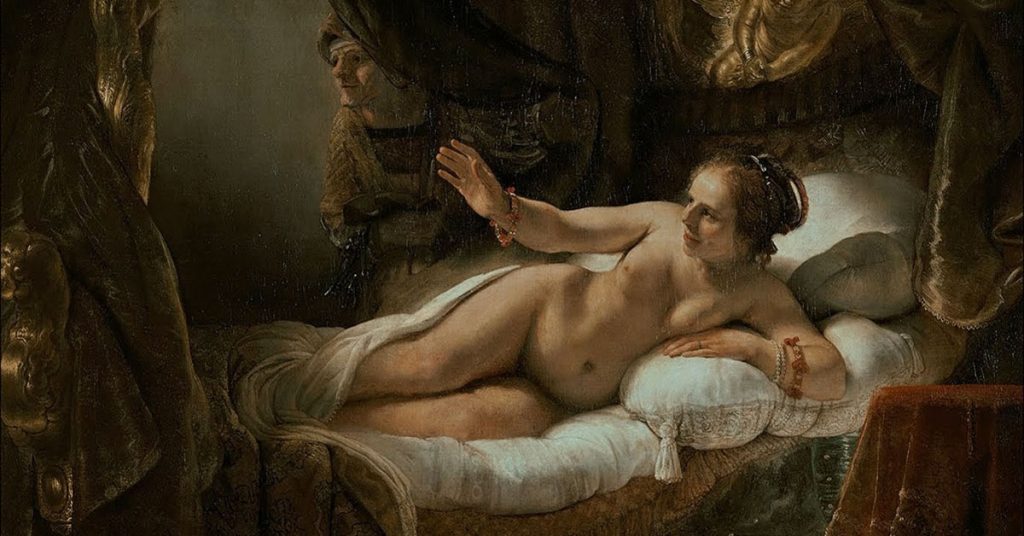
Rembrandt’s Danaë (1636, State Hermitage Museum, St. Petersburg) marks this turning point. Where Titian’s Danaë is idealized and luminous, Rembrandt’s is earthier, more psychologically complex. The golden light is still present, but it’s warmer, more intimate. Rembrandt emphasizes the moment of contact, the vulnerability of the human body meeting the divine. The painting asks a different question than Titian’s: what does it feel like to be visited by a god? What is the interior experience of this mythological moment?
This shift reflects a broader change in artistic practice. As the centuries progressed, artists moved away from depicting myths as literal narratives and toward using them as conceptual lenses. The myth became a framework for exploring universal human experiences: transformation, desire, power, isolation, and mortality. Consider desire itself: the story of Zeus and Danaë allowed artists to explore desire as a universal human condition rather than as a specific, contemporary scandal.
Myth as Psychological Space
This evolution continued through the 18th and 19th centuries. By the 20th century, this evolution reached its fullest expression. Many artists engaged with myth implicitly rather than explicitly, referencing classical narratives through gesture, color, or composition without depicting the story directly. The mythological reference became something the viewer had to recognize through the artwork’s title, context, and the artist’s intention. This recognition became part of the artwork’s intellectual depth.
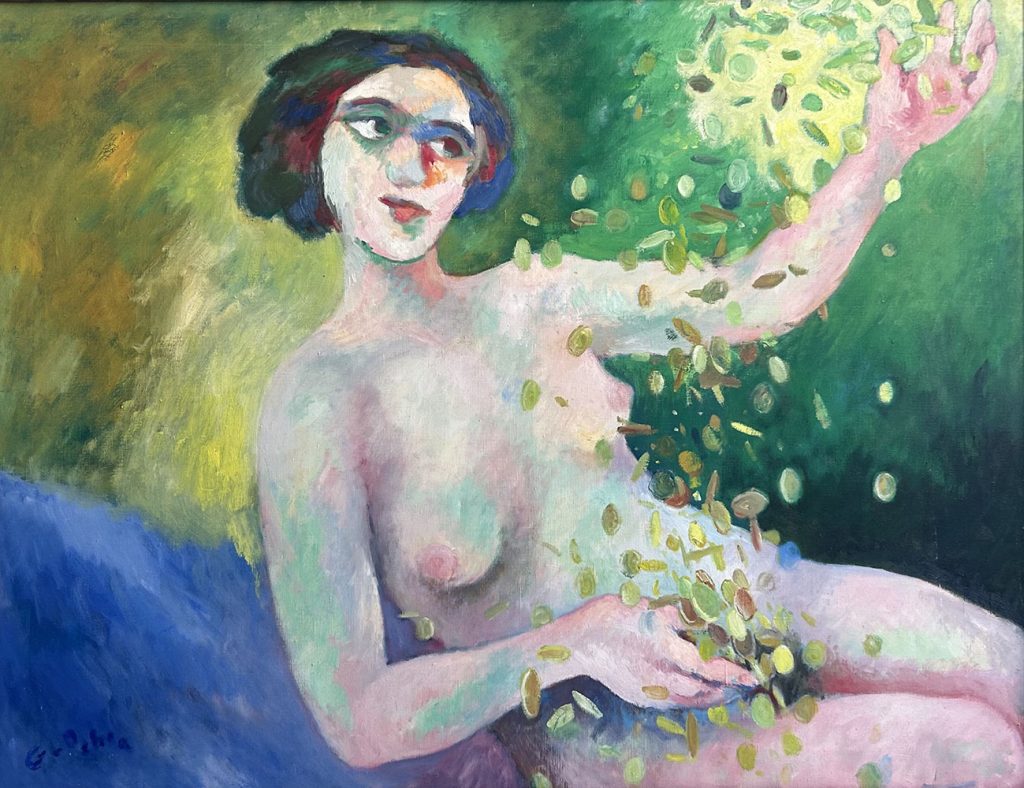
This is where we find Luis García-Ochoa (1920-2019), the Spanish Fauvist painter whose Danaë (89 × 116 cm, oil on canvas) represents a distinctly modern interpretation of the classical myth. García-Ochoa was a master of Fauvism, a movement known for bold color, emotional intensity, and psychological depth. His approach to the Danaë myth strips away Renaissance idealization and Baroque spectacle. Instead, it captures something more fundamental: the raw emotional moment of vulnerability itself.
García-Ochoa’s Danaë captures the psychological intensity of that moment, the vulnerability, the overwhelm, the meeting of self with something transcendent. The bold, expressive brushwork and saturated color create a sense of intensity and intimacy that mirrors the emotional essence of the mythological moment.
Why Myth Endures in Contemporary Practice
The enduring use of myth in art can therefore be understood as a reflection of its intellectual adaptability. It offers artists a culturally grounded yet flexible language capable of addressing deeply human themes without being confined to a specific temporal or social context. By providing symbolic distance, historical continuity, and conceptual depth, myth remains one of the most sophisticated and resilient frameworks in artistic practice.
When we encounter a contemporary work like García-Ochoa’s Danaë, we’re witnessing this framework at work, an artist using ancient narrative to explore deeply contemporary concerns about vulnerability and desire. The myth hasn’t aged. Neither has the human experience it explores. What changes is how artists engage with it, how they interpret it, how they use it to speak to their own moment.