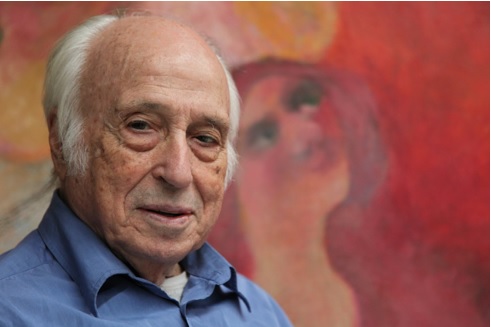
Luis García-Ochoa Ibáñez (1920-2019) was born in San Sebastián and moved to Madrid during his childhood, where his artistic talent became evident at an early age. He studied at the prestigious Royal Academy of Fine Arts of San Fernando, combining his artistic education with early exposure to architecture, working in his father’s architectural studio. A key figure in the Madrid School in the 1940s and 1950s, García-Ochoa contributed to the post-Civil War artistic innovation in Spain.
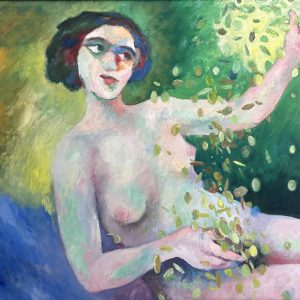
His style evolved throughout his career. Initially influenced by cubism, he later transitioned to a more expressionist approach, characterized by vibrant compositions and a strong use of color. His work, marked by a powerful visual impact, reflects his constant search to convey emotion through form and color. As a prominent member of the Madrid School, García-Ochoa played a key role in the renewal of Spanish art after the Civil War, incorporating new influences and exploring universal themes. His work spanned both painting and engraving, allowing him to experiment with different techniques and media to express his artistic concerns.
Towards 1942, and under the leadership and influence of Benjamín Palencia, he participated in the Segunda Escuela de Vallecas, a group that served as the basis in the 1950s for the so-called “Escuela de Madrid”. At this stage he evolved from early cubism to figurative expressionism. He was invited to the Venice Biennial in 1940, 1950, 1952 and 1954. He participated several times in the National Fine Arts Exhibitions of Madrid, as well as in multiple group shows and solo exhibitions. He also developed important work in the art of engraving and as a book illustrator. On May 5, 1980 he was elected a member of the Real Academia de Bellas Artes de San Fernando in Madrid and where he delivered the entrance speech on November 19, 1983. In 1993 he founded the School of Figurative Painters of El Escorial. A sample of his works is kept in the Reina Sofía Art Center, the Bilbao Fine Arts Museum, the Juan March Foundation and other Spanish museums.