Manuel Viola (1916-1987) began his career as a poet and artist in the Surrealist circles of Barcelona. In 1934, he joined the Amigos de las Artes Nuevas group, engaging with the Catalan avant-garde. Exiled to France after the war, Viola joined the Surrealist group Le Main à Plume and enlisted in the Foreign Legion, also participating in the Resistance and the clandestine art market. He returned to Spain in 1949 and rose as a central figure in Spanish Informalism, eventually joining the El Paso group in 1958.
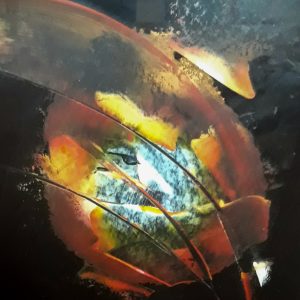
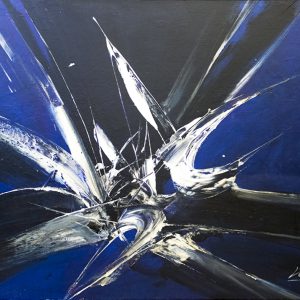
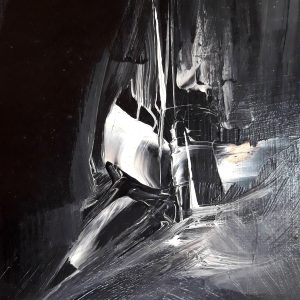
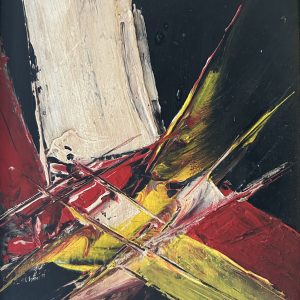
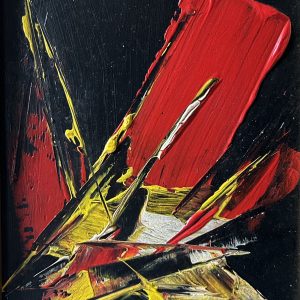
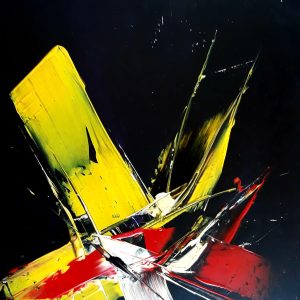
The artist’s work evolved from Surrealism to Abstract Expressionism and Informalism. Early in his career, his collages were influenced by Max Ernst. While in France, his figurative works with bold colors drew comparisons to Willem de Kooning. After returning to Spain, Viola embraced a style characterized by chiaroscuro, expressive brushstrokes, and the veta brava style, marked by dramatic contrasts of light and shadow. His works often reflected raw emotion, chaos, and energy, aligning with the tachisme movement and the gestural force of Informalism. In the 1960s and 1970s, he expanded into ceramic murals while continuing his signature abstract paintings.
Viola’s first solo exhibition was held in 1953 at Galería Estilo in Madrid, marking the beginning of his rise in the art world. His works were shown internationally throughout the 1960s, with exhibitions in Lisbon, Freiburg, Basel, Milan, Paris, Oslo, Berlin, Vienna, and Rome, as well as in Rio de Janeiro, São Paulo, Montevideo, Buenos Aires, Quito, New Orleans, New York, Chicago, and Tokyo. Notable exhibitions also included Galerie Claude Bernard and Galerie Internationale d’Art Contemporain in France. His works have been featured in group exhibitions at major institutions such as The Museum of Modern Art and Museo Reina Sofía. He has also been included in three major biennials: the Venice Biennale National Pavilion, the Venice Biennale International Exhibition, and the Bienal de São Paulo. His art is part of the collections of prominent institutions, including the Museo Reina Sofía and the Museu d’Art Contemporani de Barcelona (MACBA).
His active participation in the El Paso group solidified his influence on Spanish contemporary art, earning him recognition as one of the leading figures in the movement. His pieces have been featured in prominent collections and exhibitions worldwide, underlining his lasting importance in 20th-century Spanish art.