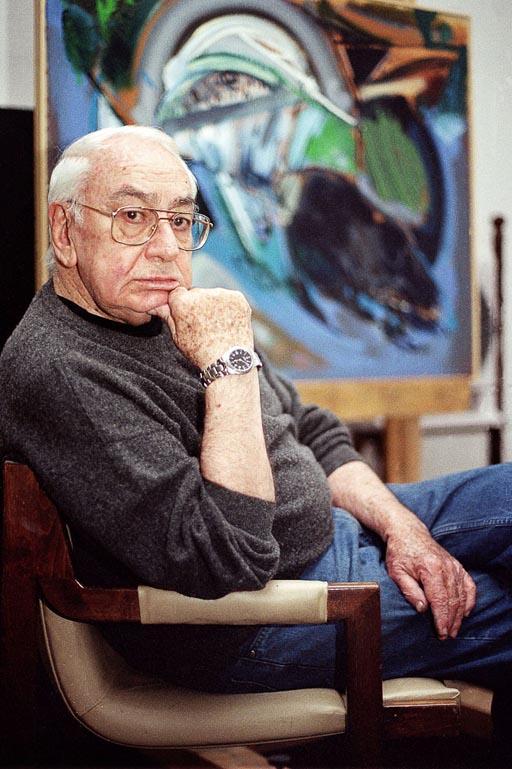
Álvaro Delgado (1922-2016) was born in Madrid. Initially pursuing business studies, Delgado ultimately followed his passion for art and enrolled at the School of Fine Arts in Madrid. There, he studied under the guidance of renowned painter Daniel Vázquez Díaz and met influential artists such as Cirilo Martínez Novillo and Luis García Ochoa. After joining the Second School of Vallecas in 1939 and later detaching from it, he became part of the Madrid School, where his artistic journey truly took shape.
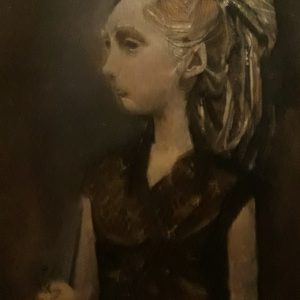
Delgado’s artistic career evolved from traditional realism into an expressionist style with a personal touch, deeply influenced by his studies in Paris, where he developed his unique approach to the human figure, landscape, still life, and portraiture. Throughout his career, he explored the decomposition of form and the distortion of images in search of greater expressiveness, particularly in his landscapes that reflect his subjective experience of places like Navia (Asturias) and Olmeda (Madrid). His early work was influenced by cubism and the painting traditions of Spain, yet over time, the human figure became his primary focus, often set against existential landscapes.
Throughout his distinguished career, he has been recognized with numerous prestigious awards, including the Medal for Merit in Fine Arts from the Madrid City Council in 1991 and the Gold Medal in 1995. His work has been prominently displayed in major international exhibitions, including the Venice Biennale (1950, 1951, and 1964), the La Habana Biennial (1954), and the São Paulo Biennial (1959 and 1963). Delgado has also held solo exhibitions at institutions like the National Modern Art Museum in Madrid and the Spanish Museum of Contemporary Art. In 1974, he was appointed a full member of the Royal Academy of Fine Arts of San Fernando, and in 2009, he was honored for his academic seniority at the same institution.