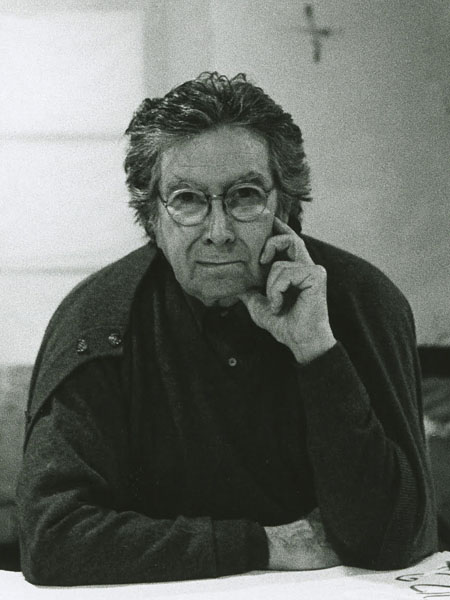
Antoni Tàpies (1923–2012) is widely regarded as one of the most important European artists of the postwar period and a central figure in the development of Art Informel and material-based abstraction. Born in Barcelona, he emerged in the aftermath of the Spanish Civil War, forging a visual language that rejected academic tradition in favor of matter, symbolism, and philosophical inquiry.
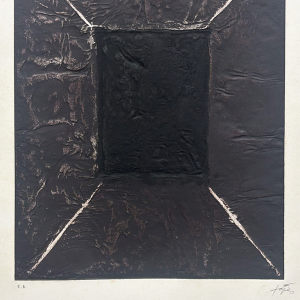
A co-founder of the avant-garde group Dau al Set in 1948, Tàpies quickly gained international recognition in the early 1950s. His incorporation of unconventional materials—marble dust, sand, fabric, and found objects—redefined the painted surface, transforming it into a site of physical, spiritual, and political resonance. His work subtly embedded dissent within abstraction during Franco’s regime, lending it both intellectual depth and historical urgency.
Tàpies exhibited extensively in major institutions worldwide and represented Spain at the Venice Biennale in 1993, where he was awarded the Golden Lion for Painting. His works are held in leading museum collections, including MoMA (New York), Tate (London), Centre Pompidou (Paris), and the Reina Sofía (Madrid). The establishment of the Fundació Antoni Tàpies in 1984 further solidified his enduring institutional legacy.
Today, Tàpies is recognized as a cornerstone of postwar European abstraction. Key works from the 1950s and 1960s—widely considered his most significant period—remain highly sought after by museums and experienced collectors, reflecting the lasting cultural and market relevance of his oeuvre.