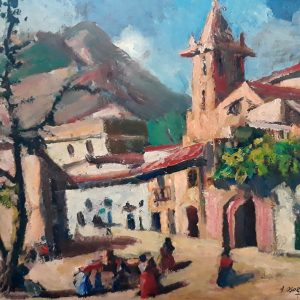
Antonio Osorio Luque (1913-1979) was born in Tucumán. He was an outstanding landscape painter, known for his love for the province of Tucumán, despite having settled in Buenos Aires. His life and work were deeply marked by his relationship with the Tucumán landscape and the life of the sugarcane harvest, themes that he approached with great dedication throughout his career.
Throughout his artistic career, Osorio Luque was a self-taught painter who stood out mainly in the 1950s. He was part of the impressionist movement of the northern landscape, along with Demetrio Iramain, and joined a group of artists who in the 1930s rebelled against the predominant academicism, seeking new aesthetic orientations and focusing on themes of the surrounding reality. His drawing skills and precociousness were admired by his teachers at the Franciscan College, where he began to develop his direct and spontaneous style.
Osorio Luque’s legacy is kept alive in several exhibitions and museums. His work has been exhibited at the Rougés Cultural Center of the Miguel Lillo Foundation, and his work continues to be celebrated within Tucumán’s artistic production. Throughout his career, he received numerous awards, including the Gran Premio del Salón Nacional, the Premio Gobernador de la Provincia at the Salón de Tucumán, and the Premio Adquisición Ministerio de Aeronáutica at the Salón de Bellas Artes. He died on May 12, 1979, leaving an indelible mark on the art of his native province.