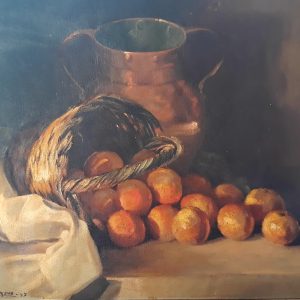
Blas Moyano (1913-2001) was a Spanish painter born in Villa del Río, Córdoba. He spent much of his life in his hometown, where he developed a deep connection with the local landscape, people, and traditions. In his later years, he settled permanently in Villa del Río with his wife, Esperanza, and continued to work and create art until his death in 2001. His work reflects a profound interest in capturing the lives of rural figures, especially the hardworking men of the fields, with an emphasis on their physical features and expressions.
Moyano trained in the local schools of his region and became a passionate painter, dedicated to portraying his surroundings through various mediums, including oil painting, charcoal sketches, and even murals. His artistic practice ranged from still lifes and portraits to detailed representations of rural life. He was particularly known for his ability to depict the aging faces and worn hands of his subjects, imbuing his works with emotional depth. Over the years, Moyano participated in multiple exhibitions in Spain and abroad, including in cities such as Madrid, New York, and Plovdiv (Bulgaria), showcasing his mastery of human figures and landscapes. His work was deeply rooted in his personal connection with his community, and he was committed to documenting the essence of the people around him.
His works are part of numerous private collections and public institutions, including the City of Villa del Río, which hosts a permanent exhibition of his paintings. In 1986, he was honored as the “Hijo Predilecto” (Beloved Son) of Villa del Río, and his legacy was further celebrated in 2001 when the local square was named in his honor. Throughout his life, he received various accolades, including the 1998 donation of his artistic legacy to the town, where many of his works remain on display. In 2003, a bronze bust was erected in his honor in the Plaza Blas Moyano, cementing his place in the town’s cultural history.