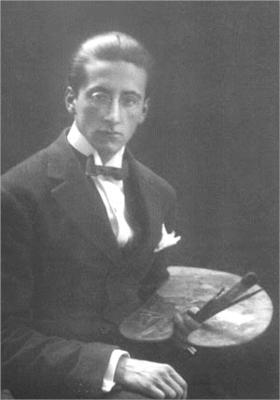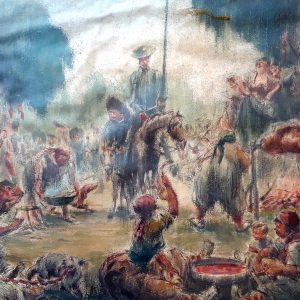
Carlos Saenz de Tejada (1897-1958)was born in Tangier, Morocco, to Spanish parents. His father was a diplomat, and the family eventually moved to Madrid, where Tejada’s artistic talents quickly became apparent. He began his art training under Daniel Cortés and José María López Mezquita, later continuing his education at the prestigious Real Academia de Bellas Artes de San Fernando, where he studied under the renowned painter Joaquín Sorolla y Bastida.
His artistic career spanned various fields, including fashion illustration and pro-nationalist propaganda art. His fashion illustrations graced the pages of prestigious publications such as Vogue, Harper’s Bazaar, and Jardin des Modes, while his propaganda works, created during the Spanish Civil War, portrayed soldiers and workers as symbols of strength, rendered in bold, muscular forms. In contrast, his fashion illustrations were delicate, capturing the elegance of modern women. Later in his career, Tejada also produced realist portraits and figurative paintings, as well as art nouveau-inspired fairy tale illustrations for Platero y yo by Juan Ramón Jiménez.
Tejada’s work was showcased in numerous exhibitions, reflecting his versatility and reach as an artist. During the Spanish Civil War, he served as the head of the Graphic Section of Foreign Propaganda, contributing significantly to nationalist visual culture. While the specifics of his awards and prizes are not widely recorded, his work has been recognized in both the fields of fashion illustration and fine art. Tejada’s legacy continues to be celebrated for its stylistic diversity and contribution to Spanish art in the early to mid-20th century.