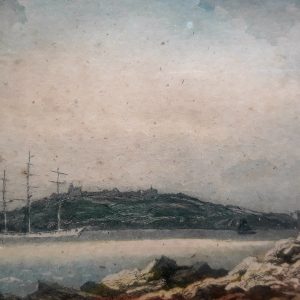
Claude Rowbotham (1864–1949) was a distinguished British landscape artist, best known for his invention of a unique process of producing colored aquatints. Unlike standard hand-colored prints, Rowbotham’s works often achieved a rich, watercolor-like softness through his specialized printing technique. This piece, executed as a hand-colored etching, exemplifies his style: atmospheric, technically precise, and deeply romantic. He is synonymous with the “Golden Age” of British topographical art, dedicating his career to capturing the idyllic charm of the English countryside and coastlines.
Rowbotham’s legacy lies in his ability to democratize art through high-quality prints that were both affordable and artistically accomplished. His work is preserved in regional institutions such as the Falmouth Art Gallery and the Cornwall Museum, which value him as a vital chronicler of Britain’s maritime and topographical history. This piece serves as a historical document of the “Old English” aesthetic, a romanticized vision of village harmony that defined the nation’s visual identity.