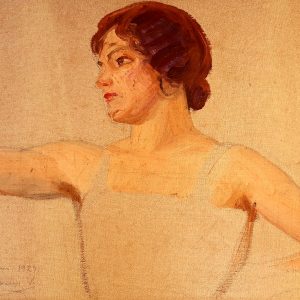
Dionís Baixeras i Verdaguer (1862–1943) was a prominent Spanish painter and drawing artist born in Barcelona. He began his artistic journey at a young age, studying at the La Lonja School of Fine Arts, where he was mentored by notable Catalan painters such as Agustín Rigalt, Ramón Martí Alsina, and Antoni Caba. His early exposure to these masters laid the foundation for his future work. At the age of 24, he moved to Paris for four years, where he was influenced by the realist and naturalist paintings of Jean-François Millet, which deeply impacted his artistic practice.
Baixeras’ artistic career was marked by a strong focus on realism and naturalism, with his work often depicting everyday life scenes and Orientalist themes. He was a founding member of the San Lucas Art Circle, a group of Catalan Modernista artists who emphasized art aligned with Catholic principles. Baixeras gained recognition for his detailed and emotive works, often exploring scenes of rural life and landscapes. His artistic journey included key commissions such as the decoration of the main assembly hall at the University of Barcelona and the collaboration with Joan Llimona and Alexandre de Riquer in the decoration of the Hotel Internacional for the 1888 Barcelona Universal Exposition.
Baixeras exhibited his works frequently, with notable showings at the Sala Parés in Barcelona and international exhibitions, including the Paris Universal Exposition and the Buenos Aires International Exposition. His paintings can be found in prestigious collections, including the Musée d’art et d’industrie de Roubaix in France, and the Metropolitan Museum of Art in New York, where his painting Boatmen of Barcelona (1886) is held. Baixeras’ contributions to Spanish art, particularly his focus on realism and his Orientalist influences, have left a lasting impact on the art world.