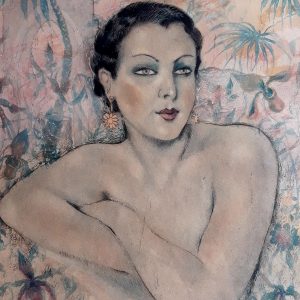
Édouard Chimot (1880 – 1959) was a French artist, illustrator, and editor born in Lille, France. He studied under Jean-Baptiste Levert and Alexis Mossa at the École des Arts décoratifs in Nice and later under Pharaon de Winter at the Beaux-Arts in Lille. Chimot initially worked in various occupations, including architecture, before dedicating himself to art, becoming known for his illustrations and etchings. His early career was delayed by World War I, and he first exhibited in 1912 at the age of 32. His talent in printmaking and his fascination with the female nude became key elements of his artistic identity.
Chimot’s artistic career flourished in Paris during the 1920s, where he became a prominent figure in the world of illustrated books. He worked as an editor and artistic director for Les Éditions d’Art Devambez, overseeing the production of books with illustrations by notable artists like Pierre Brissaud and Tsuguharu Foujita. Chimot’s works from this period include collaborations with writers such as Pierre Louÿs and Maurice Magre. His etchings and illustrations, particularly of Symbolist and sensual themes, gained significant recognition, solidifying his place in the Parisian art scene. In addition to his book illustrations, Chimot was involved in the creation of films and maintained literary connections with artists of the time, including Surrealists like Gilbert Lély.
Throughout his life, Chimot’s works were exhibited in numerous prestigious venues, including the Art Institute of Chicago. His illustrated books were highly regarded, particularly during the 1920s, although the Wall Street Crash of 1929 led to a decline in the market for luxury editions. Despite this, his legacy as both an artist and editor continues, with his works being collected by major institutions, such as the Art Institute of Chicago. A bibliography of his illustrated books was published in 1991, further cementing his influence on 20th-century French art.