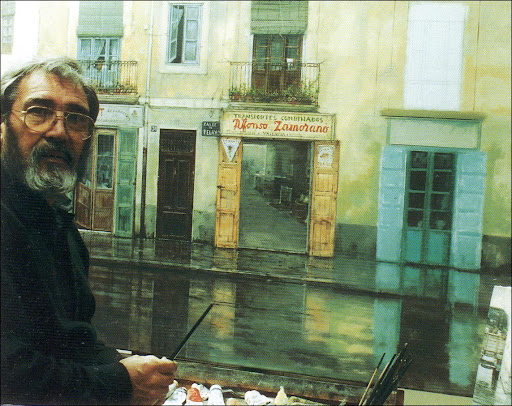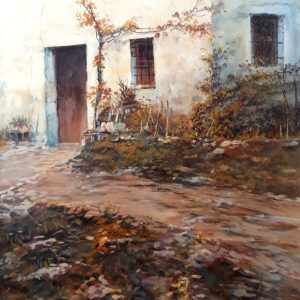
Francisco Mir Belenguer (1934-2023) was born in Benimàmet, Valencia. His childhood was shaped by the hardships of post-Civil War Spain in a working-class family. For about two years, his family lived in a barn without water or electricity, an image that Mir Belenguer vividly remembers and later captured in one of his paintings. His artistic journey began at the young age of nine, showing a natural talent for drawing, as evidenced by his first piece, “Descenso de la cruz de Jesús.” At the age of ten, encouraged by his teacher, Don Alberto Luz, he painted his first artwork, an image of the Church of San Vicente Mártir. Despite the economic struggles, he enrolled in the School of Arts and Crafts in Burjassot, Valencia, in 1946, where he studied until 1952. His self-taught artistic education continued through an extensive library on art, which he studied meticulously, solidifying his identity as an autodidact painter.
His artistic career began in earnest in 1958 when he began exhibiting his work at the Círculo de Bellas Artes in Valencia, initially showcasing his impressionist style. Over the years, his art evolved, spanning figurative, abstract, and eventually, more disciplined realist styles after 1975. His work delves into social realism and urban themes, a reflection of his personal connection to the world around him. He emphasized the importance of expressing quality and aesthetic value, regardless of style. Known for his fascination with color, Mir Belenguer often worked within tonal grey palettes, incorporating all primary colors. His journey as an artist included participation in various national and regional contests, where he earned a respected reputation, winning numerous awards and becoming a prominent figure in the Spanish art scene.
Throughout his career, Francisco Mir Belenguer participated in many exhibitions both individually and collectively across Spain. His solo exhibitions have been held in various cities, including Valencia, Madrid, Bilbao, and Barcelona. His works are housed in numerous public institutions, such as the Museo de Villafamés in Castellón, the Museo de León, and the Casa Museo de Pego in Alicante. Additionally, his pieces can be found in local government offices and collections across Spain, including those of Barcelona, Castellón, Teruel, and Paterna. His work has been displayed in multiple international collections in countries like Germany, England, and Latin America. Mir Belenguer’s numerous awards include top honors at national art competitions and prestigious recognitions, such as the Medalla de Honor del Premio BMW in 1991 and various first-place prizes in his early years. His legacy continues through his art and exhibitions, solidifying him as a significant figure in Spain’s contemporary art history.