John Morley Bury (1919-1999), born in Bournemouth, Hampshire, was a British painter and teacher. Growing up in Holdenhurst, he developed an early passion for art, which he pursued through his education at Bournemouth Municipal College of Art (1937–1939) and Reading University (1939–1940). After serving six years in the British Army, including time as a prisoner of war in Italy and Germany, he returned to his studies, meeting his wife, art historian Shirley Bury, during his time at Reading University. He furthered his education at Regent Street Polytechnic, Goldsmiths’ College, and Central School of Arts and Crafts.
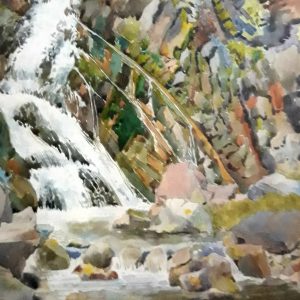
His artistic journey saw a shift from figure subjects in the 1950s to landscapes in the 1960s, where he embraced abstracted representations of the natural world, emphasizing the relationship of color and space. He worked as a part-time teacher at Emanuel School from 1948 to 1958, later teaching at Hornsey College of Art until his retirement in 1984. Throughout his career, Bury exhibited widely, including shows with the New English Art Club and the London Group in the 1950s and 1960s, and held solo exhibitions in Hampstead from 1960 onward. His work reflected a deep exploration of texture and color relationships, which were central to his evolving landscape compositions.
Bury’s paintings are held in significant public collections, including the Victoria and Albert Museum, Salford Art Gallery, and Cambridge University. His self-portrait is archived at the Tate Gallery, and he also has works in corporate collections such as Staveley Industries, Lintas, and Rank Xerox. Bury’s contribution to British art has been recognized in exhibitions such as The Forgotten Fifties (1984), and his legacy continues through his innovative approach to landscape painting and his influence as an educator.