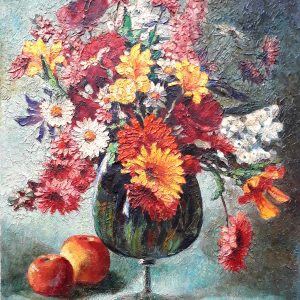
Joseph Couture (1890-1965) was a Belgian painter and draftsman born in Forêt, where he spent most of his life. He studied at the Royal Academy of Fine Arts in Liège, under the guidance of renowned artists such as Adrien de Witte, Auguste Donnay, Évariste Carpentier, and François Maréchal. In 1914, when World War I broke out, Couture volunteered for military service, during which he was wounded and subsequently declared a war invalid. He married A. Lejeune on September 15, 1921. Couture later became a drawing professor at the Royal Academy of Fine Arts in Liège, where he taught from 1921 to 1954.
His artistic career is marked by his dedication to painting and drawing, primarily working in oil and watercolor. His artistic focus was on landscape painting, seascapes, still lifes, and, particularly, floral compositions. He developed a distinctive style that gained him recognition, especially for his delicate and detailed flower paintings. Couture’s works reflect a deep appreciation for nature and an expert mastery of his chosen mediums.
Couture’s works have been featured in numerous exhibitions and are part of various collections. His pieces are housed in the Musée de l’Art Wallon (La Boverie) and the Province of Liège collections. He exhibited regularly at the Cercle Royal des Beaux-Arts in Liège from 1921 to 1961, and participated in notable exhibitions such as the 1926 show at the Palais des Beaux-Arts du Parc de la Boverie in Liège, and the 1964 exhibition at the Musée des Beaux-Arts in Liège, marking the 125th anniversary of the Royal Academy of Fine Arts. Other exhibitions include a 1992 retrospective at the Cercle Royal des Beaux-Arts and the 2019 “Logne autrefois” exhibition at the Musée du Château Fort de Logne.