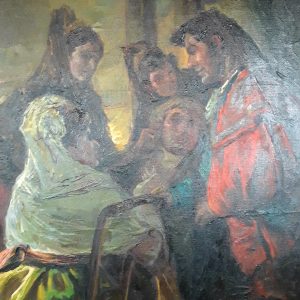
Juan Soler (1940-1984) was a Spanish painter born in Madrid, Spain. He spent much of his life between Spain and France, where he became known for his work in historical painting, figure and genre scenes, Parisian street scenes, and still lifes. Soler’s early exposure to art came at a young age when he trained under the Spanish master Sottomayer at the Prado Museum from the age of 13. Later, he attended the Arts and Crafts School and the Fine Arts Circle in Madrid, laying the foundation for his distinctive artistic style.
Soler’s artistic career was deeply influenced by his studies at the Prado Museum, where he developed a strong admiration for the Dutch and Flemish painters, especially Vermeer, Holbein, and Dürer. His style evolved through the 1970s when he became interested in the movement of Nuevo Realismo, drawing on a variety of influences, including Botticelli, Salvador Dalí, and Ingres. Soler’s works captured a remarkable technical precision, combining realist objectivity with elements of Impressionism. He traveled extensively, living in places such as Italy, Greece, and the USA, and exhibited widely in cities like Madrid, Leon, Salamanca, Torremolinos, Caracas, Mexico City, Lisbon, Oporto, New York, and Miami.
Throughout his career, Soler’s works were featured in numerous group exhibitions worldwide and solo exhibitions in prestigious venues across the globe. He was awarded the Gold Medal at the Castilian Miniature Paintings Competition in 1978. His art can be found in both private and public collections, including those of notable figures like Richard Nixon, Dean Martin, and Giscard d’Estaing, as well as institutions such as the Saudi Embassy in Madrid and the Maria da Fontinha Museum. His artistic contributions were widely recognized by critics, with many praising his ability to combine technique, gesture, and emotional expression in his work.