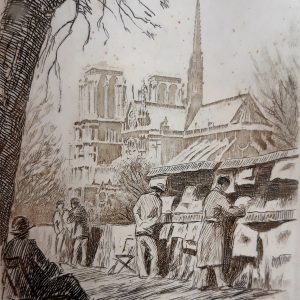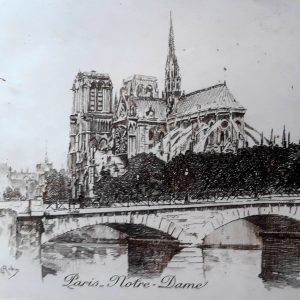
Léopold Robin (Active c. 1900–1950) was a French etcher and engraver, widely recognized for his atmospheric and detailed depictions of Parisian landmarks. His body of work serves as a significant visual archive of the city during the first half of the 20th century. Robin’s style is rooted in the traditional Veduta (view painting) genre, adapted for the medium of etching. He is known for his precise line work and his ability to render the texture of stone and foliage through dense cross-hatching, often creating a romanticized, timeless view of the capital that appealed to both locals and travelers.
Although often categorized as a “Petit Maître” (Little Master) of topographical engraving, Léopold Robin’s legacy is vital as a visual chronicler of his time. He dedicated his career to document France architecture, producing series on Paris, Strasbourg, and the Loire Valley châteaux prior to modern post-war transformations. His work is preserved in heritage collections and historical archives, including the Musée National des Beaux-Arts du Québec (MNBAQ) and various historical funds in France.