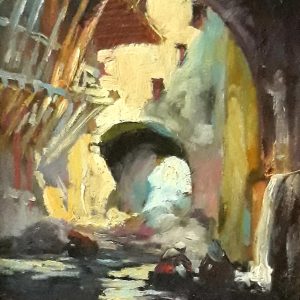
Mariano Bertuchi (1884-1955) was born in Granada, Spain. From a young age, he displayed remarkable artistic talent and soon pursued formal education in the arts. He began his studies under the guidance of landscape artist José Larrocha and later attended the San Fernando School of Fine Arts in Madrid. Influenced by the Mediterranean light and the vibrancy of color, Bertuchi’s early works were deeply rooted in Spanish culture and landscapes. He later moved to Tangier, Morocco, where he began to develop his signature style and focus, drawing inspiration from the unique surroundings and people of the region.
The artist is best known for his Orientalist style, specifically capturing the Spanish Protectorate in Morocco. His paintings and sketches depict scenes of daily life, landscapes, and the culture of Morocco, focusing on views of Tetouan, Chefchaouen, markets, streets, cafes, and festivals. He skillfully combined elements of Impressionism, reminiscent of his mentor Joaquín Sorolla, particularly in his use of light and shadow. Bertuchi’s work often centered on the Mediterranean light and vibrant color, with a strong emphasis on capturing the daily life of the Maghreb people. In addition to his paintings, Bertuchi produced works in watercolor, ink sketches, and even posters and stamps. His art contributed to the cultural development of Morocco during the Spanish Protectorate, and he was deeply involved in the preservation of historical landmarks and the promotion of traditional heritage.
Bertuchi’s work has been celebrated in numerous exhibitions, both in Spain and internationally; “Painters Orientalists of the Nineteenth and Twentieth Centuries” at the Louvre Museum (1987), “Eighteen Moroccan and Spanish Painters of the School of Tetouan” (1992) at the Morocco Pavilion of Seville and “Mariano Bertuchi, Morocco Painter” (2000) at institutions such as the School of Arts and Crafts in Tetouan, Wafabank, and the Exhibition Hall of Casablanca, “Morocco Time” (1999) in Paris, “Tribute to Mariano Bertuchi” (2005) at the Centre Hassan II in Asilah, Morocco, and “Mariano Bertuchi, 50 Years Later” (2006) at the Cervantes Institute in cities such as Tetouan, Tangier, Rabat, Casablanca, Málaga, Córdoba, and Madrid. Bertuchi was also instrumental in founding the School of Indigenous Arts in Tetouan in 1945, later becoming the National School of Fine Arts in 1993.