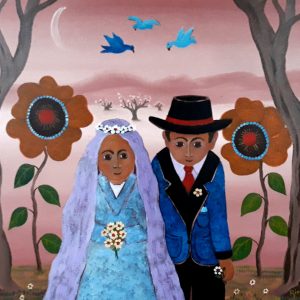
Miquel Rivera Bagur was a Spanish painter regarded as one of the leading exponents of Naïve painting in the Balearic Islands and an important figure within 20th-century Spanish art. Largely self-taught, he developed his artistic practice independently while maintaining close contact with prominent Mallorcan artists. Between 1959 and 1964, he was associated with the Grupo Tago in Palma, a collective that contributed to the renewal of the island’s artistic scene.
Rivera Bagur began painting in the late 1940s. His early works reflect an expressive and emotionally charged character, influenced by his personal experiences during the Spanish Civil War and his time in the Blue Division. During the mid-1950s he went through a realist phase before consolidating his mature language within the Naïve tradition, which he developed consistently from the late 1950s onward.
He held his first solo exhibition in 1954 at Galeries Danús in Palma. In 1961 he exhibited internationally for the first time in Chicago, and subsequently presented his work in Germany, Austria, New York, Beverly Hills, Zürich, Caracas, Italy, Morocco, and Sub-Saharan Africa, while continuing to exhibit extensively in Spain, particularly in his native Mallorca.
Rivera Bagur’s mature work is characterized by vibrant color, decorative detail, and harmonious compositions. Floral elements, trees, and figures are arranged in serene and balanced scenes that convey optimism and poetic simplicity. His distinctive visual language secured his position within the Spanish Naïve movement and attracted both national and international attention.
His paintings are held in major museum collections, including the Museo Nacional Centro de Arte Reina Sofía (Madrid), the Frans Hals Museum (The Netherlands), the Museo Español de Arte Contemporáneo, and the Musée de la Peinture Naïf de l’Île-de-France (Paris), among others. He was awarded the Medal of the Salón de Tardor at the Cercle de Belles Arts twice, in 1960 and 1971.
Rivera Bagur passed away in Palma de Mallorca in 1999, leaving behind a significant body of work that continues to be exhibited and collected both in Spain and internationally.