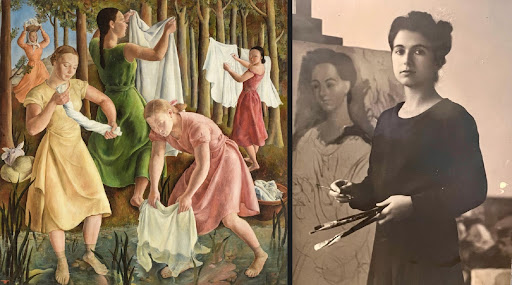
Rosario de Velasco (1904–1991) was a figurative painter born in Madrid. She began her formal education in art at the age of 15, studying under the prominent genre painter Fernando Álvarez de Sotomayor y Zaragoza. De Velasco’s work was also influenced by Magic Realism and neo-traditional themes. Her career was further impacted by her personal life, including her narrowly escaping execution during the Spanish Civil War due to her affiliation with the Falange Española. After marrying Xavier Farrerons-Co, she relocated to France, eventually returning to Spain post-war.
De Velasco’s artistic output includes seascapes, portraits, and landscapes, often blending elements of Magic Realism and neo-traditionalism. Her style evolved throughout her career, initially focusing on realism but later shifting to a more personal, freer expression, particularly after the 1950s. Known for creating serene, melancholic works, her later paintings increasingly incorporated oil on canvas and paper. Her figures and landscapes often convey a sense of stillness and introspection.
Her career was marked by significant recognition, with a notable achievement in 1932 when her painting Adam and Eve won second prize at the National Fine Arts Exhibition in Madrid. She participated in the 1936 Jeu de Paume exhibition in Paris, which showcased contemporary Spanish art. She also held solo exhibitions at major galleries such as Sala Gaspar and Sala Parés in Barcelona. Her works are housed in several prestigious collections, including the Museo Nacional Centro de Arte Reina Sofía in Madrid and the Centre Pompidou in Paris.