
Land & Legacy: The British Tradition
Land & Legacy: The British Tradition brings together nineteenth- and early twentieth-century works that define Britain through countryside, equestrian culture, and institutional continuity. Across painting and engraving, the collection reflects a society structured by land, ritual, and hierarchy, where estate, hunt, and college form the visual architecture of national identity.
At its core is John Charles Maggs, whose stagecoach scenes preserve the drama of pre-railway England and the mythology of the coaching age. The tradition evolves in the refined sporting imagery of George Wright, a regular Royal Academy exhibitor, whose hunting scenes balance anticipation, discipline, and equestrian precision. The composition derived from Francis Calcraft Turner situates the collection within the foundational canon of British sporting art, where fox hunting became both spectacle and social code.
Architectural permanence enters through Edmund Hort New, whose detailed Oxford view reflects the Arts and Crafts reverence for heritage and craftsmanship. The equestrian diptych by Ange-Louis Janet extends the dialogue to a broader Northern European aristocratic culture, reinforcing shared visual languages of land, rank, and cultivated leisure.
FEATURED WORKs

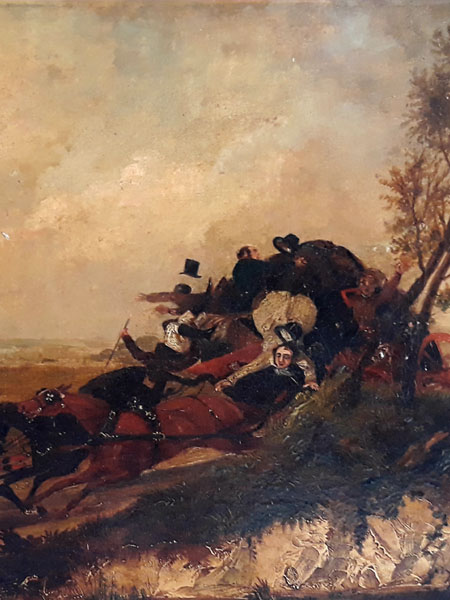
John Charles Maggs
The Runaway Coach (02/26/1932)
Oil on board
41 x 50.5 cm
In The Runaway Coach, Maggs demonstrates his skill in portraying the dramatic movement and tension of 19th-century travel. This work fits perfectly into his most sought-after thematic category: a stagecoach packed with passengers (including “outsiders” on the roof) facing peril on a rural road. The composition captures the critical moment when the coach tips dangerously as it veers off the path, with the team of horses in an uncontrolled gallop. Maggs masterfully details the travelers’ reactions, while a top hat flies through the air, emphasizing the scene’s speed.
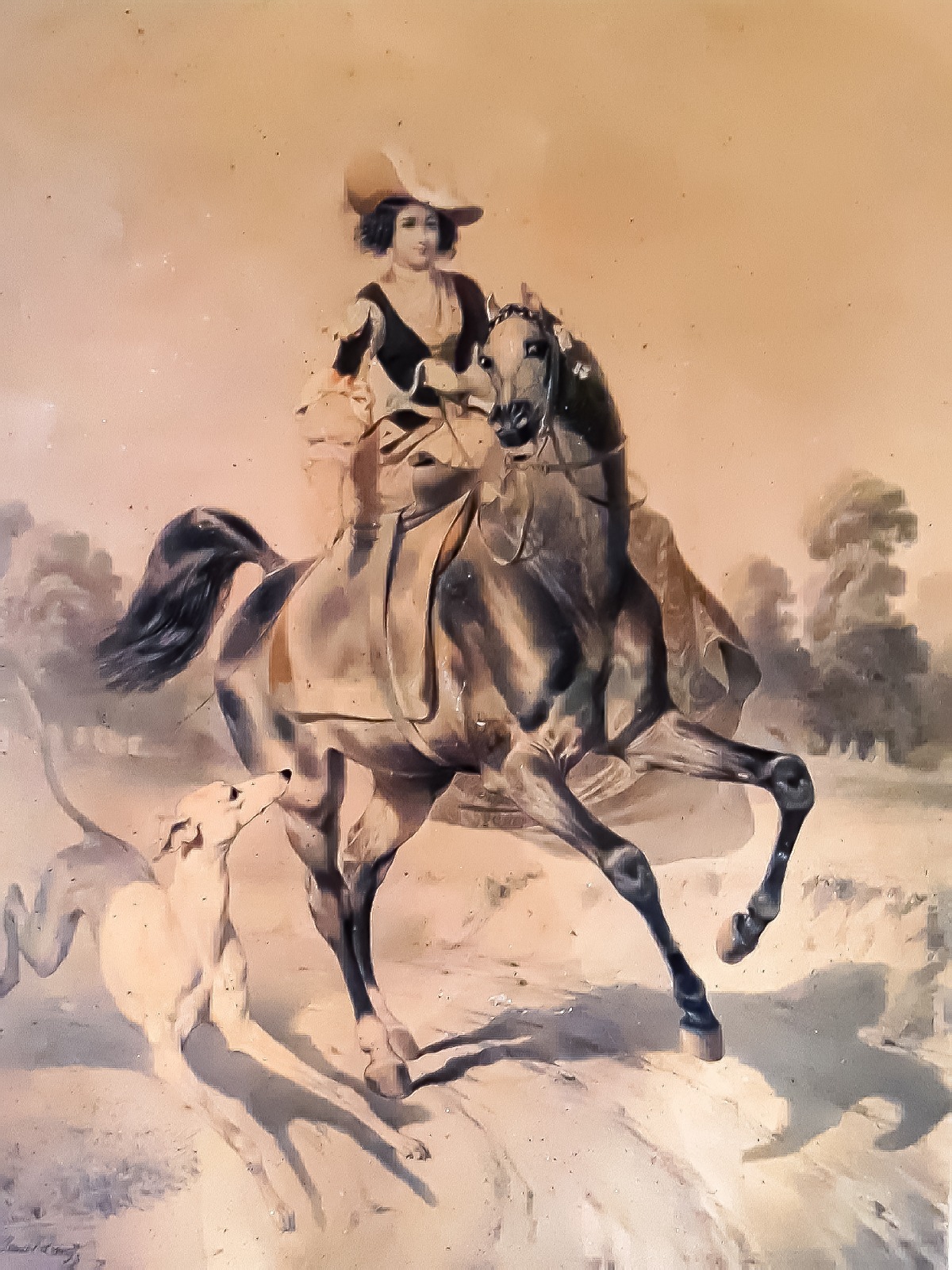
Ange-Louis Janet (Janet Lange)
The Amazon at a Gallop (Title Suggestion) (19th C.)
Ink engraving on paper
48 x 38 cm
In The Amazon at a Gallop, Janet-Lange captures the essence of speed and freedom. The protagonist, dressed in a dark riding habit with a veil trailing in the wind, rides a dappled grey horse in full gallop, its front legs raised in a powerful stride. The scene vibrates with kinetic energy, emphasized not only by the horse but also by the hunting dog (likely a greyhound) running enthusiastically alongside. The lighting is diffuse and atmospheric, typical of an open landscape, allowing the viewer to focus on the tension of the animal’s musculature. As the first part of the diptych, this image represents “Action” or “The Departure,” offering a direct contrast to the stillness and architectural structure found in the second plate.

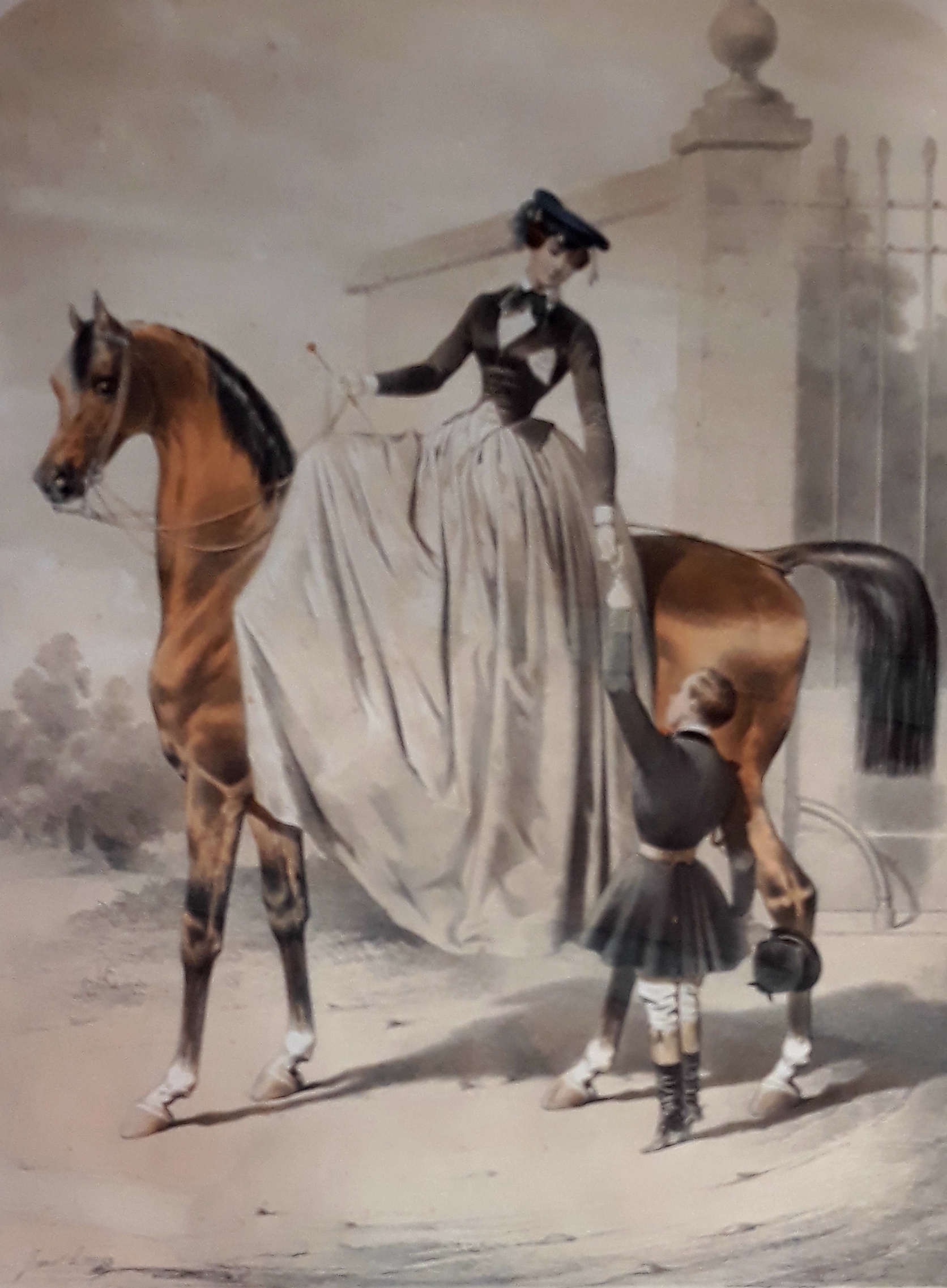
Ange-Louis Janet (Janet Lange)
The Meeting at the Gate (Title Suggestion) (19th C.)
Ink engraving on paper
48 x 38 cm
In The Meeting at the Gate, the visual narrative shifts drastically from movement to repose. The same equestrian elegance is now presented in a static situation: the horsewoman, impeccably attired, rides a bay horse, a deliberate color change from the grey in the first work to differentiate the scenes or moments. The composition is anchored by the verticality of a stone pillar and an iron gate, suggesting a boundary, an arrival, or a social pause. The rider interacts with a groom or attendant who stands reaching up to her. The lighting is more controlled and serene, highlighting the sheen of the horse’s coat and the heavy drape of the rider’s skirt, which no longer flutters in the wind. This work represents “Rest” or “Social Interaction,” closing the energetic cycle opened by the first of this series of two plates.

George Wright
The rendezvous
Watercolor on paper
14 x 11 cm
George Wright executes this piece with the refined precision characteristic of the best British sporting artists, balancing anatomical accuracy with atmospheric mood. He uses a combination of transparent washes to establish the cold, misty background and tighter, more opaque strokes to define the musculature and tack of the horses. The artist’s ability to render the sheen of the horses’ coats against the matte, soft focus of the winter landscape demonstrates his mastery of the watercolor medium, capturing the damp, chilled air of the English countryside.
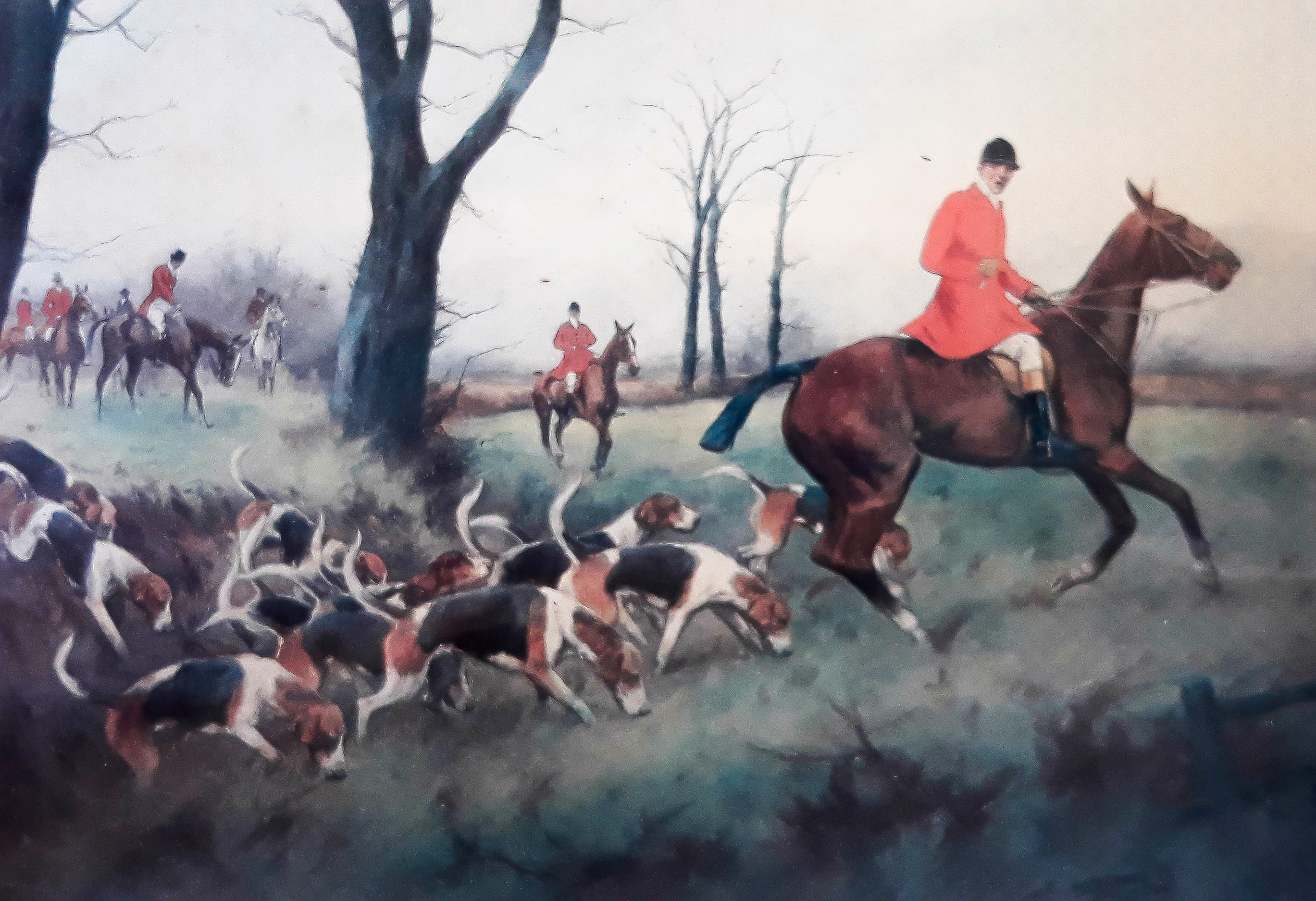
George Wright
The Opening Day
Ink engraving on paper
15 x 22.5 cm
In The Opening Day, Wright portrays the palpable anticipation of a hunt beginning in the crisp air of late autumn. A huntsman in brilliant scarlet, mounted on a muscular bay hunter, pauses to encourage his hounds as they busily scent through the underbrush of a roadside ditch. Behind them, the bare, skeletal branches of winter trees frame a misty background where other riders gather, their forms softening into the atmospheric haze of a classic English morning.
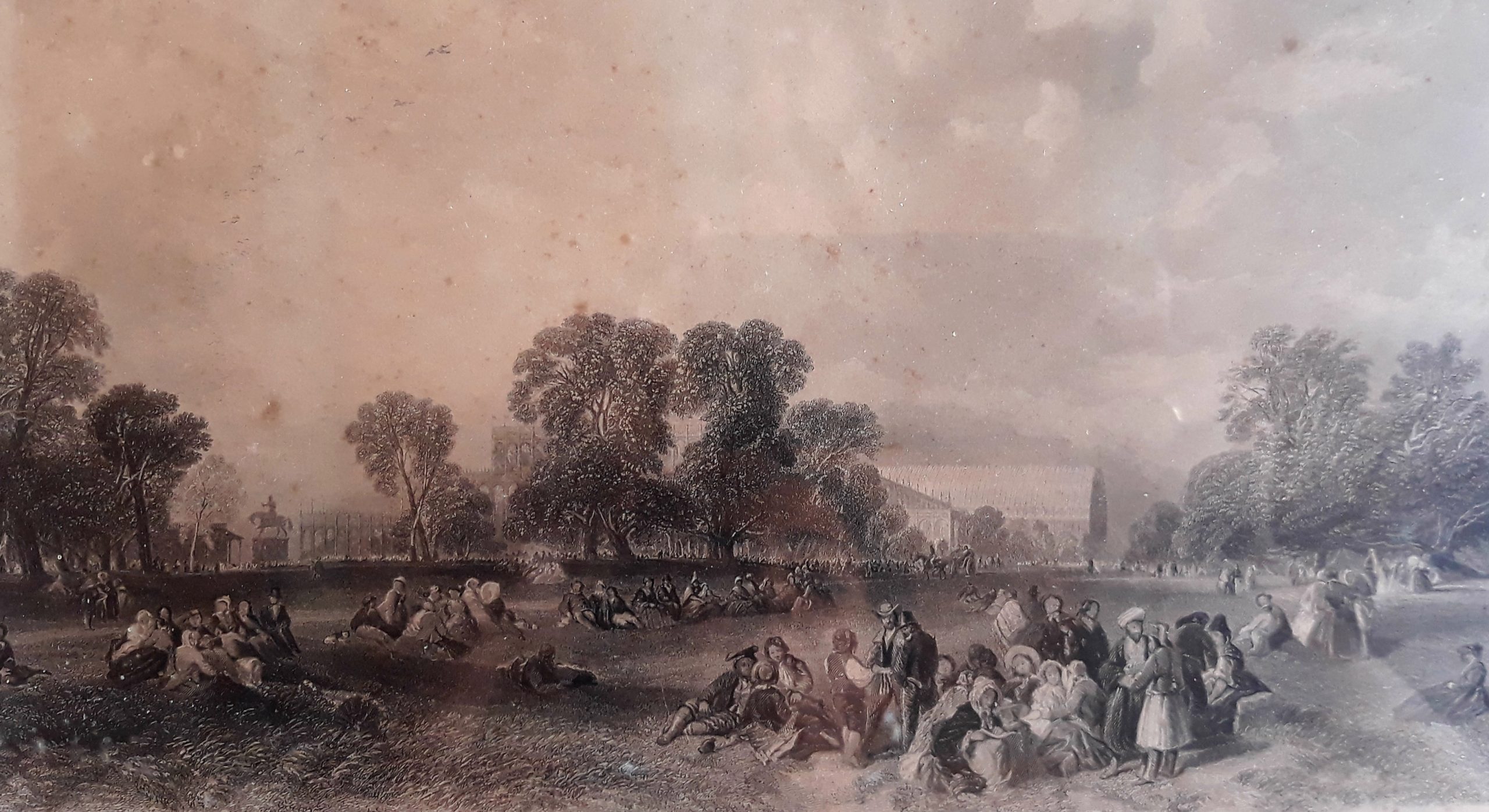
J. D. Harding
Hyde Park in 1851
Ink engraving on paper
15 x 21 cm
In Hyde Park in 1851, Harding portrays a panoramic vista of Victorian society gathered at the height of the Great Exhibition. The vast foreground is populated by diverse groups of figures lounging on the grass in a relaxed, communal display of leisure. Through the gaps in the stately, mature trees that punctuate the middle ground, the viewer glimpses the shimmering, glass-and-iron structure of Joseph Paxton’s Crystal Palace, stretching across the horizon like a modern cathedral of industry. To the left, the silhouette of a monumental equestrian statue adds a sense of scale and official grandeur to the park setting.