
Madame Flihan Art Gallery opens its doors in the heart of the Algarve to a world suspended between dream and matter. The exhibition takes its name from the language of dreams, oneiros, the ancient Greek word for vision, for that which appears to the soul when the body rests. Yet within this reverie lies a meditation on a theme as tangible as it is elusive: the weight of value.
From the masterful brush of Julio Vila y Prades, a testament to 19th-century virtuosity, to the abstract and spiritual harmonies of Fernando Zóbel and Luis Feito, ONYRICA gathers works that inhabit the boundary between what is dreamt and what endures. Each piece, while distinct in form and era, embodies both the ephemeral quality of imagination and the permanence of worth, opening a space where aesthetic vision is transfigured into cultural permanence and historical resonance.
Here, the dream is not an escape from reality but a mirror that reveals its hidden architecture. The exhibition invites the viewer to drift through this oneiric landscape, where color, gesture, and time converge in a dialogue of emotion and insight. These artworks, among the most sought-after in the gallery’s collection, evoke not only aesthetic wonder but also the invisible gravity of history, rarity, and human longing.
Inaugural by nature and intention, ONYRICA sets the tone for the path ahead: a prelude to future explorations that will traverse the territories of alchemy, mysticism, and transformation. This exhibition unfolds as a liminal space where darkness does not oppose light, but gives birth to it. Just as the alchemist seeks to transmute base matter into gold, so too does this exhibition suggest that art itself is an act of transmutation: of dream into form, of value into meaning, of time into timelessness
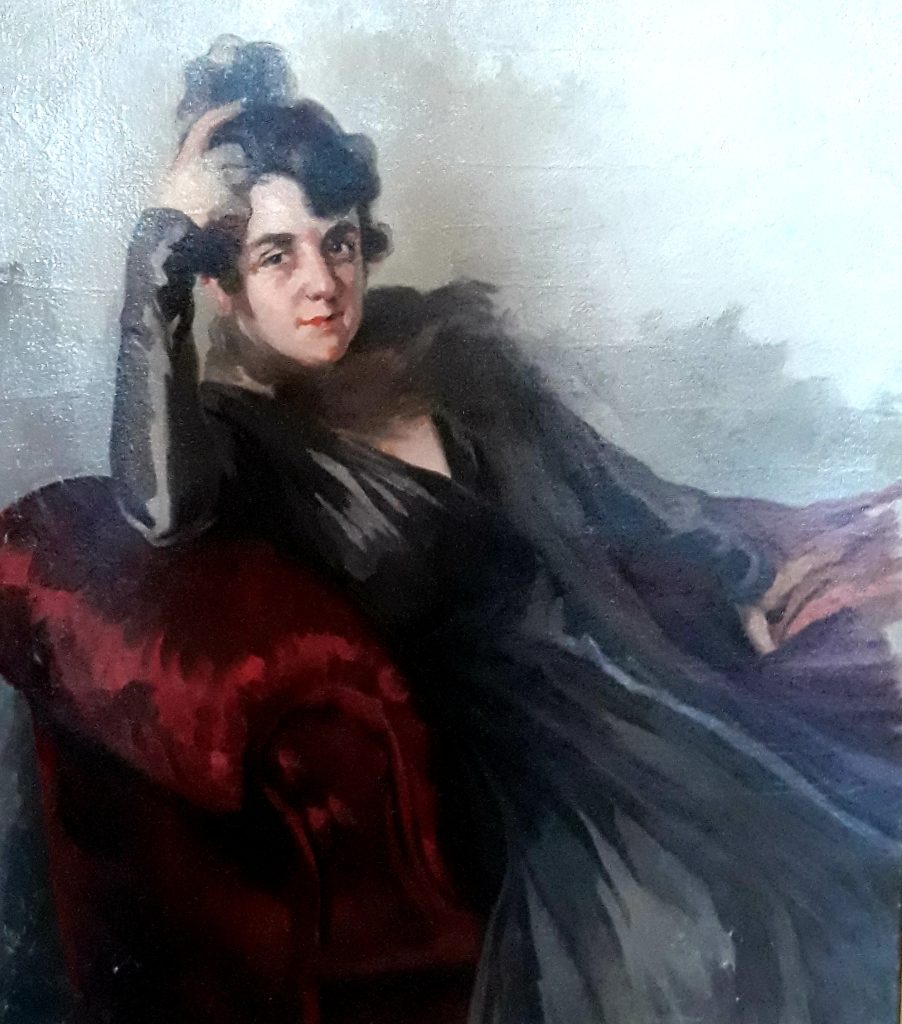
julio Vila y Prades
Lady on the couch
Oil on canvas
103 x 90 cm
Julio Vila y Prades (1873–1930) was born in Valencia, Spain, to Valero Berenguer and Rosa Prades Tarazona. Against his parents’ wishes, he pursued his passion for painting and enrolled at the San Carlos School of Fine Arts in Valencia. There, he studied under Joaquín Agrasot, Juan Peyró, and Francisco Domingo Marqués, later refining his skills in the Madrid workshop of Joaquín Sorolla y Bastida. His education and early career were marked by notable achievements, including medals at the National Exhibition of Fine Arts in 1892, 1897, and 1904. Vila y Prades also studied briefly at the Académie Julian in Paris and later gained international recognition for his work, earning honors such as the Peruvian Order of the Sun in 1928.
A versatile artist, Vila y Prades excelled in landscapes, portraits, and murals, often drawing inspiration from his travels across Europe and the Americas. His early work featured Valencian themes, evolving into depictions of Argentinean pampas, Breton seascapes, and Spanish genre scenes. Notable works include Caravana Gitana (Gypsy Caravan), Los arroceros (The Rice Growers), and Jurado de carreras del siglo XVIII (18th-Century Race Judges), the latter earning him a gold medal at the Paris Salon. His career as a muralist flourished with commissions in Buenos Aires, Lima, and Los Angeles, where he created significant works for institutions like the Museo Bolivariano and the Spreckels Foundation’s Palace of the Legion of Honor Museum.
Vila y Prades’s works have been widely exhibited, including recurring appearances at Spain’s National Exhibition of Fine Arts and international showcases in Paris, New York, Havana, Caracas, and Mexico City. He painted murals for the Gran Kursaal in San Sebastian, the Tigre Club and Club de Mar del Plata in Argentina, and the Museo Bolivariano in Lima. His art is held in museums and institutions throughout Spain and the Americas, with the Vila Artal family collection in Madrid preserving many of his masterpieces. Additionally, his portraits of Spanish royalty and influential families solidified his reputation, and his legacy remains significant in both public and private collections worldwide.
Lady on the couch by Julio Vila y Prades is a masterful portrayal that encapsulates the artist’s exceptional skill in capturing the essence of his subjects. This painting creates an intimate and psychological moment, inviting viewers into the woman’s world and challenging them to engage with her presence. The work reflects his training under Joaquín Sorolla and his experiences gained through extensive travels across Europe and the Americas. It allings with the artist´s reputation as a sought-after portrait painter for influential families and royalty, showcasing his technical proficiency in realistic representation. The relaxed pose and setting suggest a level of trust between the artist and subject. It stands as a testament to his versatility as an artist who excelled not only in large-scale murals and landscapes but also in creating intimate, personal portraits that resonate with viewers through their realism and psychological depth.
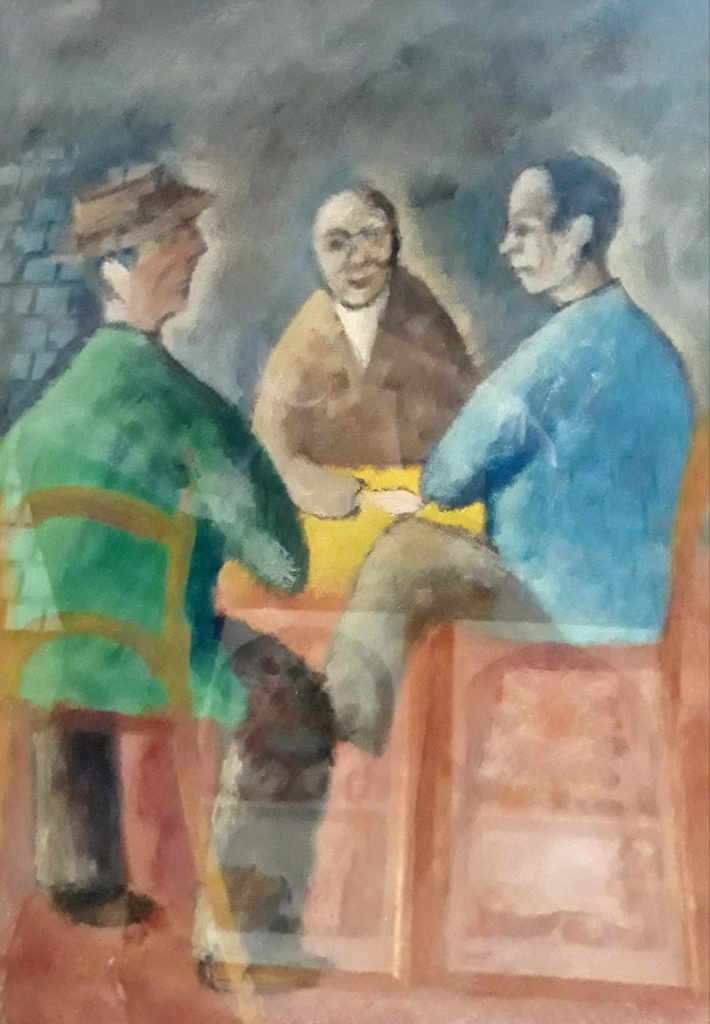
Ottone Rosai
The Encounter
Oil on carton
70 x 49 cm
1946
Ottone Rosai (1895–1957) was an influential Italian painter born in Florence, Italy. He showed an early interest in art, studying at the Academy of Fine Arts in Florence. He initially embraced Futurism, influenced by his friendships with artists like Ardengo Soffici, and exhibited with the Futurist group from 1913. His career was shaped by personal challenges, including the suicide of his father, which led him to support his family through various jobs, limiting his artistic output for a time.
Rosai’s work reflects a deep personal vision that evolved over time. His early Futurist works gave way to a more introspective, figurative style influenced by early Renaissance imagery and Cézanne’s techniques. His depictions of everyday life in Florence, particularly of humble working-class figures, became a central theme, reflecting his connection to the Strapaese movement, which celebrated rural Italian life. In the 1920s and 1930s, Rosai’s style became more austere, with Cubist influences blending into his portrayal of landscapes and portraits. His works are known for their somber tones, strong chiaroscuro, and the juxtaposition of volume and mass, reflecting the emotional and social tension of the times.
The artist exhibited widely across Europe and beyond, including in major institutions such as the Museum of Modern Art. His works were featured in two major biennials: the Venice Biennale International Exhibition and the Bienal de São Paulo. Throughout his career, Rosai had numerous solo and group exhibitions, including solo shows such as Art Parma 2024 at GALLERIA STEFANO FORNI. He also participated in various group exhibitions in 2024, such as The Art of Gifting Emotions, Cities, Towns, and Villages, and Italian Masters of Art at Florence Art Gallery. In 2023, his works were displayed in The Landscape Artists and Italian Art, April in Paris, while his fair booths included GALLERIA STEFANO FORNI at Arte Padova 2023. Rosai’s legacy endures through exhibitions and collections, including his significant presence at the Museo Novecento in Florence, where his works are part of the permanent collection.
The Encounter by Ottone Rosai captures a moment of quiet yet profound human interaction, immersing the viewer in the intimacy of a group scene. The composition reflects not only the physical presence of the individuals but also the subtle, unspoken emotions that accompany such encounters, inviting the viewer to reflect on the nature of human connection. Rosai’s use of muted, earthy tones imbues the painting with a nostalgic warmth, timelessness and tenderness. The oil technique enhances this feeling by offering rich contrasts in light and shadow, adding depth to the space and giving texture to the characters’ expressions and surroundings.
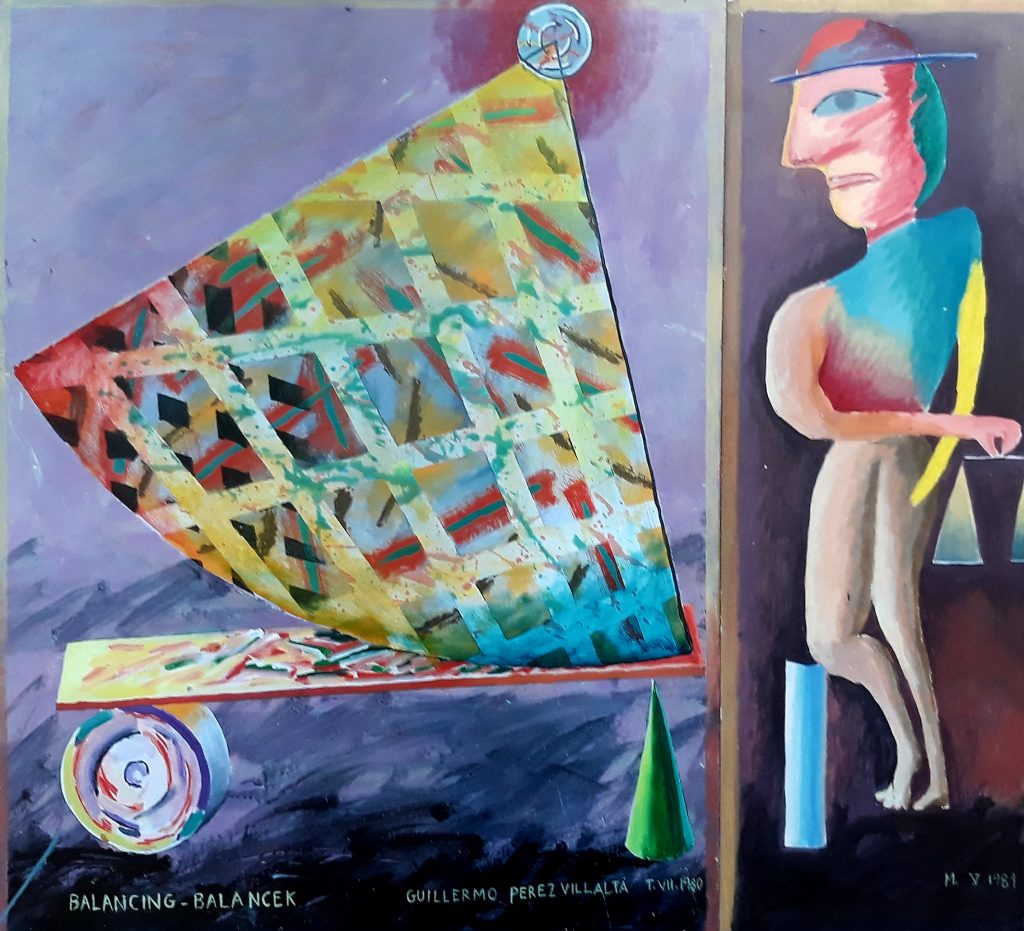
Guillermo Pérez Villalta
Balancing-Balancer
Oil on carton
66 x 72,5 cm
1981
Guillermo Pérez Villalta (1948) was born in Tarifa, Cádiz, Spain. Initially, he studied architecture but later abandoned this field to dedicate himself entirely to painting. He became a central figure in the Madrid New Figuration movement in the 1970s. Pérez Villalta’s work was influential in Spain’s post-Franco artistic landscape, contributing significantly to the development of contemporary art during this period.
Pérez Villalta is known for his distinctive fusion of painting and architectural elements. His early works reflected vibrant colors influenced by Baroque and Mannerist styles, evolving into a more neo-Mannerist approach. His paintings combine geometric forms with symbolic and mythological elements, and he explored concepts such as light, space, and emptiness. His surrealist approach often incorporates precise architectural structures, blending traditional and modern motifs to create intricate, labyrinthine compositions.
The artist’s work has been showcased in numerous solo and group exhibitions, including his solo show at Galería Fernández-Braso in 2021, and his participation in the group exhibition BLANCO, NEGRO Y, A VECES, GRIS alongside Cristino de Vera and Xavier Valls. His paintings have been displayed in prominent galleries like Buades and Fernando Vijande, positioning him as a central figure in the New Figuration movement, alongside other leading Spanish artists. Additionally, his works were featured at major art fairs, such as ARCOmadrid 2019, ARCOlisboa 2020, and ARCOmadrid 2022. Pérez Villalta’s work has been exhibited in prestigious museums, including the Museo Reina Sofía in Madrid, the Museo de Arte Contemporáneo in Barcelona, and the Musée d’Art Moderne in Paris, solidifying his global presence and continuing legacy. His works have also been part of a major group show at the Museo Reina Sofía and included in the renowned Bienal de São Paulo. Notably, his work has been collected by the Museo Reina Sofía and reviewed by the influential art publication Artforum. His distinctive fusion of modernity and tradition has influenced contemporary artists, making him a key reference point in the art world.
Balancing-Balancer (1981) by Guillermo Pérez Villalta is a striking surrealist composition that explores both the physical and symbolic concepts of balance. In this work, a figure precariously balances a cart, defying the laws of physics and inviting viewers to reconsider their perceptions of stability. The juxtaposition of controlled instability reflects the tensions of the time, as Spain emerged from dictatorship into democracy. As a key figure of the Movida Madrileña, Pérez Villalta integrates Baroque and classical influences with surrealism, creating a visually rich and conceptually layered work that speaks to the era’s spirit of freedom and experimentation.
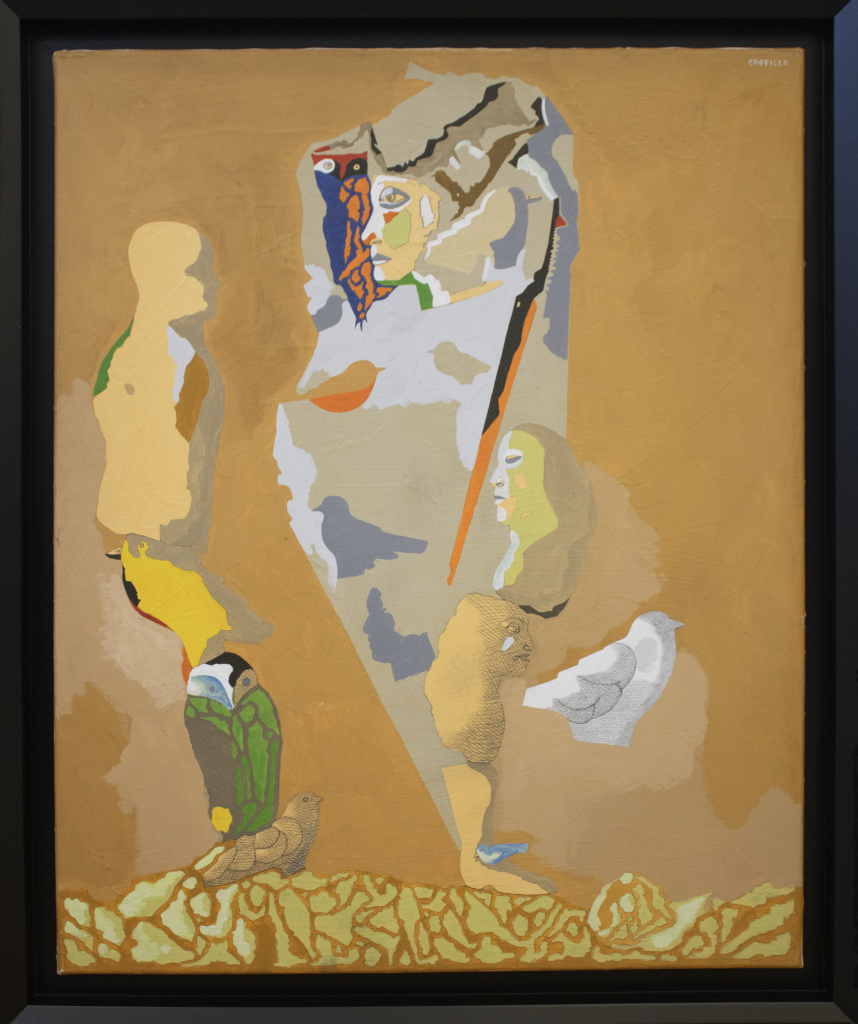
Jorge Castillo
Untitled
Oil on canvas
81 x 65 cm
Jorge Castillo (1933) was born in Pontevedra, Galicia, Spain. At the age of one, his family emigrated to Argentina due to political reasons, and he spent his youth in Buenos Aires. Castillo began creating self-taught art from a young age. In 1941, he won an art competition and was admitted to the École des Beaux-Arts in Buenos Aires, though he soon left the school due to dissatisfaction with its methods. He later trained as a technical draughtsman, continuing his education independently. In 1955, Castillo returned to Spain, where he lived in Madrid before moving to Barcelona and later, Geneva.
Castillo is known for his contributions to Surrealism and Art Informel. His work spans a variety of media, including painting, graphic arts, and sculpture. His early work focused on surrealistic ink drawings and gouaches. Castillo’s works often incorporated symbolic elements, exploring themes of mythology and human expression. Throughout his career, Castillo was praised for his generosity and influence on younger artists, including Alberto Giacometti, who was particularly encouraging.
He exhibited internationally, contributing to significant art events such as the São Paulo and Venice Biennales in the 1960s. He won the International Drawing Prize in Darmstadt in 1964. His works have been shown in Switzerland, Germany, and Italy, with solo exhibitions at major galleries such as Marlborough Gallery in New York and Galerie Dittmar in Berlin. Additionally, his works were part of group shows such as Homage to Picasso at Gerrish Fine Art in 2024 and exhibitions at Ditesheim & Maffei Fine Art. His notable solo exhibitions include the Galeria Leandro Navarro in Madrid (2010, 2016) and the Cervantes Institute in Stockholm (2015). In 2001, a retrospective of his works was presented at the Centro Gallego de Arte Contemporáneo in Santiago de Compostela, where a permanent museum is dedicated to his legacy.
Castillo’s work is held in prestigious collections worldwide, including the Solomon R. Guggenheim Museum in New York, the San Francisco Museum of Modern Art, the Albertina Museum in Vienna, and the Museo Nacional del Prado in Madrid. His contributions to public sculpture include pieces in La Coruña, Messina, and Barcelona, such as the renowned El Ciclista in Barcelona.
The oil on canvas work by Jorge Castillo, intentionally mimicking collage in a painted medium can be interpreted as a commentary on the nature of perception and reality, themes often explored in Surrealist art. It might also represent Castillo’s synthesis of various artistic influences and experiences, reflecting his time in different countries and exposure to diverse artistic traditions.
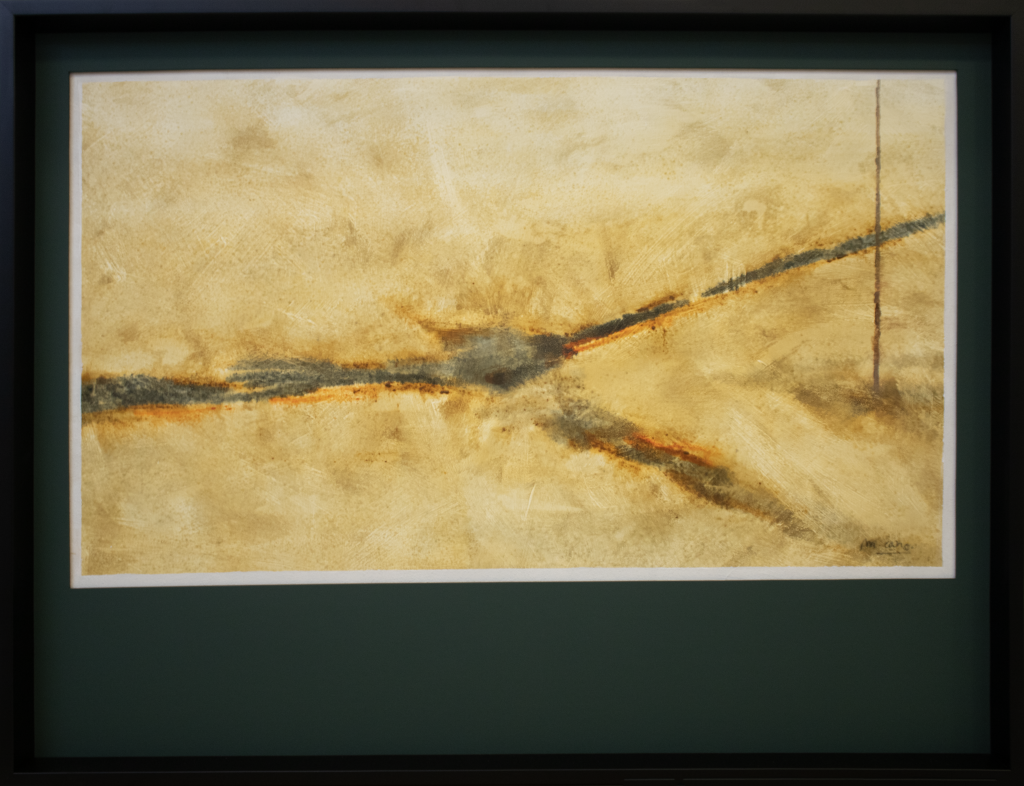
Manolo Cano
Untitled
Oil on canvas
89 x 116 cm
Manolo Cano (born in 1958, Cádiz) is a prominent painter and draftsman from the Cádiz region, known for his exceptional mastery of painting techniques and his deep connection to artistic tradition. He resides in San Roque and has cultivated an artistic career throughout his life that reflects his dedication to painting and his constant search for expressive essence. Cano is an artist who prefers solitude in his creative process, rejecting the whims of contemporary art and focusing on the purity and authenticity of painting. His style is characterized by a detailed and rigorous approach that allows him to navigate between figuration and abstraction, always with a strong presence of form and color.
Throughout his career, he has developed a body of work full of strength and technical refinement, transitioning from a detailed figurative style to more abstract and informalist painting, always with a personal and emotional approach. His art has witnessed a constant evolution, moving towards new proposals that explore both the tangible and the suggested, with his work being a continuous reflection on landscape and the human figure. Despite his success, Cano has never settled into a single formula, always seeking to challenge his own artistic boundaries and expand the horizons of his painting.
Manolo Cano’s oil on canvas, exemplifies the artist’s ability to distill complex emotions and concepts into simple yet powerful visual elements. In this abstract work, the composition centers around three dynamic lines that converge at the heart of the canvas, suggesting a profound sense of connection and interaction. The earthy tones dominate the piece, evoking a sense of groundedness and depth, characteristic of Cano’s mastery over texture and form. The minimalist approach, with its deliberate spareness, mirrors his tendency to strip away excess, focusing on the essence of the composition and allowing the viewer to experience the work as a reflection of the natural world and human emotion.
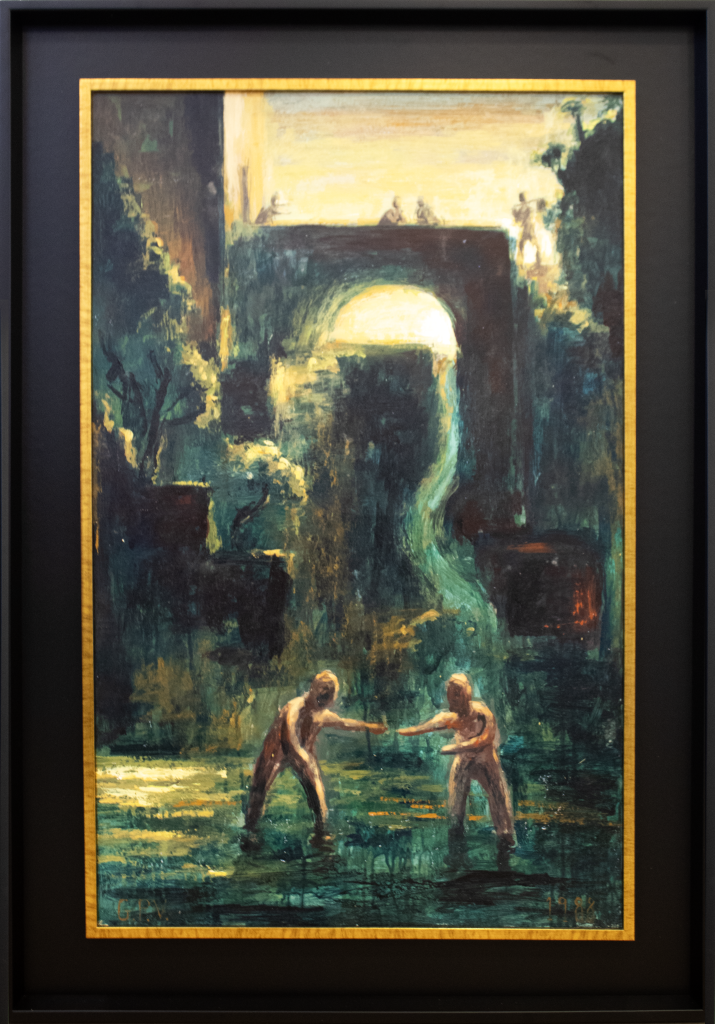
Guillermo Pérez Villalta
Untitled
Oil on carton
75 x 48 cm
1988
The oil on carton (1988) by Guillermo Pérez Villalta falls within a fascinating period of his artistic career, representing a transition in his style and thematic focus. During the 1980s, Pérez Villalta’s work evolved towards a warmer color palette and a more fluid painting technique, reminiscent of old masters like Titian. This painting reflects this phase of his artistic development, combining figurative elements with a lush landscape. The artist often uses elaborate settings to create dreamlike or surrealistic atmospheres. It stands as a testament to his evolving style and his enduring fascination with the interplay between human narrative and natural symbolism.
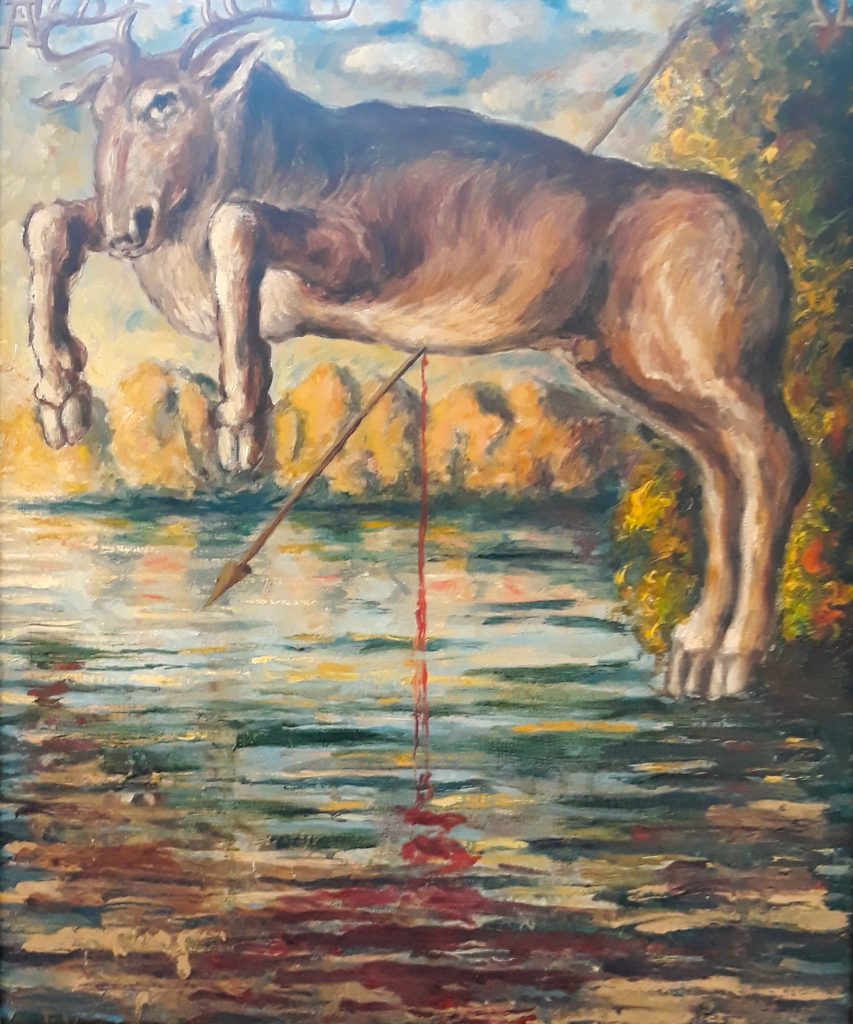
Guillermo Pérez Villalta
Emblema con ciervo
Oil on canvas
46 x 38 cm
1987
Emblem with deer (1987) by Guillermo Pérez Villalta is a powerful representation of the artist’s unique style and thematic interests. The deer, a recurring motif in art history, often symbolizes purity, grace, and spirituality. In this context, the arrow piercing the deer adds a layer of complexity, could be read as a commentary on the human condition, the struggle between nature and civilization, or even as a personal allegory. This multifaceted approach to storytelling through art is consistent with Pérez Villalta’s reputation as a pioneer of figurative, narrative, and biographical painting. It likely showcases his ability to create art that is simultaneously rooted in historical references and deeply personal, a quality that has made him a significant figure in Spanish contemporary art.
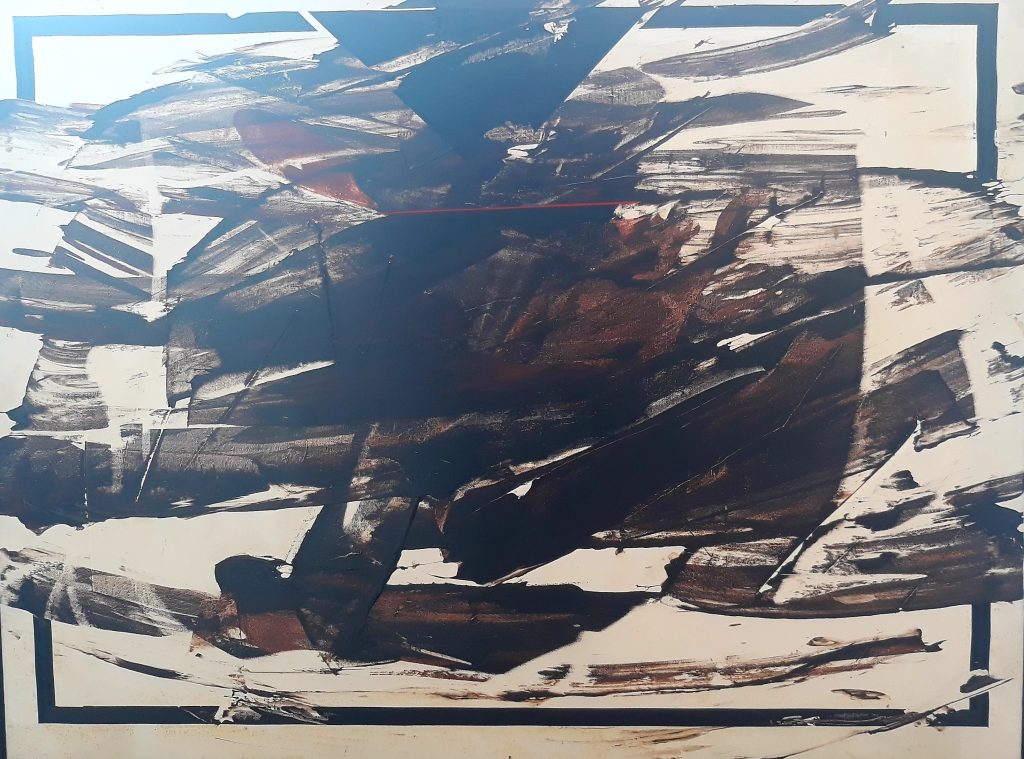
Luis Feito López
Untitled
Oil on canvas
75,5 x 100 cm
1988
Luis Feito López (1929-2021) was born in Madrid, Spain. After completing his studies at the prestigious San Fernando School of Fine Arts in Madrid, where he also taught, Feito moved to Paris in 1956. He spent nearly 25 years in the French capital, forming deep ties with the Spanish avant-garde.
Feito is best known for his transition from figurative art to lyrical abstraction. Early in his career, his work included figurative elements, but by the 1950s and 1960s, he shifted towards abstraction, becoming known for his expressive use of color and innovative material application. Feito’s signature style incorporated smooth surfaces layered with contrasting textures such as sand, which evolved in the 1960s into simpler forms, often using circular motifs influenced by Japanese art. As a founding member of the El Paso group, Feito sought to infuse Spanish art with a new spiritual dimension, reflecting a response to the moral and social challenges following the Spanish Civil War.
The artist has exhibited widely in solo and group shows, with notable exhibitions including The Sensuality of Color at Galeria Jordi Pascual in 2023, Feito-Saura. La pintura matérica at Havet Gallery in 2022, and Abstract View at Galeria Jordi Pascual in 2021. His work has been featured in international group exhibitions such as Paris 1940-1980. City in Movement (2024) and Great Maesters (2024) at Aurora Vigil-Escalera Art Gallery. Feito’s presence extends to prestigious art fairs, including Artelandia Gallery at ESTAMPA Madrid 2024 and Galeria Jordi Pascual at BRAFA 2024.
The artist has also participated in several renowned international exhibitions, including the Venice Biennale (1956, 1958, 1960, 1968), the São Paulo Biennial (1957, 1963), and Documenta Kassel (1959). Retrospectives of his work have been held at Galerie Arnaud in Paris (1961), the Hamburg Museum (1964), and the Museo Nacional Centro de Arte Reina Sofía in Madrid (1998). Feito’s works are included in prestigious museum collections worldwide, such as the Guggenheim Museum in New York and the Museo Nacional Centro de Arte Reina Sofía, ensuring his continued influence on Spanish contemporary art and his enduring legacy.
The oil on canvas painting by Luis Feito López, with its black background and bold, sweeping strokes, exemplifies his ongoing exploration of abstract expressionism. The raw, unstructured energy of the piece reflects the artist’s deep engagement with the El Paso group’s ideals, pushing the boundaries of form and structure. Feito’s signature style, grounded in his commitment to abstraction, is further revealed through this work’s diffuse geometry and visual tension. It is a meditation on the interplay between chaos and control, a theme central to his artistic journey as he continued to refine his unique language of abstraction.
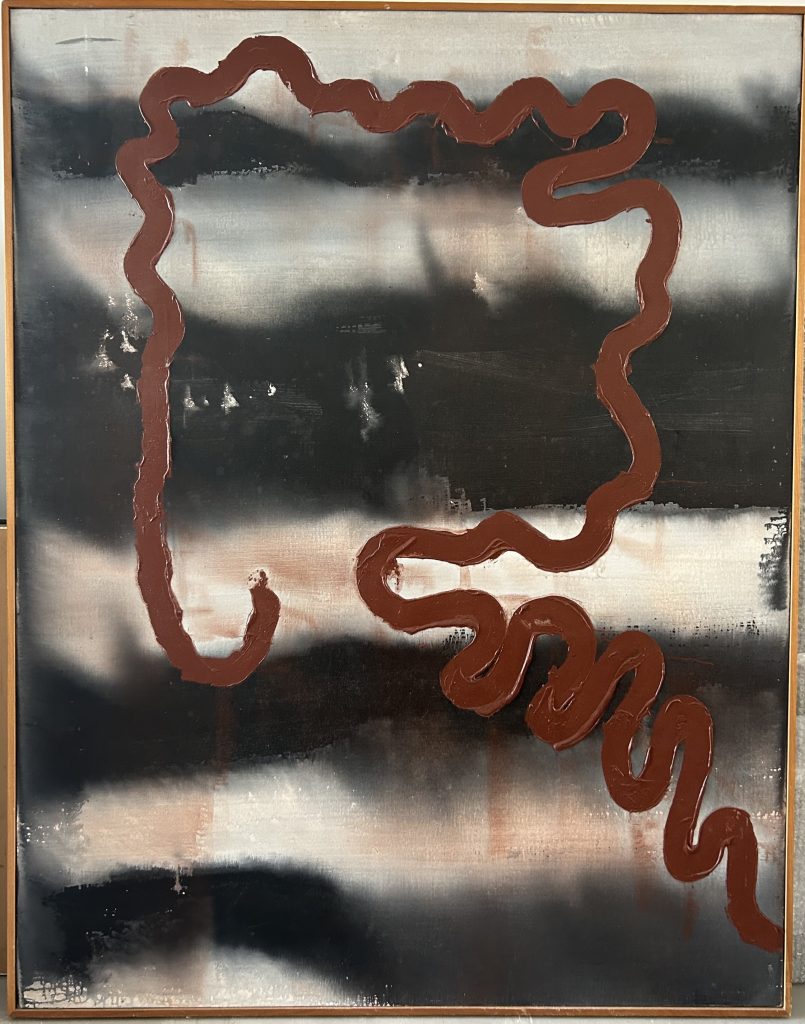
José Manuel Broto
Abstract Painting
Mixed media on canvas
146 x 114 cm
1988
José Manuel Broto Gimeno (1949) born in Zaragoza, Spain, is a highly influential contemporary artist known for his pioneering work in abstract art. He began his formal studies at the Escuela de Artes y Oficios de Zaragoza, where his artistic ambitions took root. In 1972, he moved to Barcelona, where he co-founded the Grupo Trama, an artist collective with roots in Marxism and psychoanalysis. The group drew inspiration from the French Suport Surface movement and brought theoretical depth to Broto’s work, pushing him to articulate and defend his artistic vision more assertively.
The artist’s work embodies a vibrant, intellectual approach to abstraction, with color as a central element to provoke emotional responses. His technique includes broad, irregular brushstrokes and occasional dripping effects, which add layers of spontaneity and experimentation. Geometric shapes frequently appear in his compositions, blending with expressive brushwork to create a dynamic sense of movement and emotion. Deeply influenced by music, Broto aims to evoke in his audience the same visceral reactions that music can inspire, using rhythm and melody as conceptual tools in his paintings.
Broto achieved international recognition with exhibitions in major cities like New York, Tokyo, Amsterdam, and Helsinki, and played a key role in advancing avant-garde painting through Grupo Trama. Highlights of his career include a 1996 retrospective at Madrid’s Museo Reina Sofía and the traveling show Broto. Rever (2004). He also participated in the Venice and Istanbul Biennials and exhibited at MACBA and the Museo Reina Sofía. Honored with awards such as the Gran Premio del Salon de Montrouge (1988), the Premio Nacional de Artes Plásticas (1995), and the Premio ARCO (1997), Broto remains a significant figure in contemporary art worldwide.
Abstract Painting by José Manuel Broto uses minimal elements to explore themes of movement, spontaneity, and structure—hallmarks of his work. Broto’s work often involves balancing order and spontaneity, and here, the lone black line feels like an act of restraint against the complex, pulsating background. This line’s journey across the painting may symbolize Broto’s own exploration of form and fluidity, bridging stability with the dynamic, sometimes unpredictable nature of abstract expression. The painting resonates with his broader artistic journey, where he continuously revisits themes of gesture, color, and space, evolving them into meditative yet powerful statements on abstraction.
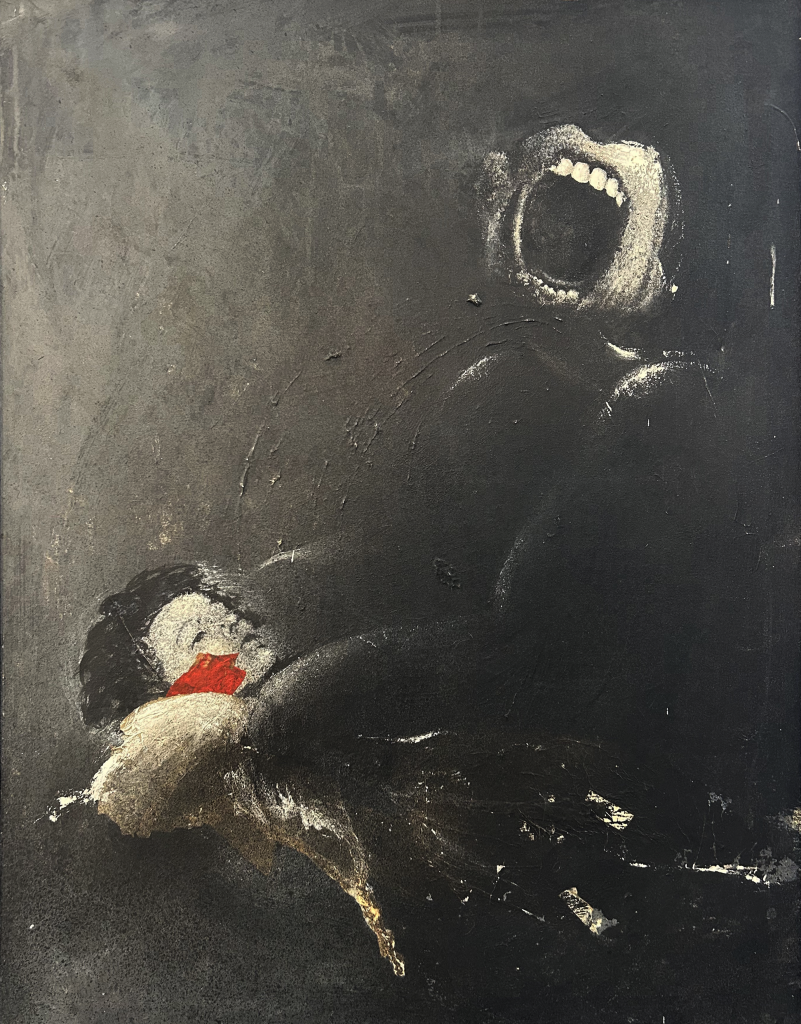
Francesc Genovés
Sarajevo suit
Mixed media on canvas
100 x 80 cm
1994
Francesc Genovés (1944–1995) was a Spanish artist whose career unfolded against the backdrop of the transformative 1960s. His life coincided with a period of global sociopolitical upheaval, which significantly influenced the themes and philosophies of his generation. Genovés’s work is marked by an exploration of existential ideas, a reflection of the era’s redefinition of identity, morality, and societal structures.
Genovés drew from the dominant art movements of his time, particularly Minimalism and Existentialism. He engaged with themes of human emotion, the interplay between physical and spiritual boundaries, and the pursuit of meaning within abstract forms. His creations often resonated with the minimalist ethos of self-contained art, yet carried the emotional depth associated with artists like Francis Bacon and Alberto Giacometti. Genovés’s pieces subtly echoed the zeitgeist of 1960s radicalism while maintaining a unique, introspective perspective.
Exhibitions of Genovés’s work took place primarily in European galleries during his lifetime, though his legacy remains less documented than that of some of his contemporaries. His contributions, however, reflect the broader artistic evolution of the mid-20th century, aligning with the experimental and philosophical inquiries that defined the period.
Sarajevo Suit (1994, New York) by Francesc Genovés, offers a haunting reflection on the horrors of human suffering and the pervasive trauma of war. Created during a period of intense global unrest, particularly the Bosnian War (1992–1995), channels the emotional devastation and helplessness that conflict imposes on individuals. It evokes the unsettling experience of sleep paralysis, where a figure lies immobilized, seemingly trapped in a nightmare. The dark, empty background intensifies the sense of isolation, while the distorted face—its mouth open in a silent scream—becomes a personification of anguish and dread. In Genovés’ broader artistic career, this work aligns with his exploration of existential themes and the human condition. Known for his ability to convey deep emotional and social commentary through his art, Genovés frequently employs stark imagery to confront viewers with uncomfortable truths. Through this piece, Genovés not only documents a moment of history but also transforms it into a timeless exploration of vulnerability, resilience, and the enduring scars of conflict.
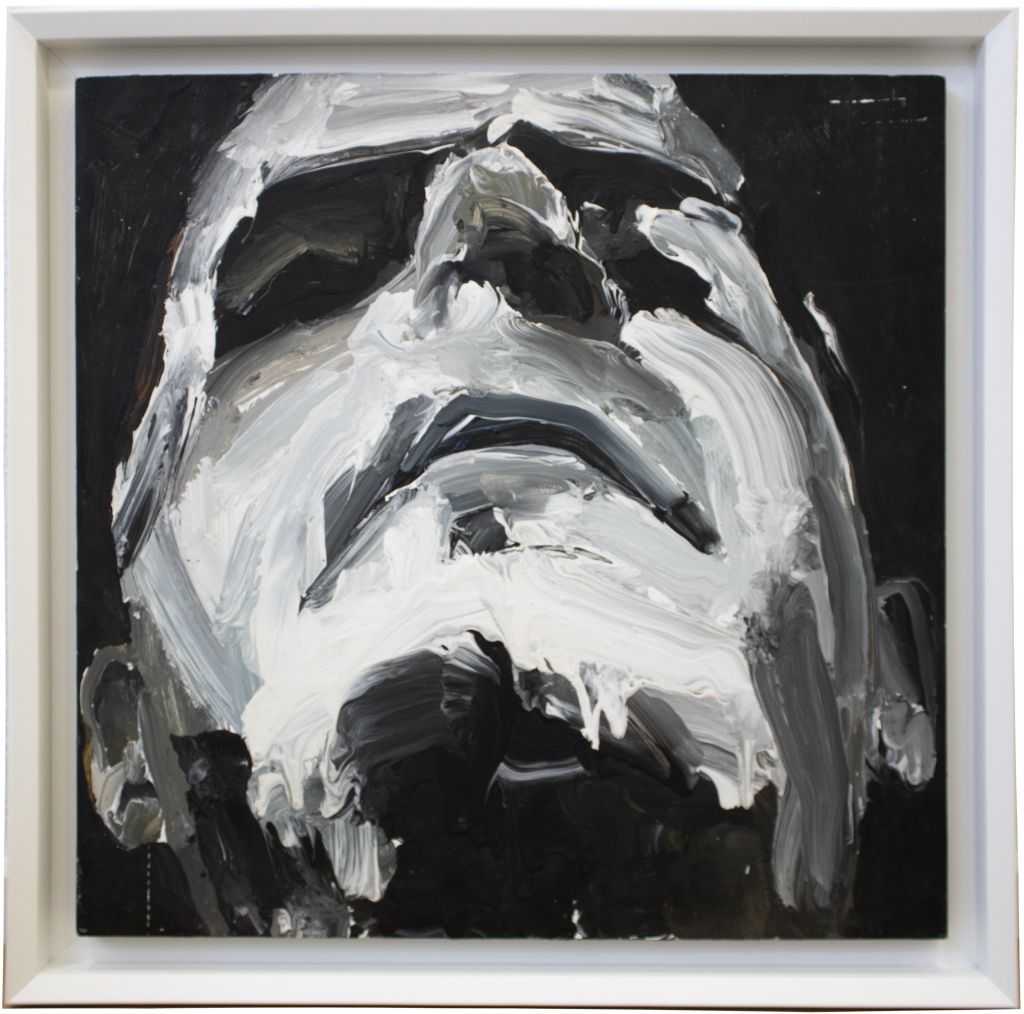
Santiago Ydáñez
Untitled
Acrylic on board
60 x 60 cm
2002
Santiago Ydáñez (1967) born in Jaén, Spain, is a renowned painter celebrated for his expressive approach to the human figure. He studied Fine Arts at the University of Granada, where his interest in painting began to flourish. He has been awarded scholarships from institutions such as the Spanish College in Paris and the Botín Foundation, which have helped support his development and career.
The artist is known for his distinctive style, which combines gestural, quick brushstrokes with a vibrant and emotionally charged color palette. His work explores themes related to the human figure, addressing aspects such as spirituality, carnality, and human passions. This exploration of the human form is presented in both portraits and still lifes, where he merges the natural world with deep emotional resonance. His work conveys strength, movement, and vitality, and he often incorporates textures and color choices inspired by his personal experiences and surroundings. This innovative approach allows Ydáñez to capture both the physical and emotional dimensions of his subjects, making his work both dynamic and introspective.
Ydáñez has been a prolific painter for over two decades, earning international recognition through awards such as the ABC Prize for Painting and the 33rd BMW Painting Prize. His works have been showcased in prestigious venues worldwide, including the CAC Málaga, Museo de Huelva (2006), Fundación Rodríguez Acosta in Granada (2010), the Künstlerhaus Bethanien in Berlin, and the Whitebox Art Center in Beijing (2019). Highlights of his career include solo exhibitions such as To Walk-Kill The Silence at Invaliden1 in Berlin (2007), Himmelfahrt at Galería Invaliden1 in Berlin (2010), and Myself & Others at Dillon Gallery in New York (2015). Group shows like ECOS at Santander Art Gallery (2019), Schmutziger Schnee in Berlin (2013), and CAAC in Sevilla (2014) further solidified his position in the art world. Additional significant exhibitions include Las cenizas del ruiseñor at Museo Lázaro Galdiano in Madrid (2015) and Birds at Dillon Gallery in New York (2015).
The painting captures Santiago Ydáñez’s profound fascination with the complexity of facial expressions and the raw intensity of human emotion. With his gestural and energetic technique, Ydáñez creates a portrait that goes beyond simple representation, offering an intimate exploration into the psychological depth of the subject. The dramatic interplay of deep blacks and nuanced grays enhances the sense of contrast and tension, while the subject’s posture adds a layer of mystery and introspection. These elements, recurring throughout Ydáñez’s work, invite the viewer to engage with the emotional and psychological undercurrents that inform the painting, creating a compelling connection between the subject and the viewer. Through this evocative approach, Ydáñez delves into the essence of human expression, using the portrait not just as a likeness, but as a powerful narrative of inner turmoil and reflection.
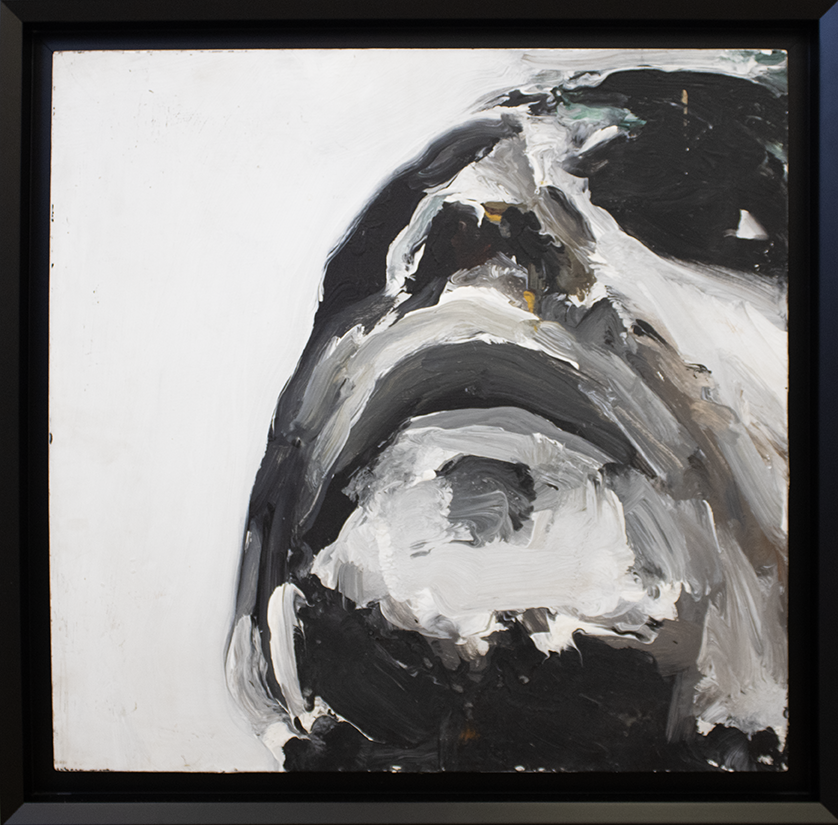
Santiago Ydáñez
Untitled
Acrylic on board
60 x 60 cm
2002
The work stands as a testament to Santiago Ydáñez’s evolving exploration of the human figure as a profound vehicle for expressing universal emotions. Through the use of soft gray tones, applied with his signature gestural technique, Ydáñez creates an ethereal, almost otherworldly atmosphere that invites deep contemplation. The subtle, fluid application of paint allows the viewer to engage with the work not just visually, but emotionally, as the human form becomes a conduit for complex, universal feelings. Ydáñez transcends the purely aesthetic, creating a visual experience that challenges the viewer to reflect on the psychological and emotional dimensions of the work, fostering a sense of connection that goes beyond the surface.
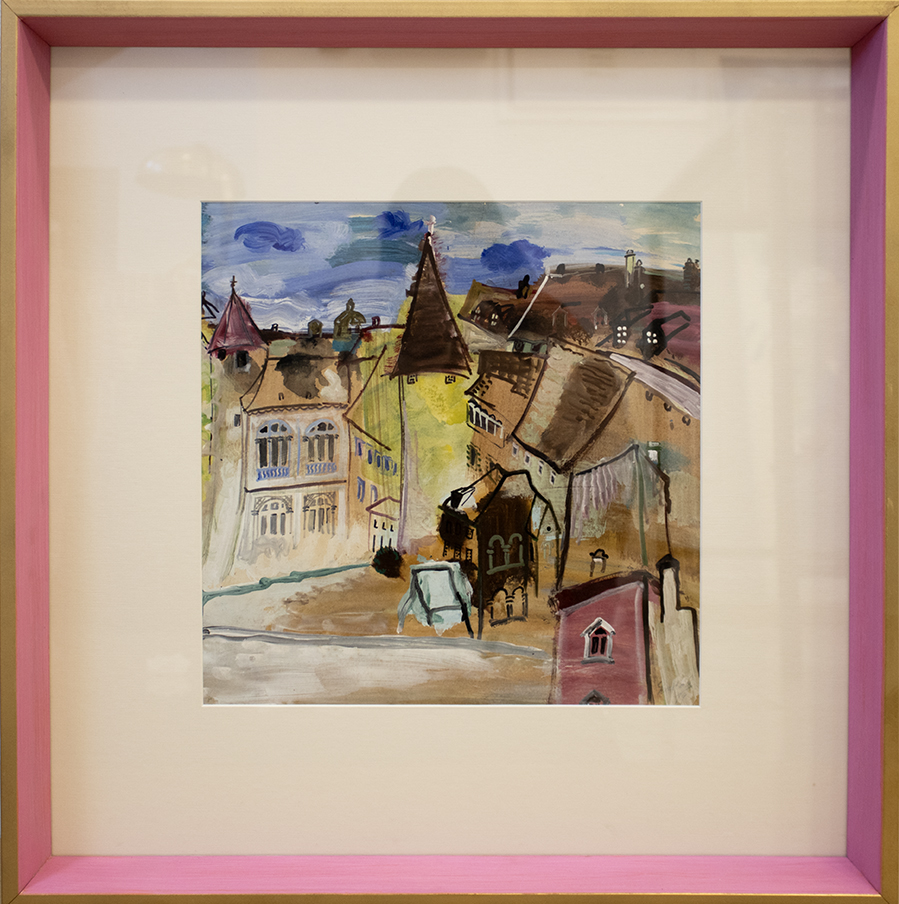
Carlos Nadal Ferreres
Untitled
Acrylic on paper
32 x 32 cm
Carlos Nadal Ferreres (1917-1998) was born in Paris to a family of Spanish origin. He grew up in a creative environment and began working as an apprentice in his father’s decorative painting workshop, which laid the foundation for his artistic training. He studied at the School of Arts and Crafts and the Academy of Fine Arts of San Jorge in Barcelona. Nadal’s personal experiences, including his service in the Republican army during the Spanish Civil War and his subsequent imprisonment, profoundly influenced his artistic development.
He was a painter who developed a post-impressionist style that merged the influence of the Impressionists with a strong emotional and expressive quality. Throughout his career, his work reflected an artistic evolution that not only retained the technique of his predecessors but also innovated it through a freer and more spontaneous approach, characterized by the use of vibrant colors and loose brushstrokes. His work embodies the shifts in 20th-century art, showcasing how post-impressionism and fauvism opened new ways of experiencing light, color, and form. Recurrent themes in his work included landscapes, everyday scenes, and human figures, always with a strong focus on conveying emotions and sensations through color and texture.
In recent years, Carlos Nadal has maintained strong demand in the art market, with an 82% auction sell-through rate and works surpassing estimates, including sales up to $27,000. His record price of $91,163 was set at Christie’s London in 2019. Nadal’s work continues to be featured in major exhibitions at leading galleries and museums, most recently The Joy of Living (Galeria Jordi Pascual, 2023) and Gallery Painters 1877–1950 (Sala Parés, 2024), reaffirming his lasting significance in Impressionist and Modern art.
The acrylic on paper painting representing an urban landscape is a recurring theme in Nadal’s oeuvre, inspired by his experiences in various cities and his cosmopolitan lifestyle. The painting’s minimal detail and use of simple strokes demonstrates Nadal’s tendency towards simplification and abstraction, a technique likely influenced by modern artists like Henri Matisse and Raoul Dufy. This approach allows to focus on the overall impression and atmosphere. This painting embodies Nadal’s artistic philosophy: a vibrant, colorful interpretation of life, filtered through the lens of Fauvism and his personal experiences, capturing the energy and spirit of urban life with expressive, well-placed strokes.
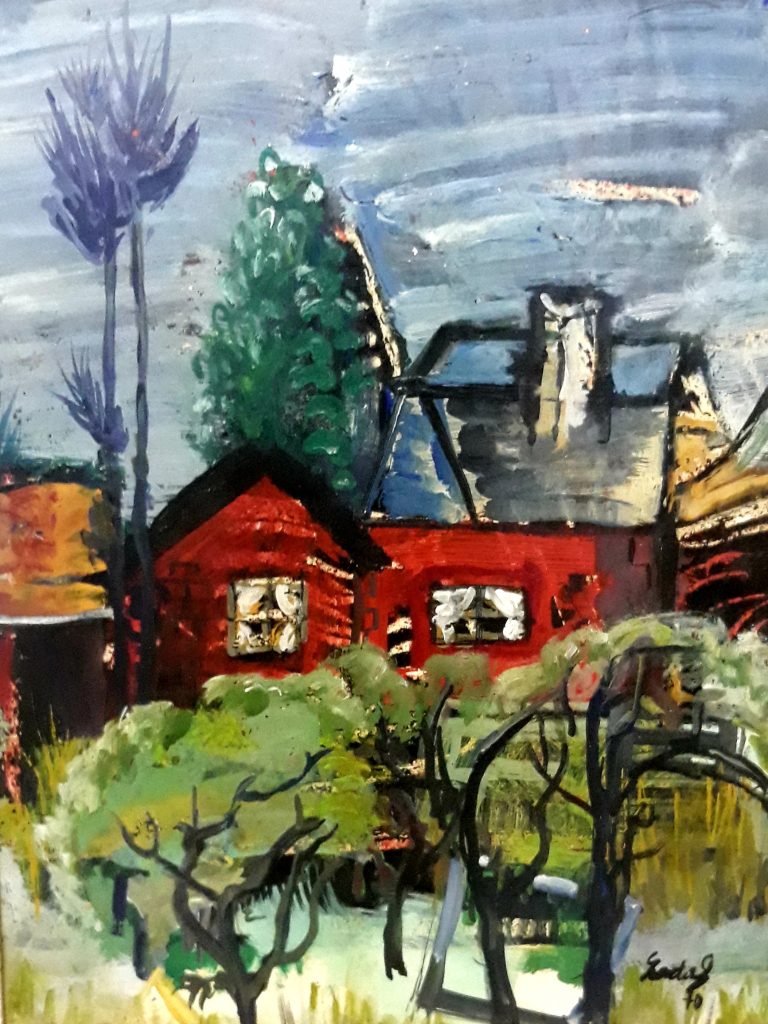
Carlos Nadal Ferreres
Serenity
Oil on board
44 x 35 cm
1970
Serenity (1970) is a representative work of Carlos Nadal’s post-impressionist style, created on a period marked by great artistic innovation. Through his use of color and fluid brushstrokes, he creates a sense of calm and reflection that invites the viewer to a unique sensory experience. The work not only reflects the artistic context of its time but also exemplifies the shift toward greater expressive freedom in 20th-century painting.
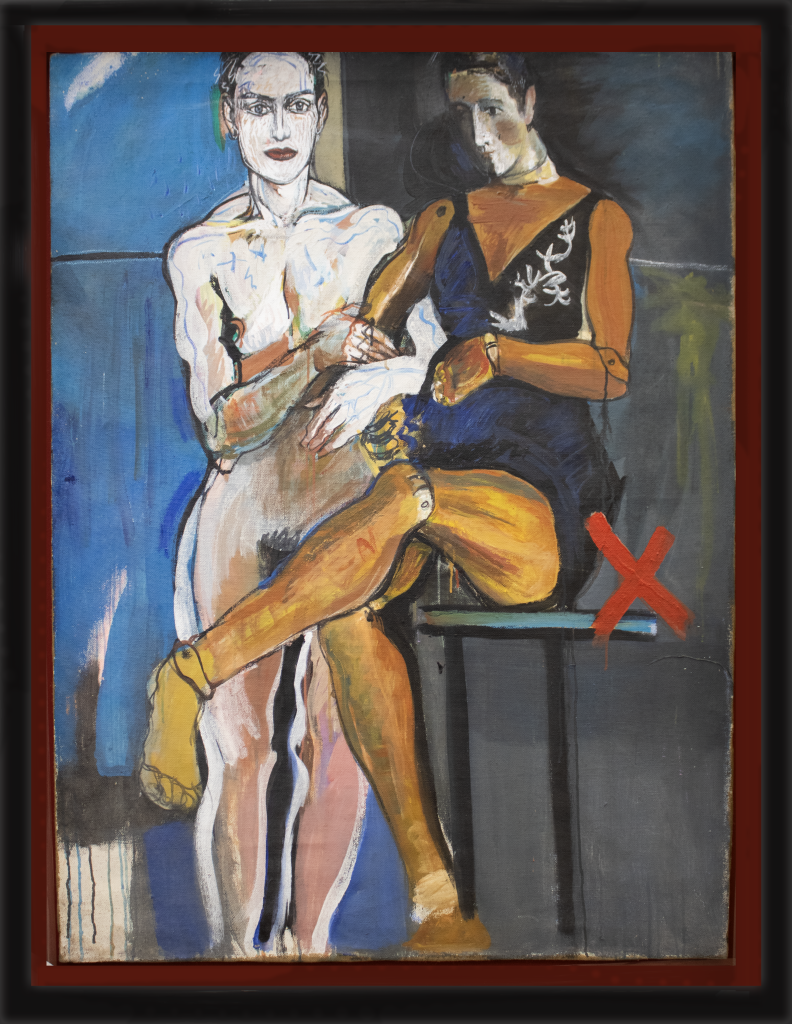
Alejandro Ortiz Cabria
Untitled
Oil on canvas
130 x 97 cm
This oil on canvas by Alejandro Ortiz Cabri presents an intriguing and provocative scene that invites reflection. The contrast between the vulnerability of the human figure and the inanimate nature of the doll raises questions about the nature of emotional connection and the inherent loneliness of the human condition.
The brush strokes are loose and swift, imparting a vibrant energy to the work, while the color palette unfolds in a variety that enhances the sense of movement and emotion. The red cross on the side adds an element of mystery, suggesting a symbolic background that invites diverse interpretations regarding suffering, redemption, or the search for identity.
This painting resembles works of expressionism, where emotion and personal perception take precedence over literal representation. It is a piece that not only adorns but also provokes dialogue and reflection, perfect for those seeking art that challenges and enriches their space. Undoubtedly, it will be a focal point that attracts the attention and curiosity of all who gaze upon it.
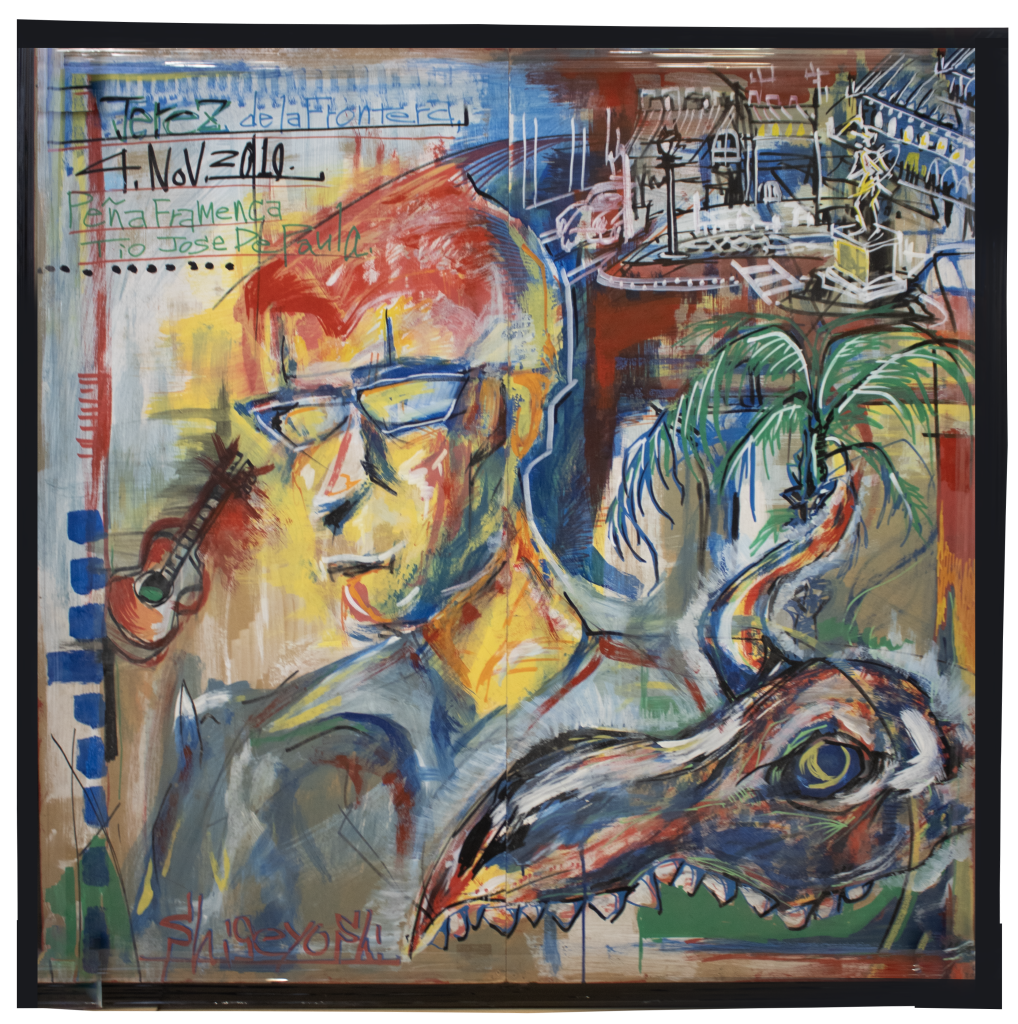
Shigeyoshi
Untitled
Acrylic on board
120 x 60 cm
Shigeyoshi’s painting is a vibrant representation of the rich flamenco culture of Jerez de la Frontera, capturing the essence of the legendary Peña Flamenca Tío José de Paula. Dated November 4, 2010, the artwork blends iconic elements of flamenco and Jerez’s identity into a surreal and evocative composition.
This artwork is a vibrant, expressive acrylic piece with a chaotic yet compelling composition. It features a central figure, likely a portrait of a man wearing glasses, rendered in bold, angular brushstrokes with shades of red, yellow, blue, and green. To the left, there is a small red guitar, hinting at a musical theme. The background is layered and abstract, with elements suggesting a coastal or urban landscape, including a plaza with a statue, palm trees, and winding paths.
In the lower right, a striking, almost surrealistic creature or animal head emerges, with an exaggerated eye and sharp teeth, blending into the abstract surroundings. The piece conveys intense energy and emotion through its jagged lines, bold colors, and overlapping forms. There are also handwritten texts and dates at the top left, adding a personal or narrative dimension. The overall impression is one of dynamic, almost dreamlike storytelling, combining portraiture, surrealism, and abstract expressionism.
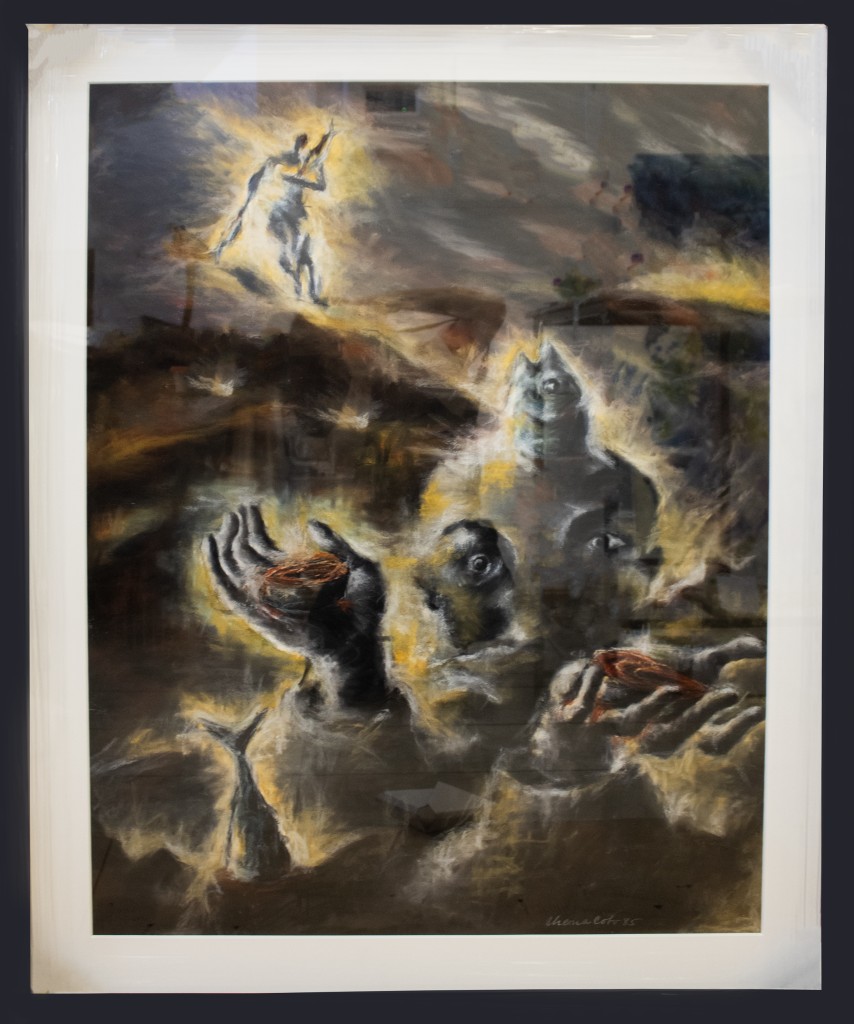
Chema Cobo
Untitled
Pastel on paper
92 x 72 cm
1985
Chema Cobo (1952-2023) was born in Tarifa, Cádiz. He was a leading figure in contemporary Spanish art, known for his innovative style that evolved over decades. His artistic career took off with his first solo exhibition in 1975 at the Buades Gallery in Madrid, and he would go on to participate in major international exhibitions. His contributions to art were also recognized through his role as a visiting professor at prominent institutions such as the School of Art Institute of Chicago and the NY Art School in New York.
Cobo’s work is characterized by a unique fusion of conceptual art and painting. His use of recurring symbols, such as jesters, parrots, and chameleons, allowed him to explore complex ideas and invite viewers to question perspectives and meanings. In the 1980s, he distanced himself from his earlier influences and began to connect with international artistic movements such as Neo-Expressionism and Trans-avant-garde . His work was marked by a constant pursuit of new visual languages and metaphors, blending personal reflection with broader cultural commentary.
The artist’s work has been featured in a wide array of exhibitions worldwide. Notably, he exhibited at The Mezzanine Gallery of the Metropolitan Museum of Art in New York (1987), the Andalusian Center for Contemporary Art in Seville (1998), and the Contemporary Art Center of Málaga (2009). Significant international events includes the XVI São Paulo Biennial and the Carnegie International in Pittsburgh. Cobo’s works are part of major collections at prestigious museums such as the Metropolitan Museum of Art, MoMA in New York, and the Museo Nacional Centro de Arte Reina Sofía in Madrid, solidifying his place in contemporary art history. Throughout his career, Cobo received numerous accolades, including the Andalusia Prize for Plastic Arts in 1994 and the Francisco de Goya Painting Prize from the Villa de Madrid in 2009.
In Chema Cobo’s artwork, made in 1985, pastel technique allows for a striking interplay of texture, light, and shadow, which breathes life into the figures and their dynamic interactions. The high contrast of black and yellowish tones speaks to the artist’s mastery of contrasting emotions and energy. This technique aligns with Cobos’ broader focus on the human form and relationships, often exploring tension and intimacy. His work invites viewers to connect with the rawness of human experience, capturing fleeting moments with both softness and intensity.
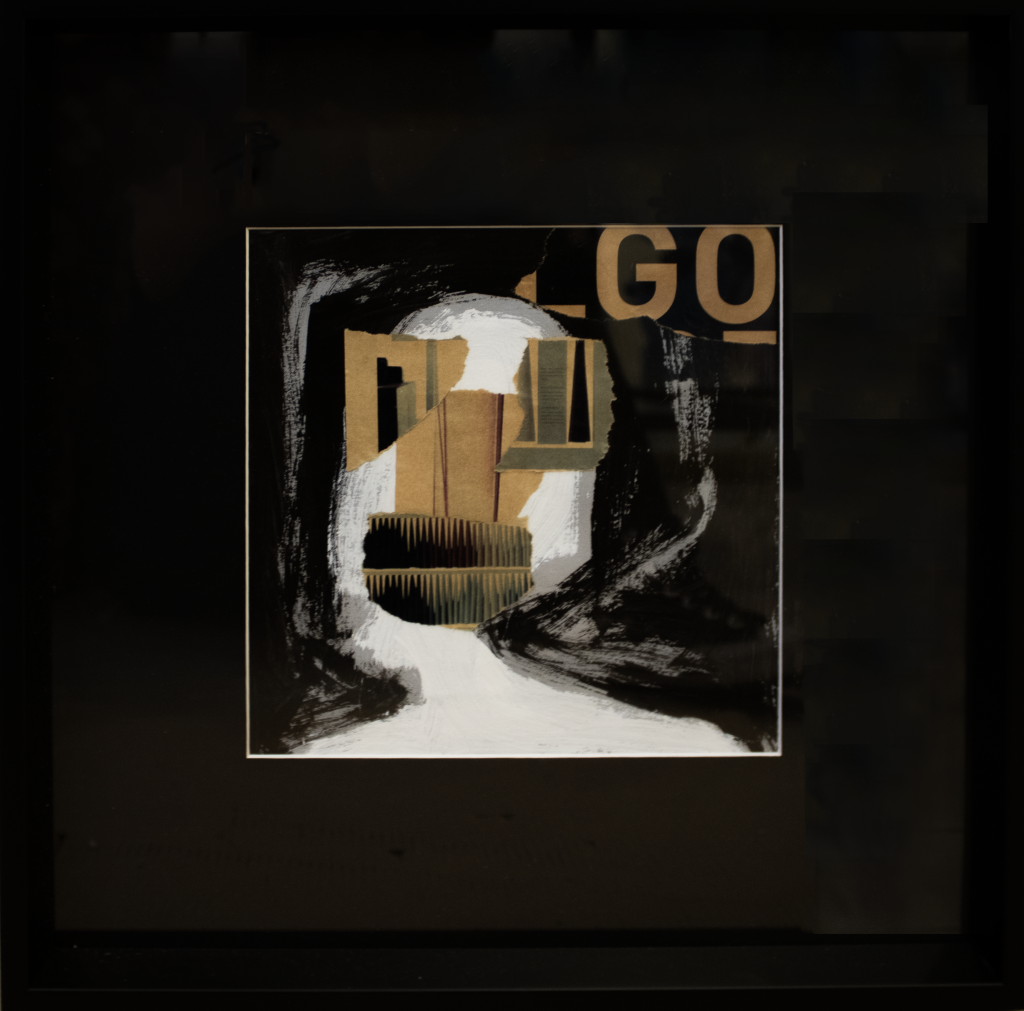
Yann Leto
Delicate moments
Mixed media on paper
21 x 21 cm
2005
Yann Leto (1979) was born in Bordeaux, France, and currently resides and works in Madrid, Spain. He has exhibited in several renowned galleries across cities such as London, Los Angeles, Naples, and Zaragoza. Leto received a scholarship to attend the Royal Spanish Academy in Rome for the 2015-2016 period, which contributed to his development as an artist.
Leto’s artistic practice challenges traditional boundaries, often creating pieces that are both striking and controversial. His work is built on extensive research, gathering digital material from diverse sources, including Google images, press clippings, and articles. This material serves as the foundation for his visual collages, where he merges typographic elements with reinterpretations of classical paintings. His works often incorporate empty spaces in contrast with densely painted areas, which allows for a dynamic and provocative visual impact. The themes in his art revolve around modern societal concerns, particularly social unrest, and the repositioning of the human being in this context. His approach is free from conventional rules, creating a visual emotional cycle that invites deep reflection from the viewer.
Yann Leto’s works have been exhibited in notable galleries in various international cities, including London, Los Angeles, Naples, and Zaragoza. One of his controversial works, “Congress Topless,” gained significant attention at ARCO 2014, reflecting his willingness to engage with contentious topics. His exhibitions span across multiple prestigious platforms, and his artworks are part of a broader conversation on contemporary art that challenges both the medium and the messages conveyed.
Delicate moments (2005) by Yann Leto, one can observe his focus on the decomposition and reconstruction of the image. This collage method not only brings a unique texture to the work but also suggests an exploration of identity and perception. There is a kind of dialogue between form and content, which is a hallmark in Leto’s work, who often incorporates elements of pop culture and visual references that invite reflection. His influences can be traced to movements such as Dadaism and Surrealism, where the use of unconventional materials and the manipulation of meaning are fundamental. Through this work, Leto not only challenges the traditional form of painting but also invites the viewer to question the relationship between art, language, and social interaction.
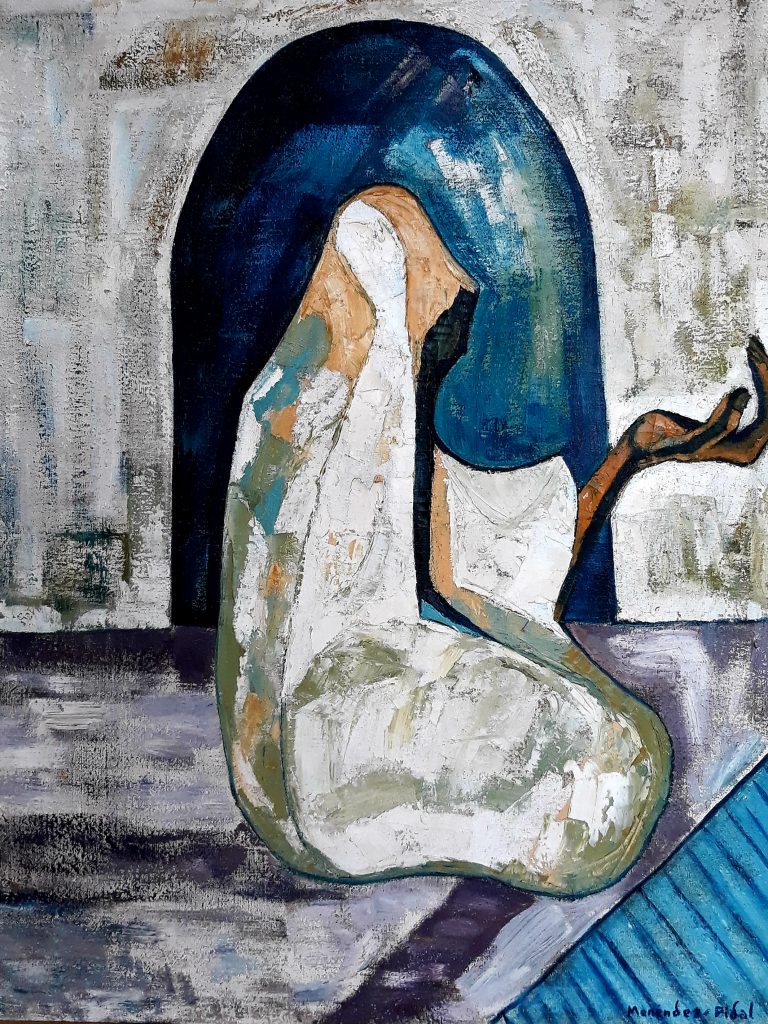
Luis Menéndez Pidal
Untitled
Oil on canvas
95 x 75 cm
Luis Menéndez Pidal (1861-1932) was born in Pajares, Asturias. He was a notable Spanish painter and educator with significant influence on Asturian and Spanish art during the late 19th and early 20th centuries. Menéndez Pidal pursued formal training at the Escuela de Bellas Artes de San Fernando in Madrid and continued his studies in Rome under prominent artists such as Francisco Pradilla. He later became a professor and influential figure in Spanish academic circles, teaching at the Escuela Superior de Artes Industriales and the Escuela de Artes y Oficios in Madrid.
The artist is known for his realist style, primarily focusing on genre painting and portraiture. His works often depict everyday life and human emotions, with an emphasis on rural customs and scenes. In addition to genre scenes, he explored religious themes, such as his well-known frescoes on the dome of the Chapel of San Francisco el Grande in Madrid. Menéndez Pidal’s realist approach reflects a blend of detailed human depictions with an often muted color palette, creating emotional depth.
His work has been showcased in numerous exhibitions, both in Spain and internationally. He earned prestigious awards, including medals at Spain’s National Exhibition of Fine Arts and a gold medal at the 1900 International Exposition in Munich. Some of his notable works, such as Salus infirmorum and Un éxtasis de San Francisco, remain on display at institutions like the Museo del Prado.
Luis Menéndez Pidal’s artistic prowess shines through in this exemplary work, which epitomizes his signature style of portraying solitary figures or individuals in their everyday environments. The painting masterfully evokes a sense of introspection and contemplation, drawing viewers into a moment of quiet reflection. By sweeping applications of paint, Menéndez Pidal was able to suggest form and presence with remarkable efficiency. The palette knife enabled him to blend colors directly on the canvas, creating smooth transitions that convey the simplicity and stillness of this scene.
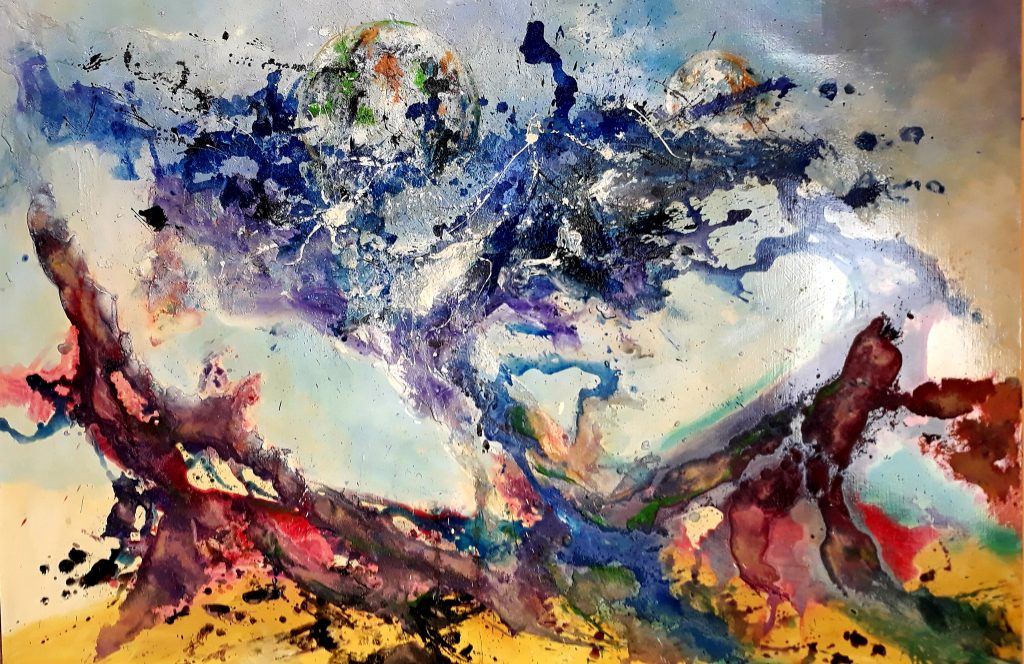
Ángel Jurado
Abstraction
Mixed media on canvas
135 x 185 cm
Ángel Jurado (1944) is a contemporary Spanish artist renowned for his exploration of abstraction art and his ability to convey the essence of nature through oil painting. Over the years, Jurado has made significant contributions to the Spanish art scene, using abstraction to evoke emotional responses and reflections from his audience.
The artist work is a contemplation of nature, often focusing on the beauty found in everyday subjects. His approach blends realism with abstraction, creating a distinctive visual language and layers of deeper meaning. Through his paintings, Jurado invites the viewer to reflect on the transience of life and the emotional power of nature.
Ángel Jurado’s work has been exhibited in several important galleries and museums, both in Spain and internationally. Notably, his art has been showcased at the Galería de Arte Moderno in Barcelona, the Modern Art Center, and the Museum of Abstract Art. His ability to evoke emotions and contemplative reflections through his art has made him a significant figure in contemporary Spanish abstraction, contributing to the ongoing dialogue in the art world.
Abstraction by Ángel Jurado embodies a visceral exploration of energy and emotion, reflecting his deep engagement with abstract expressionism. The explosive mix of colors, amplified by a textured surface—possibly enhanced with sand—creates a dynamic interaction between form and material. This tactile approach to painting mirrors Jurado’s broader career, where his works often emphasize the physicality of paint and its emotional charge. It suggests a rupture of restraint, capturing a moment where chaotic energy breaks through, echoing the internal struggles and bursts of creativity that Jurado continuously delves into in his art.
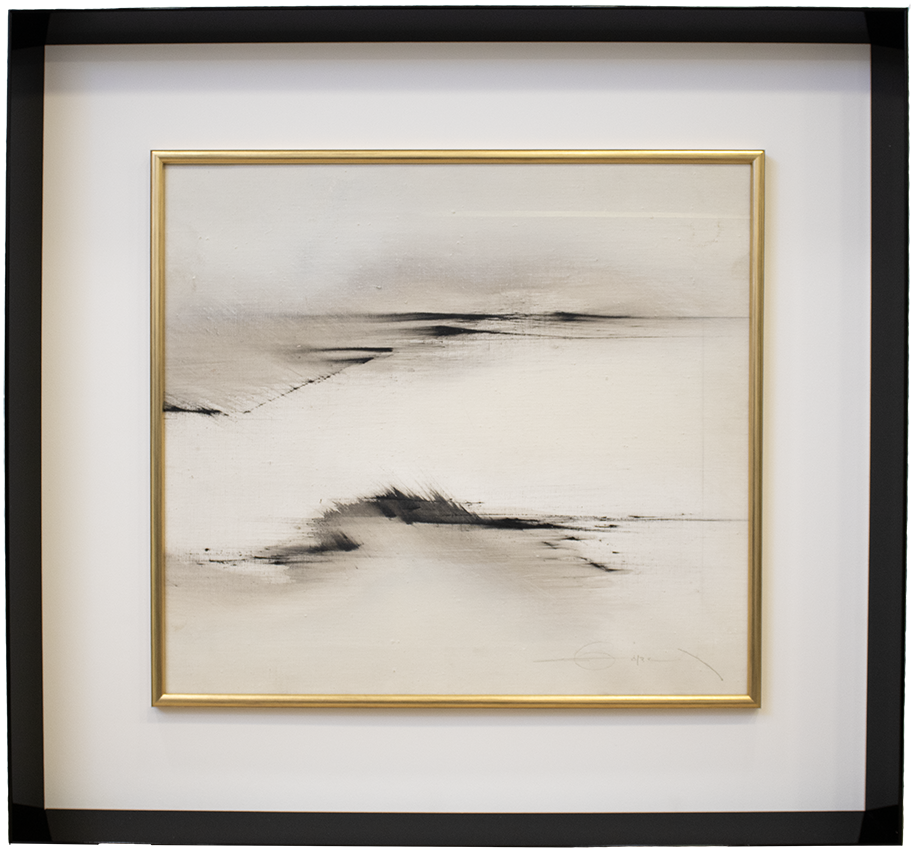
Fernando Zóbel
Untitled
Oil on canvas
45 x 48 cm
Fernando Zóbel (1924-1984) was a Spanish painter, art collector, and philanthropist of Filipino descent. He studied at Harvard University, where his exposure to American abstract expressionism began to shape his artistic career. Zóbel’s influence on contemporary Spanish art is immense, particularly through his founding of the Museo de Arte Abstracto Español in Cuenca in 1966, which became one of Spain’s most important cultural institutions. He is recognized not only for his artistic achievements but also for his role in the development of Spain’s modern art scene.
The artist´s approach combines abstract expressionism with influences from Eastern philosophy and calligraphy, which formed his meditative, delicate style. His works are marked by minimalistic lines and a sense of balance and serenity, often evoking contemplation rather than pure emotion. Zóbel’s paintings are an exploration of abstraction that transcends formal technique to achieve a kind of refined stillness and beauty. The simplicity and elegance in his work reflect a blend of Western modernist influence and Eastern aesthetic principles, distinguishing him as a key figure in contemporary Spanish art.
Fernando Zóbel’s work has been exhibited and auctioned by major institutions like Christie’s and Sotheby’s. He participated in key exhibitions such as the Venice Biennale (1962), Before Picasso, After Miró at the Guggenheim (1960), and Modern Spanish Painting at the Tate (1962). After moving to Spain in 1959, he exhibited regularly at Galería Biosca, Juana Mordó, Bertha Schaefer Gallery (New York), and Galerie Jacob (Paris). He held a solo show at Museo Reina Sofía and was featured in group exhibitions at Museo Tamayo, the Guggenheim Bilbao, and MoMA. Zóbel also founded the Museo de Arte Abstracto Español (1966) and the Ayala Museum (1967). His legacy is vital to modern art in Spain and the Philippines.
The oil on canvas composition by Fernando Zóbel reflects his lifelong pursuit of abstraction infused with contemplative simplicity. Zóbel, profoundly influenced by Eastern calligraphy and Zen philosophy, often sought to capture the essence of landscapes with minimal elements. This work’s restrained lines and diffused shadows are signature techniques he developed over time, evolving from representational to non-representational forms. In his career, Zóbel moved from earlier figurative works towards abstraction, where he began using calligraphic techniques to create “landscapes of the mind” rather than direct visual depictions. This approach aligned with his interest in Eastern aesthetics, emphasizing balance, restraint, and the beauty of empty space. The soft, light-brown background, combined with the simplicity of two dark lines, embodies his philosophy of silence and subtlety, capturing nature’s quietude without conventional representation.
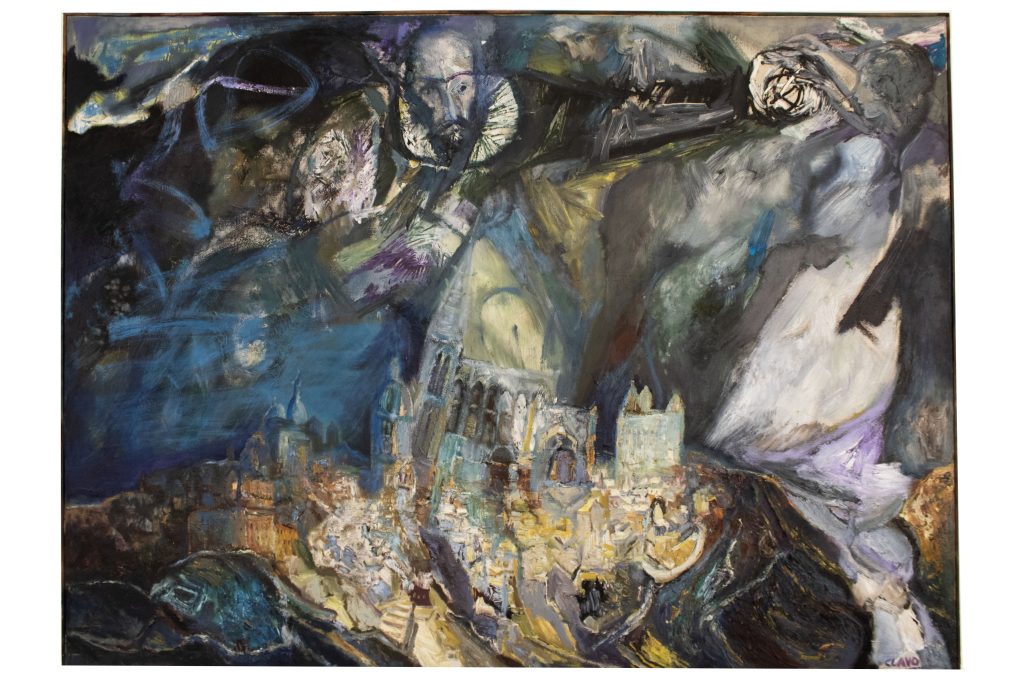
javier Clavo
Homage to El Greco
Oil on canvas
146 x 204 cm
Javier Clavo (1918-1994) was a Spanish artist born in Madrid. Throughout his career, Clavo studied under notable figures such as Daniel Vázquez Díaz and was inspired by masters including Goya, Picasso, El Greco, Matisse, and Bonnard. His long career saw a wide array of artistic achievements, from his early years in Spain to his time studying fresco painting in Italy and later experimenting with abstract expressionism.
Clavo’s work is known for its vibrant color palette and emotional depth, often reflecting his personal interpretation of reality while retaining naturalistic elements. His themes were diverse, including dynamic bullfighting scenes, urban landscapes, nudes, and portraits. He is especially noted for his depictions of Toledo, blending historical architecture with winding streets in a style that combined expressionist and post-cubist influences. Clavo’s engagement with color was central to his expression, evoking intense emotions through his distinctive approach. In addition to painting, Clavo worked in sculpture, engraving, and fresco painting, showcasing his broad artistic abilities.
He exhibited widely during his career, including a major retrospective at the Centro Cultural de la Villa de Madrid in 1990, which showcased his diverse range of styles and techniques. His works are included in collections at prestigious institutions such as the Museo Reina Sofía in Madrid. Additionally, Clavo’s pieces have been featured in both private and public exhibitions, reflecting his influence on 20th-century Spanish art. His fresco paintings and experiments with different media gained recognition internationally, particularly during his time in Italy.
Homage to El Greco is a profound tribute to the master of Spanish Renaissance art and his enduring influence on Clavo’s work. Drawing inspiration from El Greco’s iconic style, Clavo reimagines the cityscape of Toledo—a place integral to both his own artistic journey and El Greco’s life—as a vibrant, almost otherworldly vision. His dynamic treatment of light seems to breathe life into the city, casting it in a glow that amplifies its almost ethereal presence. The expressive oil pastel strokes and vivid palette lend the work an emotional intensity. Buildings and structures seem to pulse and shift, creating an almost abstract yet recognizable portrait of the city, inviting the viewer to experience it through Clavo’s unique lens—a contemporary reimagining of the world that El Greco once captured so powerfully. Through this work, Clavo honors the legacy of El Greco, blending expressionism with the timeless spirit of the city and its historical significance.
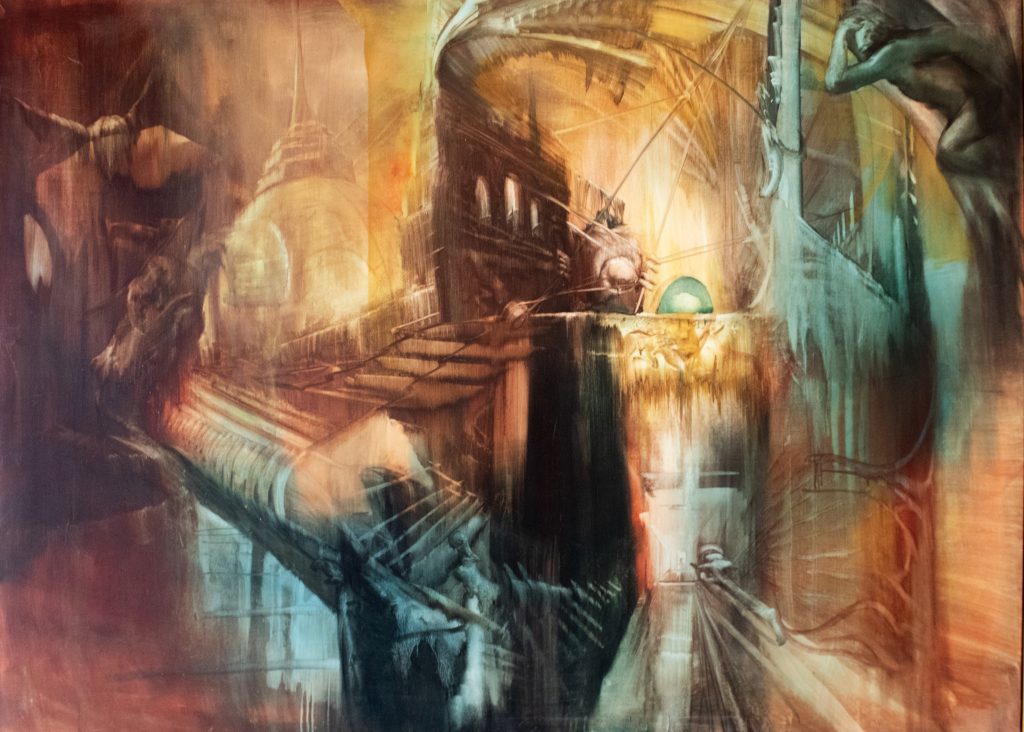
Javier Gil
Untitled
Oil on canvas
135 x 190 cm
The oil on canvas by Javier Gil exemplifies the Uruguayan artist’s ability to blend reality with imagination, creating a dreamlike urban landscape that challenges viewers’ perceptions. He often explores themes of cultural fusion, psychological landscapes, and urban complexity. Through his skillful composition and use of color to evoke mood, this fantasy city representation stands as a significant work in Gil’s oeuvre, embodying his artistic journey and his observations of urban environments across different cultures.
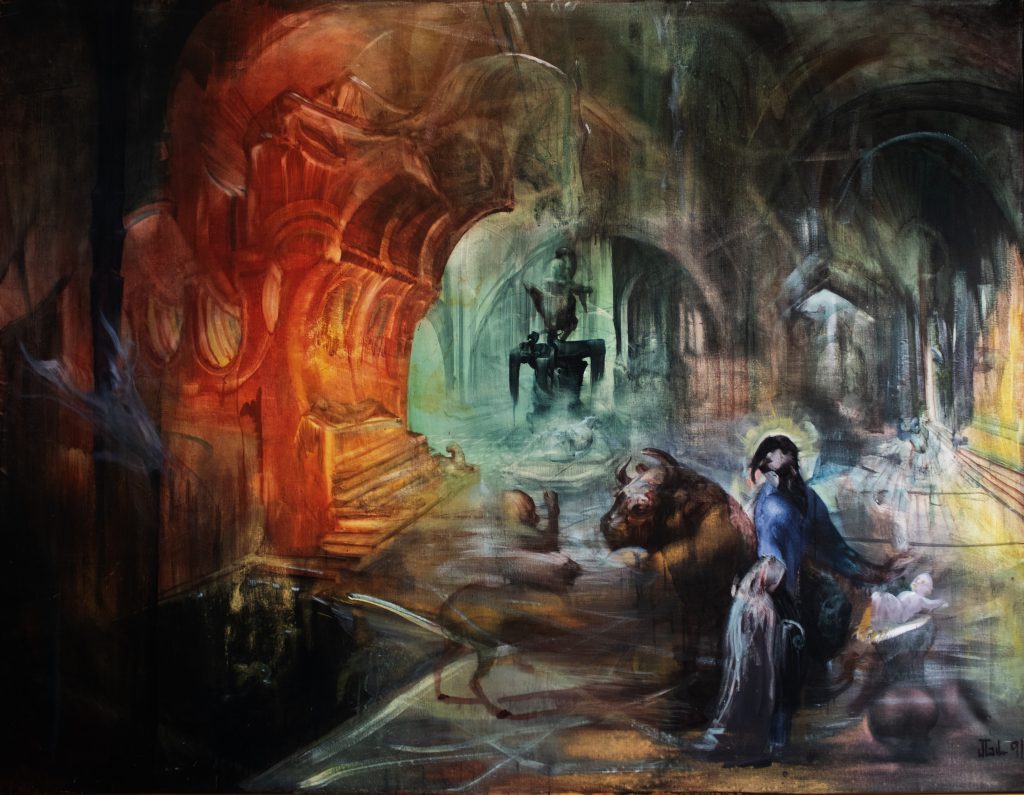
Javier Gil
Untitled
Oil on canvas
135 x 190 cm
The Baptism of Velarde by Javier Gil Pérez, is an evocative oil painting where Gil Pérez masterfully uses chiaroscuro to dramatize a transformative scene. Through controlled lighting, he crafts a profound atmosphere that highlights Velarde, who stands as a central figure undergoing a symbolic rebirth or initiation. Known for blending narrative with figurative and symbolic elements, Gil’s works often capture intense, introspective moments. This use of light and shadow not only shapes the composition but evokes the layered emotional complexity for which Gil is known, as he frequently invites viewers to engage with the psychological dimensions of his subjects. These recurring themes —such as baptisms, crossings, and awakenings— underscores Gil’s exploration of personal identity within historical or allegorical frameworks, which resonates with collectors who appreciate the juxtaposition of classical subjects with a contemporary sensibility.
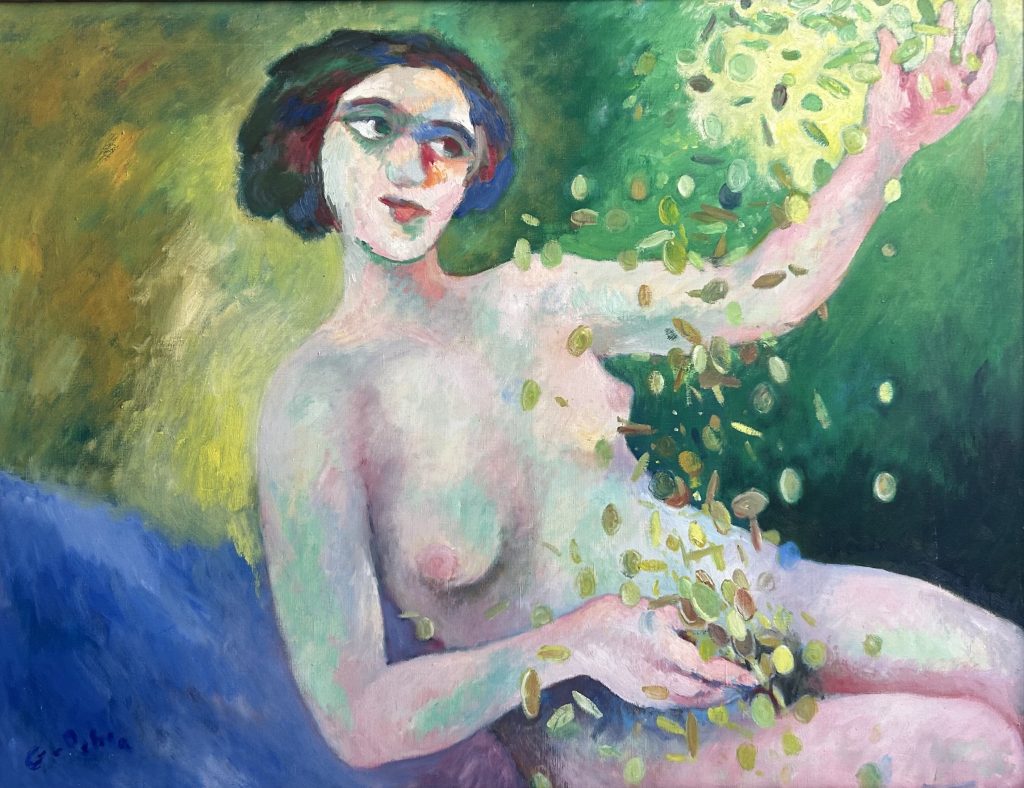
Luis García Ochoa
Danae
Oil on canvas
89 x 116 cm
Luis García-Ochoa Ibáñez (1920-2019) was born in San Sebastián and moved to Madrid during his childhood, where his artistic talent became evident at an early age. He studied at the prestigious Royal Academy of Fine Arts of San Fernando, combining his artistic education with early exposure to architecture, working in his father’s architectural studio. A key figure in the Madrid School in the 1940s and 1950s, García-Ochoa contributed to the post-Civil War artistic innovation in Spain.
His style evolved throughout his career. Initially influenced by cubism, he later transitioned to a more expressionist approach, characterized by vibrant compositions and a strong use of color. His work, marked by a powerful visual impact, reflects his constant search to convey emotion through form and color. As a prominent member of the Madrid School, García-Ochoa played a key role in the renewal of Spanish art after the Civil War, incorporating new influences and exploring universal themes. His work spanned both painting and engraving, allowing him to experiment with different techniques and media to express his artistic concerns.
He was a central figure in the Segunda Escuela de Vallecas under Benjamín Palencia, a group that later formed the foundation of the “Escuela de Madrid.” His style evolved from early cubism to a distinctive figurative expressionism. His work was recognized internationally with invitations to the Venice Biennial on four occasions (1940, 1950, 1952, 1954) and he frequently exhibited in Spain’s National Fine Arts Exhibitions. Beyond painting, he was a prolific engraver and book illustrator. In 1980, he was elected to the Real Academia de Bellas Artes de San Fernando and later founded the School of Figurative Painters of El Escorial in 1993. His works are held in major Spanish institutions, including the Museo Reina Sofía, the Bilbao Fine Arts Museum, and the Juan March Foundation.
Danae by Luis García-Ochoa is a powerful and evocative piece that depicts the female figure in an intimate and sensual context. Inspired by the myth of Danae, who was visited by Zeus in the form of a golden shower, the painting captures the moment of revelation and vulnerability of the protagonist. It addresses universal and mythical themes, adding great value for both collectors and institutions interested in Fauvism art. The painting is characterized by its ability to capture the emotional depth of the moment and the complexity of the human figure, elements that are central to García-Ochoa’s work.
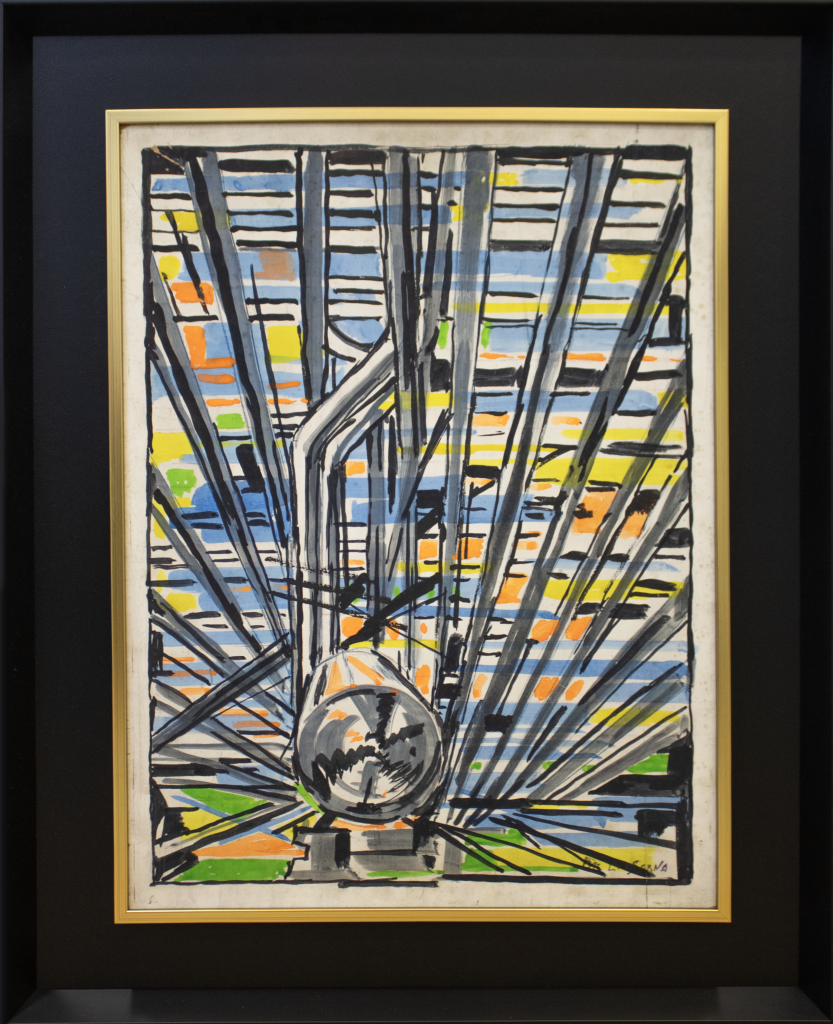
ismael de la Serna
Tunnel
Tempera on board
58 x 43 cm
1958
Ismael de la Serna (1898-1968) born in Guadix, Spain. He studied at the Academy of Fine Arts in Granada and later at the San Fernando School of Fine Arts in Madrid. The artist’s early work was influenced by Spanish intellectuals and artists, and his friendship with poet Federico García Lorca was particularly significant, as he illustrated Lorca’s first book, Impresiones y Paisajes, in 1918. González spent most of his life in Paris after 1921, where he became part of the avant-garde Spanish School of Paris and was influenced by Cubism, particularly through his relationships with artists like Pablo Picasso and Juan Gris.
De la Serna’s work evolved from neoclassical forms to a more Cubist style, influenced by Georges Braque and Pablo Picasso. While rooted in Cubism, his paintings remained unique due to his fondness for color, influenced by the French Impressionists like Cézanne and Pissarro. Over time, he moved toward more abstract forms, reducing images to their essence, often to a mere outline, exploring the core of the painting. His work reflects a blend of Cubism, Expressionism, and Surrealism, although he never fully aligned with any one movement, instead integrating elements that suited his artistic goals. He spent much of his later life focusing on finding “the essence and the ultimate goal of painting,” a journey that led him to increasingly minimalistic and abstract works.
The artist exhibited widely in the 1920s, with a major exhibition organized by art dealer Paul Guillaume. This exhibition led to notable showings at the Musée du Jeu de Paume in Paris in 1936 and at the Spanish Pavilion of the 1937 Paris International Exhibition. In the years following, he had successful solo exhibitions in cities such as Berlin and Mexico, and a retrospective at the Tate Gallery in London in 1963. His legacy was celebrated posthumously with a retrospective at the Museum of Modern Art in Paris in 1968.
Tunnel (1958) by Ismael González embodies his transition from his earlier Cubist influences towards a more abstract and introspective style that characterized his later years. The tunnel motif suggests a journey through time and space, possibly reflecting the artist’s own path from his Spanish roots to his life in Paris, where he was exposed to various artistic movements. This artwork can be seen as a visual representation of de la Serna’s artistic philosophy, encapsulating his search for the fundamental essence of painting. Through the metaphor of a tunnel, he invites viewers to embark on their own journey of introspection and discovery, mirroring his own artistic exploration.
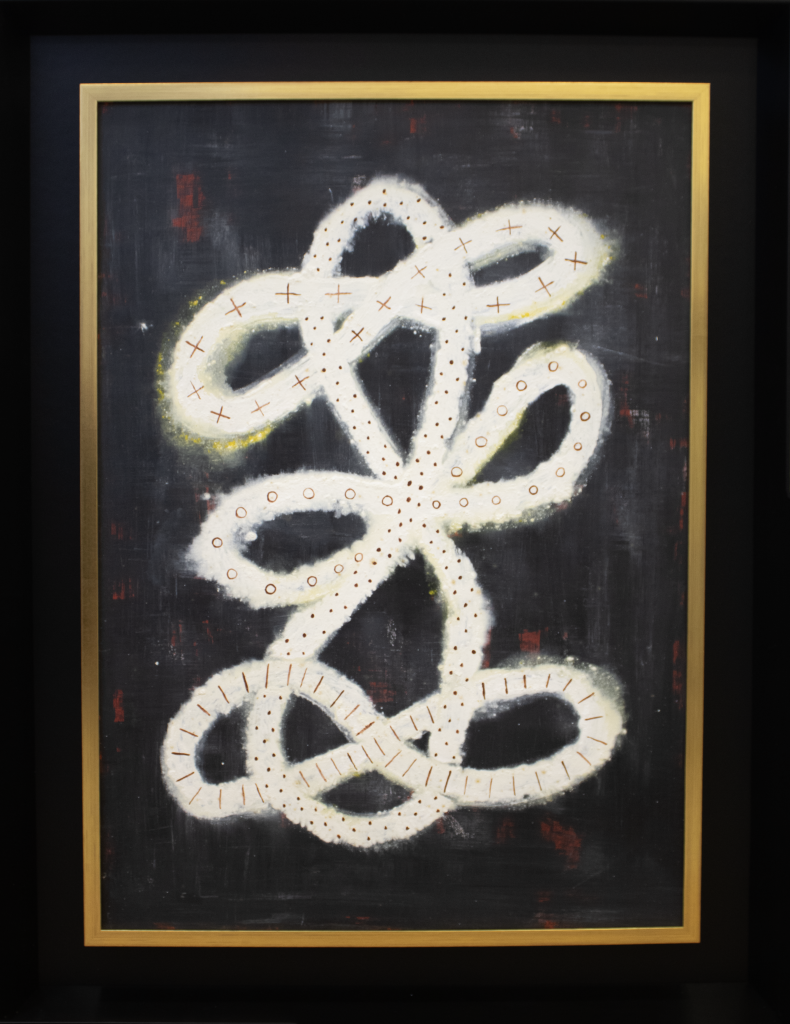
Ferran García Sevilla
Untitled
Mixed media on carton
75 x 53 cm
1989
erran García Sevilla (1949) was born in Palma de Mallorca, Spain. He moved to Barcelona in 1969 to study Art History and Modern and Contemporary History, where he settled permanently. In the 1970s, he began his artistic journey in the realm of conceptualism, experimenting with various disciplines such as video and photography. His career took a significant turn in the 1980s when he became one of the most important figures in European painting. García Sevilla was particularly influenced by artists such as Albert Ràfols-Casamada, Antoni Tàpies, and Joan Miró.
García Sevilla’s early work was heavily influenced by conceptualism, exploring the function of art and its consumption through mediums like video and photography. In the 1980s, his painting became prominent, marked by the use of drips and rapid brushstrokes that reflected a distinctive primitivism. His works often combined elements of abstraction with everyday objects and ironic phrases, making his art a playful commentary on visual language. In the early 1990s, García Sevilla expanded his imagery to include parts of the human body, developing a more introspective approach.
García Sevilla’s works have been showcased in major exhibitions worldwide. He participated in the 1986 Venice Biennale and the 1987 Documenta in Kassel. He has exhibited at prominent museums such as the Fondation Cartier in Paris, the IVAM in Valencia, the Malmö Konsthall in Sweden, the Museo Nacional Centro de Arte Reina Sofía in Madrid, and the Irish Museum of Modern Art in Dublin. His works are part of prestigious public and private collections, including the Museo Nacional Centro de Arte Reina Sofía in Madrid, the Museu d’Art Contemporani de Barcelona, Fundació “la Caixa” in Barcelona, Fundação Serralves in Oporto, and the Centre Pompidou in Paris.
Ferran Garcia Sevilla´s mixed media on carton demonstrates his evolution from conceptualism to a more personal and symbolic visual language. The work showcases the artist’s characteristic exploration of form and space, utilizing a minimalist approach that echoes his interest in primitivism and symbolic representation. The use of infinity symbols to create a figure reflects Garcia Sevilla’s ongoing fascination with duality and the interplay between presence and absence. This piece exemplifies his later, more introspective period, where he moved away from the political art of his earlier years towards a more contemplative and philosophical approach.

Ricardo Zamorano
Prégon
Egg tempera on canvas
81 x 100 cm
1997
Ricardo Zamorano (1924-2020) was born in Valencia, Spain. He studied at the Superior School of Fine Arts in Valencia, where he honed his skills as a painter, illustrator, and engraver. Zamorano was an active participant in the Spanish art scene during the 20th century and is best known for his contributions to social realism. He was a key figure in the Estampa Popular movement, which aimed to address social issues through art, particularly in the context of post-Civil War Spain.
Zamorano’s artistic work was deeply rooted in social realism, and he often used his art to comment on the socio-political realities of Spain in the mid-20th century. His style is known for its direct and accessible content, often conveying messages of social protest and highlighting the struggles of the working class. Through the Estampa Popular movement, Zamorano created prints that were characterized by their clear, powerful imagery and focus on political themes. His works often depicted the harshness of daily life, labor struggles, and the impact of political unrest.
Throughout his career, Ricardo Zamorano exhibited widely, with solo shows in Spain, France, and Colombia. A significant milestone in his career was his participation in the 1974 Venice Biennale, where his work was featured in the exhibition Spain: Artistic Avant-Garde and Social Reality 1936-1976.
Announcement (1997) by Ricardo Zamorano is a work that combines the social realism that characterized much of his production with surreal and symbolic elements. Although he is known for his participation in the Estampa Popular movement and his commitment to political art, this piece shows an evolution towards a more personal and metaphorical expression. Zamorano’s deep roots in the Spanish pictorial tradition manifest through his interest in the symbolic and social aspects, as well as in his evolution towards a more complex and personal visual language in his later decades of production.
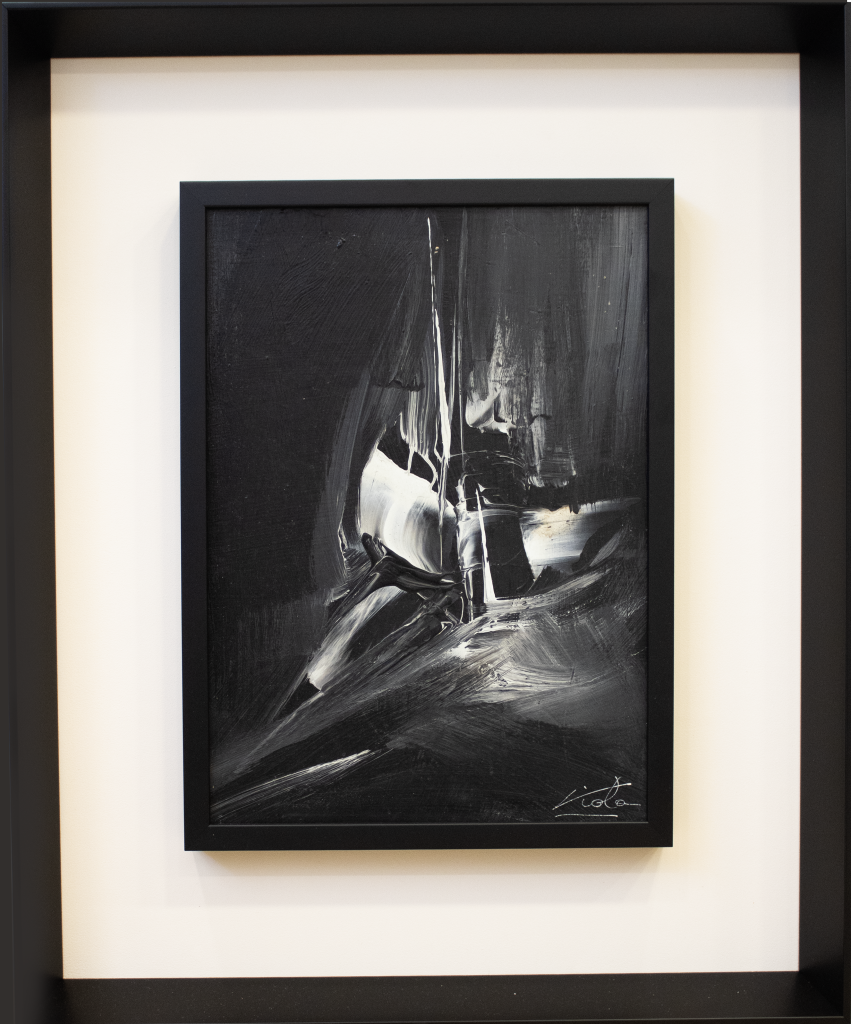
Manuel Viola
Untitled
Oil on board
37 x 27 cm
Manuel Viola (1916-1987) began his career as a poet and artist in the Surrealist circles of Barcelona. In 1934, he joined the Amigos de las Artes Nuevas group, engaging with the Catalan avant-garde. Exiled to France after the war, Viola joined the Surrealist group Le Main à Plume and enlisted in the Foreign Legion, also participating in the Resistance and the clandestine art market. He returned to Spain in 1949 and rose as a central figure in Spanish Informalism, eventually joining the El Paso group in 1958.
The artist’s work evolved from Surrealism to Abstract Expressionism and Informalism. Early in his career, his collages were influenced by Max Ernst. While in France, his figurative works with bold colors drew comparisons to Willem de Kooning. After returning to Spain, Viola embraced a style characterized by chiaroscuro, expressive brushstrokes, and the veta brava style, marked by dramatic contrasts of light and shadow. His works often reflected raw emotion, chaos, and energy, aligning with the tachisme movement and the gestural force of Informalism. In the 1960s and 1970s, he expanded into ceramic murals while continuing his signature abstract paintings.
Viola held his first solo exhibition in 1953 at Galería Estilo in Madrid, launching his rise in the art world. Throughout the 1960s, his work was shown internationally in major cities across Europe, the Americas, and Japan, including Lisbon, Milan, Paris, New York, and Tokyo. He participated actively in the El Paso group, becoming a key figure in Spanish contemporary art. His works have been featured in prominent exhibitions and collections worldwide, cementing his legacy in 20th-century Spanish art.
The oil on board artwork by Manuel Viola represents his mature artistic style developed in the late 1950s, when he transitioned from surrealist and figurative works to abstract expressionism and his involvement with the avant-garde group El Paso in 1958. The explosive nature of the painting aligns with the artist’s energetic visual forms, generated from a central mass, creating contrasts between light and dark. This shift in style garnered him international recognition and solidified his position as a key figure in Spanish abstract expressionism.
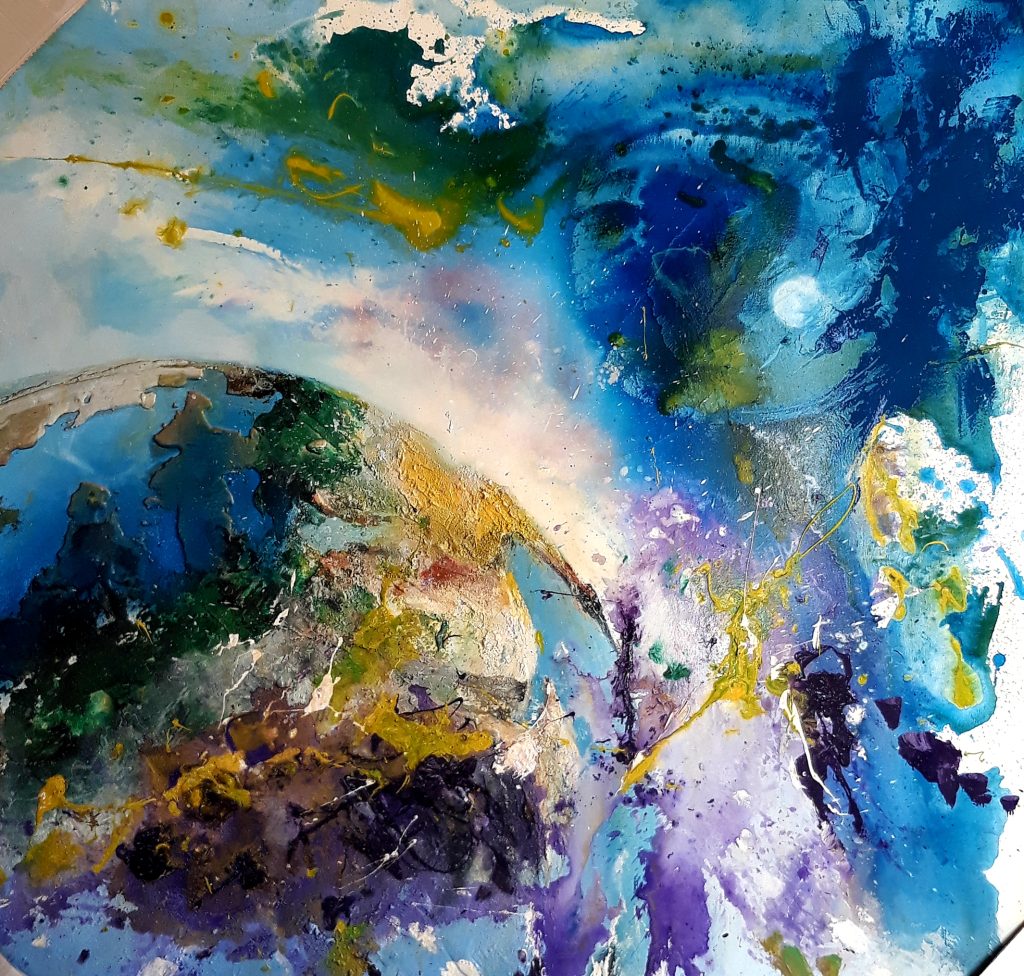
Ángel Jurado
Abstracción Lunar (2017)
Oil on canvas
150 x 150 cm
Ángel Jurado (1944) is a contemporary Spanish artist renowned for his exploration of abstraction art and his ability to convey the essence of nature through oil painting. Over the years, Jurado has made significant contributions to the Spanish art scene, using abstraction to evoke emotional responses and reflections from his audience.
Jurado’s work is a contemplation of nature, often focusing on the beauty found in everyday subjects. His approach blends realism with abstraction, creating a distinctive visual language and layers of deeper meaning. Through his paintings, Jurado invites the viewer to reflect on the transience of life and the emotional power of nature.
Ángel Jurado’s work has been exhibited in several important galleries and museums, both in Spain and internationally. Notably, his art has been showcased at the Galería de Arte Moderno in Barcelona, the Modern Art Center, and the Museum of Abstract Art. His ability to evoke emotions and contemplative reflections through his art has made him a significant figure in contemporary Spanish abstraction, contributing to the ongoing dialogue in the art world.
Lunar abstraction by Ángel Jurado, delves into abstract expressionism, creating a composition where form and color seem to arise organically, as if pulled from the canvas itself. His use of mixed media builds layers of texture, evoking cosmic imagery reminiscent of galaxies and planetary bodies, aligning with abstract expressionism’s focus on spontaneity and emotion. The color palette centers on powerful blues, imbuing the piece with a sense of celestial force. Jurado’s technique reflects influences of action painting, where brushstrokes become almost an eruption, capturing an energy that feels both primordial and expansive, as if embodying the forces of creation within the universe.