
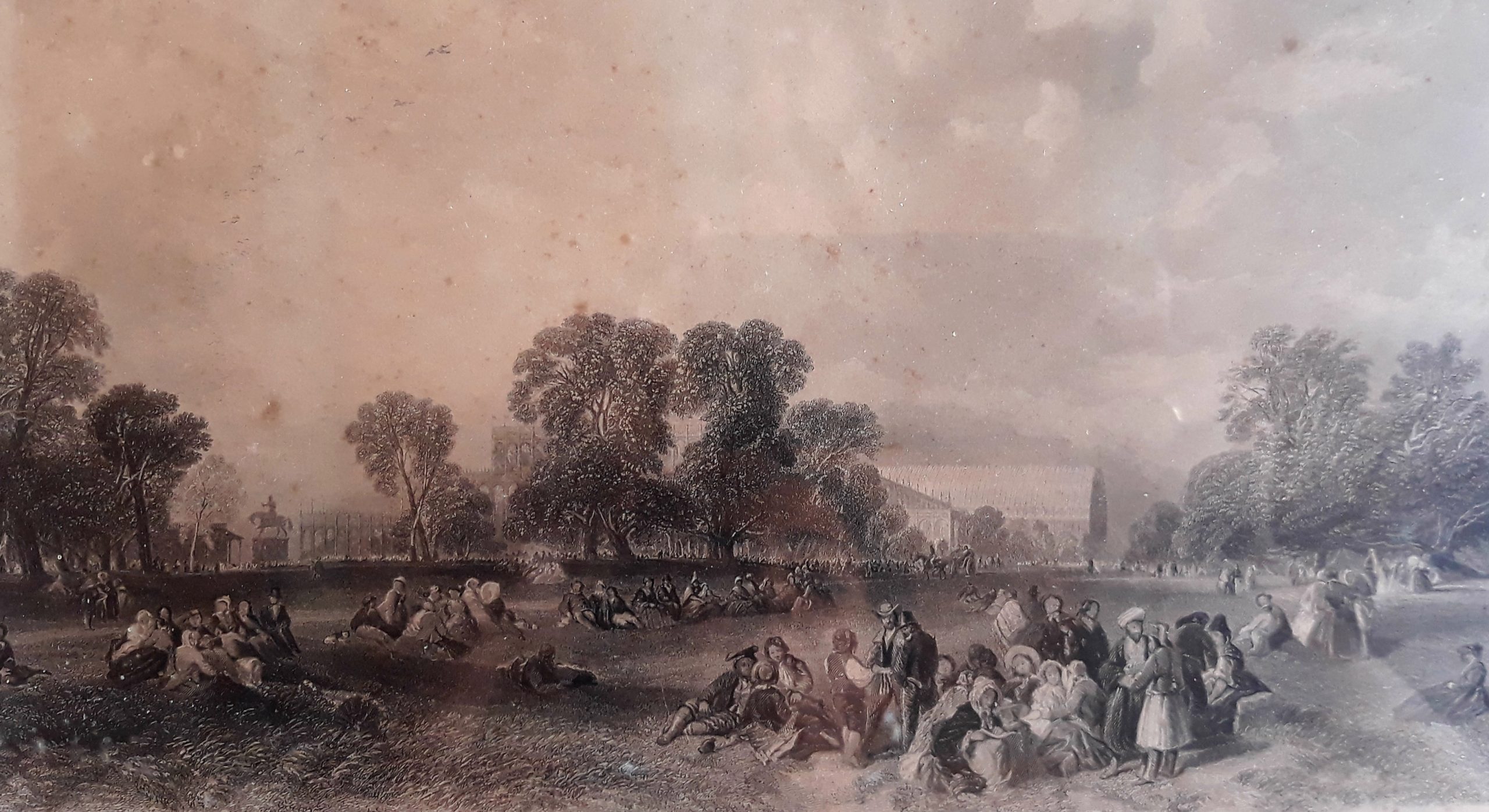
Hyde Park in 1851
In Hyde Park in 1851, Harding portrays a panoramic vista of Victorian society gathered at the height of the Great Exhibition. The vast foreground is populated by diverse groups of figures lounging on the grass in a relaxed, communal display of leisure. Through the gaps in the stately, mature trees that punctuate the middle ground, the viewer glimpses the shimmering, glass-and-iron structure of Joseph Paxton’s Crystal Palace, stretching across the horizon like a modern cathedral of industry. To the left, the silhouette of a monumental equestrian statue adds a sense of scale and official grandeur to the park setting.
In Hyde Park in 1851, Harding portrays a panoramic vista of Victorian society gathered at the height of the Great Exhibition. The vast foreground is populated by diverse groups of figures lounging on the grass in a relaxed, communal display of leisure. Through the gaps in the stately, mature trees that punctuate the middle ground, the viewer glimpses the shimmering, glass-and-iron structure of Joseph Paxton’s Crystal Palace, stretching across the horizon like a modern cathedral of industry. To the left, the silhouette of a monumental equestrian statue adds a sense of scale and official grandeur to the park setting.
The atmosphere is celebratory and expansive, capturing the optimism and national pride that defined the “Great Exhibition of the Works of Industry of All Nations.” The lighting is bright and airy, typical of a hazy English summer day, which softens the architectural rigidity of the distant palace and blends it harmoniously with the natural landscape. Stylistically, the work serves as both a historical document and a picturesque landscape, merging the tradition of the fête champêtre with the documentation of industrial progress, immortalizing a defining moment of the 19th century.
Additional information
| Dimensions | 15 × 21 cm |
|---|---|
| Art Genre | |
| Art Movement | |
| Cultural Origin | |
| Medium | |
| Size | |
| Style |
Reviews