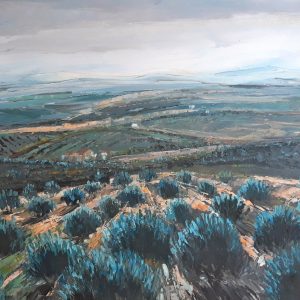
Erich Mayer (1876–1960) was born in Karlsruhe, Germany, and trained as an architect at the Charlottenburg Technische Hochschule in Berlin. He immigrated to South Africa in 1898, seeking a healthier climate, and worked as an assistant land surveyor in the Orange Free State. His career as an architect, however, was short-lived, as his true passion lay in painting. Mayer became known for his watercolors and oil paintings, particularly of the South African bush landscape and rural life.
His artistic journey began with his early training in architecture, but it was his time in South Africa that shaped his artistic identity. During the Anglo-Boer War, he joined the Boer commandos, was captured at Mafeking, and spent time as a Prisoner of War on St. Helena, where he turned to art to pass the time. After returning to Germany in 1903 to study art, Mayer returned to South Africa and Namibia, where he devoted himself entirely to painting. He became a prominent figure in the local art scene, particularly admired for his landscapes and his ability to capture the everyday lives of rural South Africans.
Mayer’s works were exhibited in several prestigious venues and galleries, and his paintings are housed in various collections throughout South Africa. In addition to his smaller paintings, Mayer completed large-scale commissioned works, including two murals in the Jeppe Street Post Office in Johannesburg and one in the dining room of Monument High School in Krugersdorp. Although he did not pursue architecture as a profession in South Africa, Mayer left a lasting legacy through his art, capturing the essence of the South African countryside and the lives of ordinary people. His influence extended beyond his own work, as he taught woodcut printing to other artists, including Henk Pierneef. Mayer passed away in 1960 in Pretoria, leaving behind a respected body of work that remains an important part of South Africa’s artistic heritage.