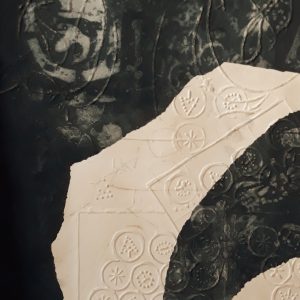
Antoni Clavé (1913-2005) was born in Barcelona, and from a young age, he showed an immense interest in the arts. At just 13 years old, Clavé began working in a textile shop while attending evening classes at the Escuela de Artes y Oficios “Llotja,” a renowned school that had been attended by famous artists such as Picasso and Joan Miró. By the time the Spanish Civil War broke out, Clavé was already involved in the world of artistic design, creating propaganda posters for the Republican government. After the fall of Barcelona, he fled to France, where he began to build a career as a painter, printmaker, and sculptor, eventually gaining international recognition.
Clavé’s artistic journey was profoundly influenced by his early encounters with artists such as Pierre Bonnard and Édouard Vuillard. In the 1940s, he formed a friendship with Pablo Picasso, which significantly impacted his style. Clavé’s early works featured bold collages and experiments with mixed media, incorporating materials such as torn newspapers and textiles into his paintings. He also became a prominent set designer for the ballet and opera, showcasing his versatility in both the visual arts and theatrical production. His work evolved through various stages, including large-scale canvases, engravings, and sculptures, often reflecting themes from medieval legends, warriors, and the theater.
Throughout his career he exhibited his works in major museums and galleries around the world. His works are part of the collections of prestigious institutions such as the Paris Museum of Modern Art, the Tate in London, and the Fine Arts Museum of San Francisco. He was involved in several high-profile exhibitions, including solo shows at Kunstmuseum Basel and Museo Reina Sofía, and participated in group exhibitions at the Dallas Museum of Art, Centre Pompidou, and Museo Reina Sofía. Clavé was also part of major biennials such as the Venice Biennale and documenta. His contributions to the world of art were widely recognized, and he received numerous accolades, including the UNESCO Prize for Engraving at the 1956 Venice Biennale and the Matarazzo Prize at the São Paulo Biennale. His legacy continues to inspire contemporary artists and art enthusiasts around the globe.