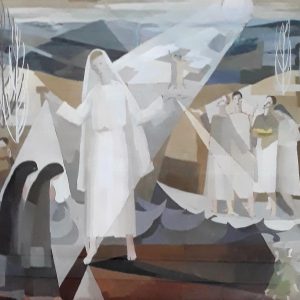
Carles Madirolas (1934-2007) was a Spanish artist born in Barcelona. He was a painter, printmaker, ceramist, and creator of stained glass windows and enamels. Known for his versatility, Madirolas worked across various mediums, including mural painting, egg tempera, oil painting, ceramics, and printmaking. His works often reflected a deep admiration for the Old Masters of the Italian Renaissance, particularly in his delicate depictions of women, ethereal beauty, and spiritual themes.
Madirolas had a distinguished artistic career, where he experimented with different techniques and artistic expressions. He became widely known for his mural and easel paintings, which included both traditional and modern methods. His work often revolved around themes of trinity and unity, and he developed a unique creative thought process based on the number three, which he considered essential both in his art and in the universe. Madirolas believed that his works must express harmony through three basic forms: human, vegetable, and animal, symbolizing life’s essence. His artistic approach was also deeply influenced by a connection between mathematics, music, and painting, imbuing his works with a rhythmic quality.
Throughout his career, Madirolas received significant recognition. In 1951, he was awarded the prestigious National Prize for his work Lovers. His most notable solo exhibition took place in 2002 at the Diocesan Museum of Barcelona, where an anthology of his works was showcased, offering a retrospective of his painting, drawing, engraving, and enameling. In addition to exhibitions, Madirolas contributed to public art projects, such as the ceramic mural at the former headquarters of Aigües de Barcelona and the 42 panels depicting the creation of the world at the Chasyr building in Barcelona. His works have also appeared at auctions, with several notable pieces being sold. Despite his accomplishments, Madirolas preferred to remain out of the limelight, often choosing to work quietly in his studio.