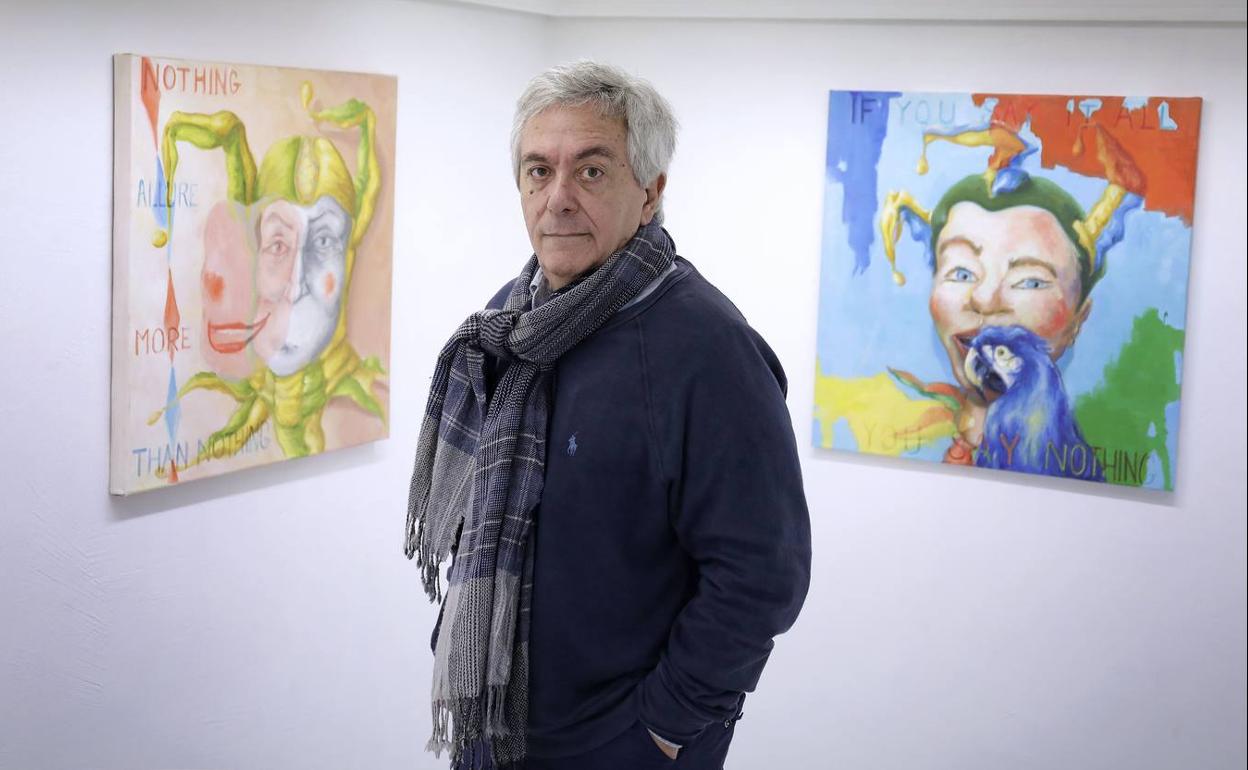
Chema Cobo (1952-2023) was born in Tarifa, Cádiz. He was a leading figure in contemporary Spanish art, known for his innovative style that evolved over decades. His artistic career took off with his first solo exhibition in 1975 at the Buades Gallery in Madrid, and he would go on to participate in major international exhibitions. His contributions to art were also recognized through his role as a visiting professor at prominent institutions such as the School of Art Institute of Chicago and the NY Art School in New York.
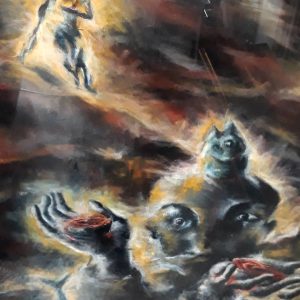
Cobo’s work is characterized by a unique fusion of conceptual art and painting. His use of recurring symbols, such as jesters, parrots, and chameleons, allowed him to explore complex ideas and invite viewers to question perspectives and meanings. In the 1980s, he distanced himself from his earlier influences and began to connect with international artistic movements such as Neo-Expressionism and Trans-avant-garde . His work was marked by a constant pursuit of new visual languages and metaphors, blending personal reflection with broader cultural commentary.
The artist’s work has been featured in a wide array of exhibitions worldwide. Notably, he exhibited at The Mezzanine Gallery of the Metropolitan Museum of Art in New York (1987), the Andalusian Center for Contemporary Art in Seville (1998), and the Contemporary Art Center of Málaga (2009). Significant international events includes the XVI São Paulo Biennial and the Carnegie International in Pittsburgh. Cobo’s works are part of major collections at prestigious museums such as the Metropolitan Museum of Art, MoMA in New York, and the Museo Nacional Centro de Arte Reina Sofía in Madrid, solidifying his place in contemporary art history. Throughout his career, Cobo received numerous accolades, including the Andalusia Prize for Plastic Arts in 1994 and the Francisco de Goya Painting Prize from the Villa de Madrid in 2009.