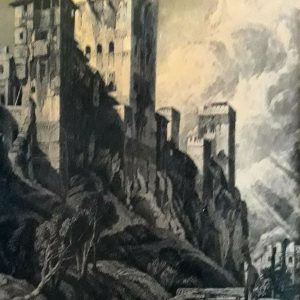
David Roberts RA (1796-1864) was a Scottish painter, born the son of a shoemaker, and initially apprenticed as a house-painter. His early career began in the theatre, where he worked from 1816 to 1830, designing and painting stage scenery in Edinburgh, Glasgow, and later London. It was during his time in Scotland that Roberts met Clarkson Stanfield, and the two would later collaborate on dioramas and panoramas in London. His first easel painting was exhibited in London in 1824, and he became a member of the Royal Academy in 1841.
His artistic career took a significant turn when he traveled abroad in search of dramatic and exotic subjects, like many of his contemporaries. His travels began with Spain in 1832-1833, and later Morocco and the Near East. In 1838, Roberts embarked on a tour of the Near East, visiting Egypt, Sinai, Petra, Jerusalem, and Lebanon, which provided inspiration for his renowned series of lithographs and paintings depicting the Holy Land, Syria, Arabia, Egypt, and Nubia. These works, made from his sketches and published in six volumes between 1842 and 1849, brought Roberts fame as a prominent Orientalist painter.
Roberts’s works have been widely exhibited, with his contributions to the Serpentine Galleries and The Museum of Modern Art. His art was also featured in major biennials, including the Venice Biennale International Exhibition. His works are part of prestigious collections, including those at the National Gallery of Art in Washington, D.C., Tate, the Art Institute of Chicago, and The Metropolitan Museum of Art. He was elected an Associate of the Royal Academy (ARA) in 1838 and a full Royal Academician (RA) in 1841, solidifying his place in British art history.