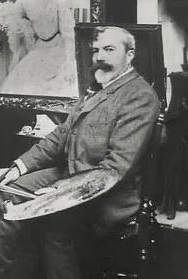
Edouard Bernard Debat-Ponsan (1847-1913) was born in Toulouse, France. He began his artistic studies at the age of fourteen at the École des Beaux-Arts in Toulouse, before moving to Paris to continue his education under the guidance of the renowned academic artist Alexandre Cabanel. Debat-Ponsan married Marguerite Hortense Louise Garnier in the 1870s, and they had three children.
His artistic career spanned a wide range of subjects, including Orientalism, history, landscape, religion, and portraiture. His early work adhered to the academic traditions of the École des Beaux-Arts, with mythological, historical, and religious themes. He participated in the Prix de Rome competition in 1873, where he placed second, and went on to study in Rome. Known for his animalier paintings, Debat-Ponsan was influenced by the likes of Constant Troyon and Jean-François Millet, focusing on rural life and animals in landscape settings. He also explored Orientalism, producing works such as Massage, scène de hammam (1883), which showcased his interest in exotic subjects.
Debat-Ponsan debuted at the Salon of 1870, where his works began to gain recognition. His first medal, a second-class award, came in 1874, and by the 1880s, he had become a well-established figure in the Parisian art scene. He was awarded the prestigious Chevalier de la Légion d’Honneur in 1881 and received commissions for prominent public buildings. He exhibited widely at the Salon and other major exhibitions, even at the Exposition Universelle of 1889. Despite his later political stances, including support for the Dreyfus Affair, which alienated some of his clientele, Debat-Ponsan continued to gain official commissions and exhibited regularly, even becoming president of the Société des Artistes Français. His work can be found in several French museums, including the Musée d’Orsay and Musée des Beaux-Arts in various cities across France.