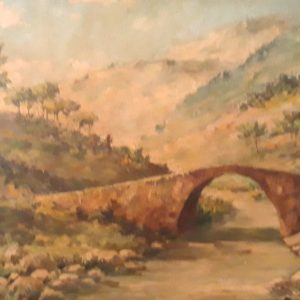
Francisco Pradilla (1848–1921) was a titan of 19th-century Spanish art, holding the prestigious positions of Director of the Spanish Academy in Rome and Director of the Museo del Prado. While best known internationally for his colossal history paintings. Pradilla also cultivated a brilliant, intimate style focused on “costumbrismo” and landscapes, influenced by the great Mariano Fortuny. In these smaller works, he abandoned academic rigidity for a fluid, expressive technique, prioritizing the “freshness of representation” and the capture of atmospheric light.
Pradilla’s career was marked by the highest honors, including Medals of Honor at the National Exhibition of Fine Arts (1878) and the Paris Universal Exhibition of 1878, as well as a first prize in Munich (1893). His work is conserved in the most important collections in Spain. His historical masterpieces and landscapes are prominent in the Museo del Prado, which recently held the exhibition Francisco Pradilla: Splendor and Decline of History Painting. Additionally, his genre works, such as Lavanderas gallegas, are featured in the Museo Carmen Thyssen Málaga. Most recently, the Museo de Historia de Madrid organized a major centenary retrospective featuring 75 of his works, solidifying his legacy as one of the great masters of his century.