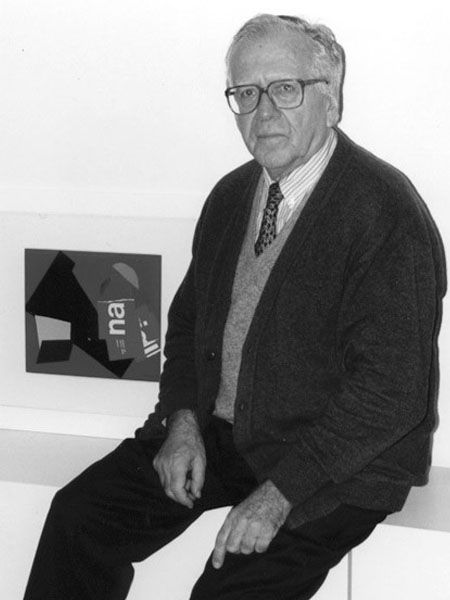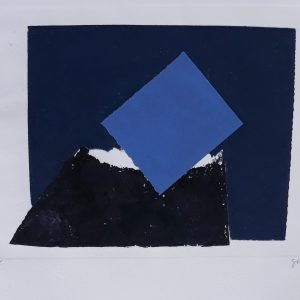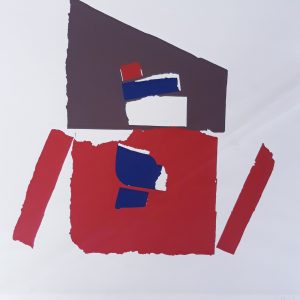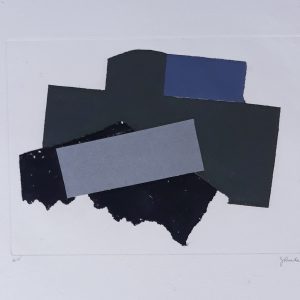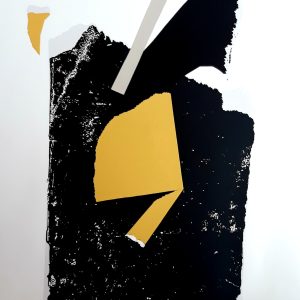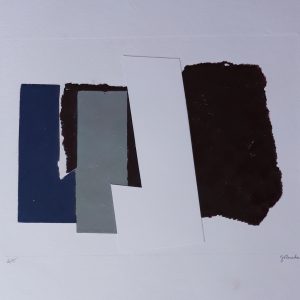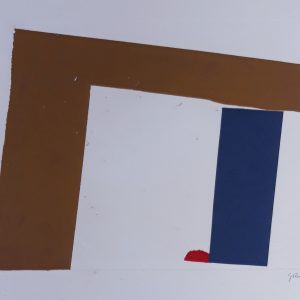
Gerardo Rueda (1926-1996) was born in Madrid and initially pursued law before becoming a self-taught artist. A painter, sculptor, and engraver, Rueda’s work evolved from early Cubist influences to abstract compositions, reflecting his deep engagement with both modern and geometric abstraction.
His artistic journey began with an interest in Impressionism, which later transitioned into a unique abstraction characterized by geometric forms and refined compositions. His self-taught approach to painting led him to experiment with various mediums, and he exhibited his first collages and abstract drawings in 1954. By the 1960s, he was a significant figure in the Spanish avant-garde, representing Spain at the Venice Biennale in 1960, and he became instrumental in establishing the Museo de Arte Abstracto Español in Cuenca alongside Fernando Zóbel and Gustavo Torner. His work was often recognized for its clean geometric style and careful balance, although he eventually incorporated bolder, more dynamic monochrome pieces. Throughout his career, he remained an active participant in both Spanish and international exhibitions.
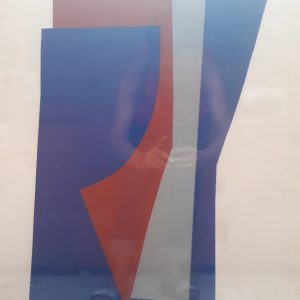
Rueda’s works are featured in numerous prominent collections worldwide, including the Museo Nacional Centro de Arte Reina Sofía, the Musée d’Art Moderne in Paris, and the Museo Internacional de Arte Contemporáneo Rufino Tamayo in Mexico. In addition to various solo exhibitions across Europe and Latin America, his art was celebrated with a large retrospective at the IVAM in Valencia in 1996, the year of his passing. He received numerous accolades, including the Medalla de Honor Especial at the Fourth El Cairo Biennale and election to the Real Academia de Bellas Artes de San Fernando in 1995. Rueda’s contributions to both the visual arts and architectural works, such as his stained-glass windows at the Cuenca Cathedral, solidified his legacy as a central figure in 20th-century Spanish abstraction.