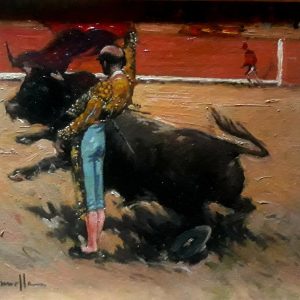
Joaquín Terruella Matilla (1891-1957) was born in Barcelona, Spain, into an artistic family as the nephew of the painter Segundo Matilla. He was deeply influenced by his uncle’s work and was also a disciple of Santiago Rusiñol, with whom he traveled to Italy in 1923. In addition to his artistic training, Terruella studied under the guidance of Burroughs and spent time painting in cities like Aranjuez, Paris, and Palma de Mallorca, marking his connection with the European artistic scene.
Terruella’s artistic career was defined by his expertise in landscape painting, capturing the beauty of natural surroundings with a distinctive Impressionist style. He also created bullfighting scenes and genre paintings, including depictions of concert café life and gypsy culture. His work was regularly featured in prestigious galleries across Barcelona, Madrid, and Paris, where he first exhibited in 1922. Known for his ability to capture light and atmosphere, he became a key figure in the Catalan Impressionist movement. His works were showcased in various solo exhibitions, such as in the Sala Parés and Sala Gaspar in Barcelona, and the Sala Busquets in 1956, marking his final exhibition.
Throughout his career, Terruella’s works have been included in notable collections, including the Banco Sabadell and the Carmen Thyssen Collection. He was recognized posthumously in 1985 with an anthology exhibition at the Sala Gothsland in Barcelona. His contributions to Spanish Impressionism, particularly through his landscapes and depictions of everyday life, cemented his place in the history of Catalan and Spanish art. His works remain highly regarded, with enduring popularity in auctions and exhibitions across Europe.