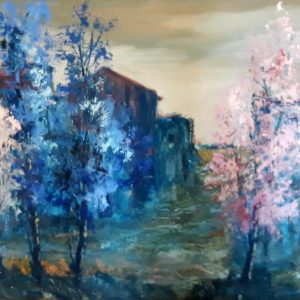
José de Rokha (1927-1994) was born in Concepción, Chile. He was the son of the celebrated Chilean poet Pablo de Rokha. Known affectionately by his friends as “Pepe de Rokha,” he grew up surrounded by the rich intellectual and artistic environment fostered by his father. His life was marked by a deep connection to art, both as a creator and a participant in the broader cultural and intellectual currents of his time. He passed away in 1994, leaving behind a significant legacy.
As an artist, José de Rokha explored various mediums and forms, with a particular focus on painting and muralism. He gained recognition for his work, which often reflected the cultural and political landscapes of Latin America. His exhibitions spanned across both the Americas and Europe, showcasing his versatile style. De Rokha’s work was not limited to galleries and museums but also included large-scale murals, which he created in several countries, including Chile, Ecuador, Spain, the United States, Italy, and Mexico. His commitment to integrating art with public spaces helped to elevate his work, making it accessible to a wider audience.
José de Rokha’s contributions to art were widely recognized, and his works can be found in numerous international collections, including the Museo de Cali, Casa de la Cultura in Guayaquil, Museo de Medellín, Museo Nacional de Cuba, and the Museo de Arte Moderno in Chile. His murals are particularly emblematic, and his time as a cultural attaché in Mexico further strengthened his international presence. Through his exhibitions and public works, de Rokha established himself as a key figure in the Latin American art scene, leaving an indelible mark on the visual culture of the 20th century.