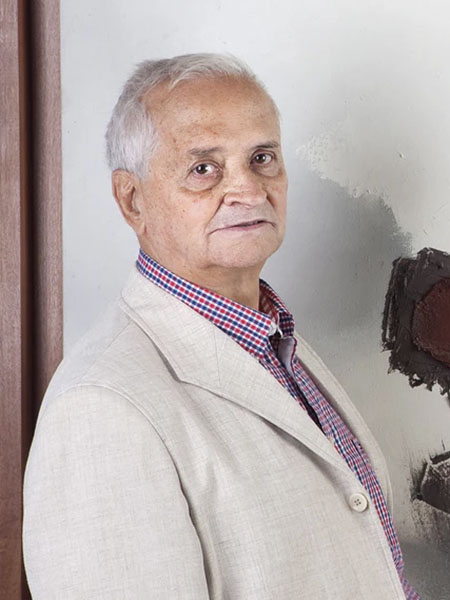
Luis Feito López (1929–2021) was born in Madrid and trained at the San Fernando School of Fine Arts, where he later taught. In 1956, he moved to Paris, remaining for nearly twenty-five years and establishing close ties with the Spanish and international avant-garde.
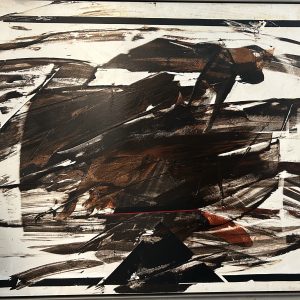
Feito is renowned for his transition from figurative painting to lyrical abstraction. By the late 1950s, he had developed a distinctive abstract language marked by expressive color, refined surfaces, and layered textures incorporating materials such as sand. During the 1960s, his compositions became increasingly simplified, frequently organized around circular forms influenced by Japanese aesthetics. As a founding member of the El Paso group, Feito sought to reintroduce spiritual and expressive depth into Spanish art in the aftermath of the Civil War.
He exhibited widely in major international forums, including the Venice Biennale, the São Paulo Biennial, and Documenta Kassel, and was the subject of important retrospectives in Paris, Hamburg, and at the Museo Reina Sofía in Madrid. His works are today held in leading museum collections worldwide, including the Guggenheim Museum, New York, and the Museo Nacional Centro de Arte Reina Sofía.